
What Is the Moles to Gas Volume at STP Calculator?
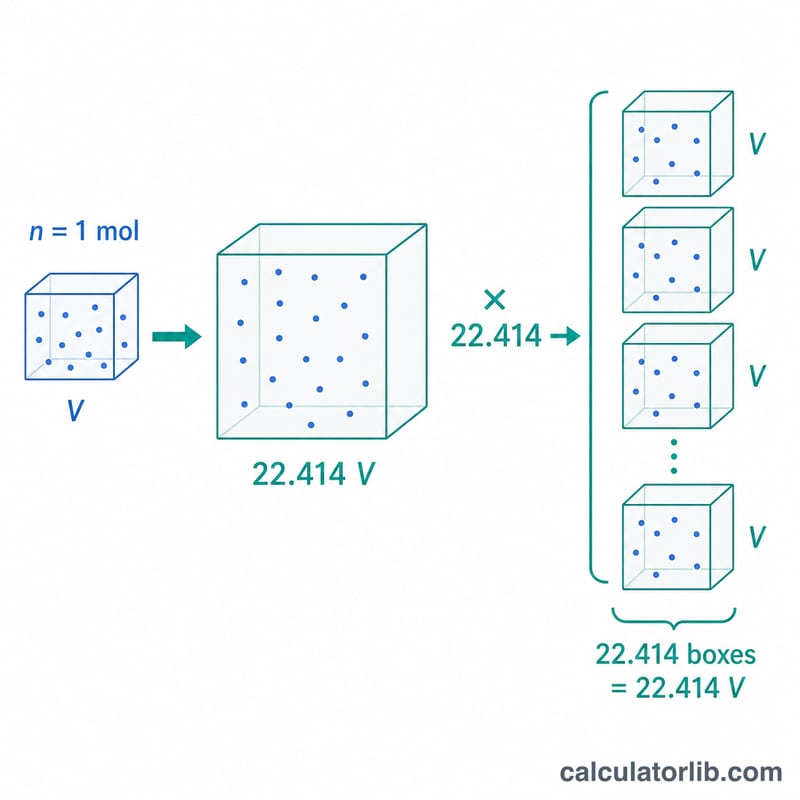
This calculator converts an amount of gas measured in moles into its volume at standard temperature and pressure (STP). It relies on Avogadro's law, which states that equal volumes of ideal gases at the same temperature and pressure contain the same number of molecules. At STP — defined here as 0 °C (273.15 K) and 1 atm — one mole of any ideal gas occupies 22.414 liters, known as the molar volume.
How to Use It
Enter the amount of gas in moles and the calculator instantly returns the volume in liters and milliliters. It works for any ideal gas — oxygen, nitrogen, carbon dioxide, hydrogen — because the molar volume is independent of the gas identity under ideal conditions.
The Formula Explained
The relationship is simply:
$$V = n \times 22.414\ \text{L}$$where V is the volume in liters and n is the number of moles. This is derived from the ideal gas law (\(PV = nRT\)) evaluated at STP. Some textbooks use 22.4 L/mol as a rounded value; this calculator uses the more precise 22.414 L/mol.
Worked Example
How much volume does 2.5 moles of nitrogen gas occupy at STP?
$$V = 2.5 \times 22.414 = 56.035\ \text{L}$$(or 56,035 mL). The gas type does not matter — 2.5 moles of any ideal gas gives the same answer.
FAQ
What exactly is STP? STP traditionally means 0 °C and 1 atm pressure, which gives a molar volume of 22.414 L/mol. Note that IUPAC's modern STP (0 °C, 100 kPa) uses 22.711 L/mol instead.
Why 22.414 instead of 22.4? 22.4 L/mol is a commonly rounded value; 22.414 L/mol is the more accurate figure derived from the ideal gas constant.
Does this work for real gases? The result is exact only for ideal gases. Real gases deviate slightly, especially at high pressure or low temperature, but the approximation is excellent for most everyday chemistry problems.