
What Is the Moles Calculator?
The mole is the SI unit for amount of substance. One mole contains Avogadro's number (\(6.022 \times 10^{23}\)) of particles. This calculator converts a measured mass of a substance into the corresponding number of moles using its molar mass. It is a universal chemistry tool that works for any element or compound.
How to Use It
Enter the mass of your sample in grams and the molar mass of the substance in grams per mole (g/mol). The molar mass equals the sum of the atomic masses of all atoms in the formula — for example, water (H₂O) is about 18.015 g/mol. Click calculate to get the number of moles instantly.
The Formula Explained
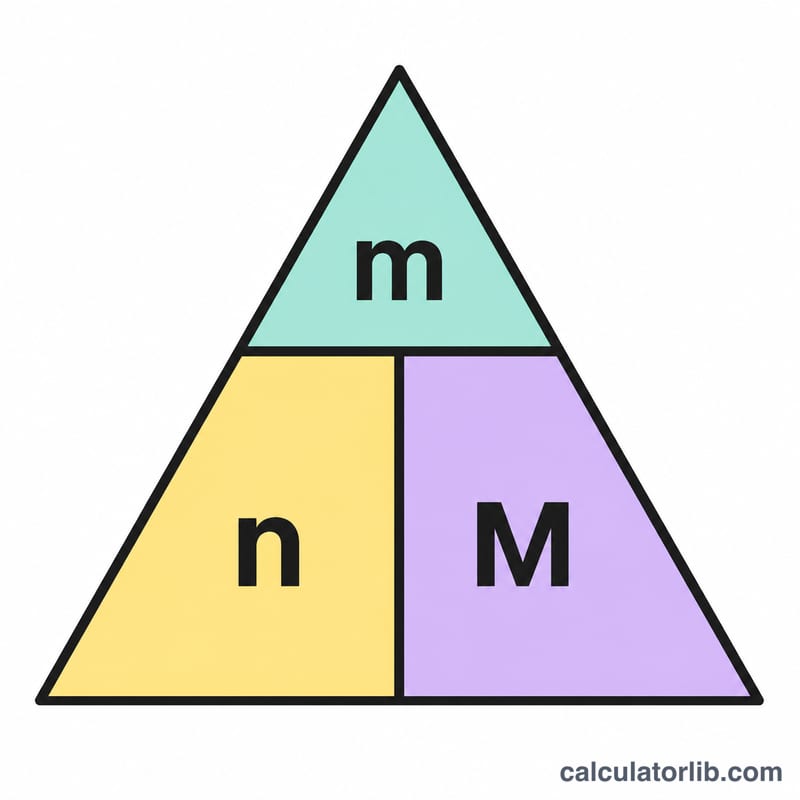
The relationship is:
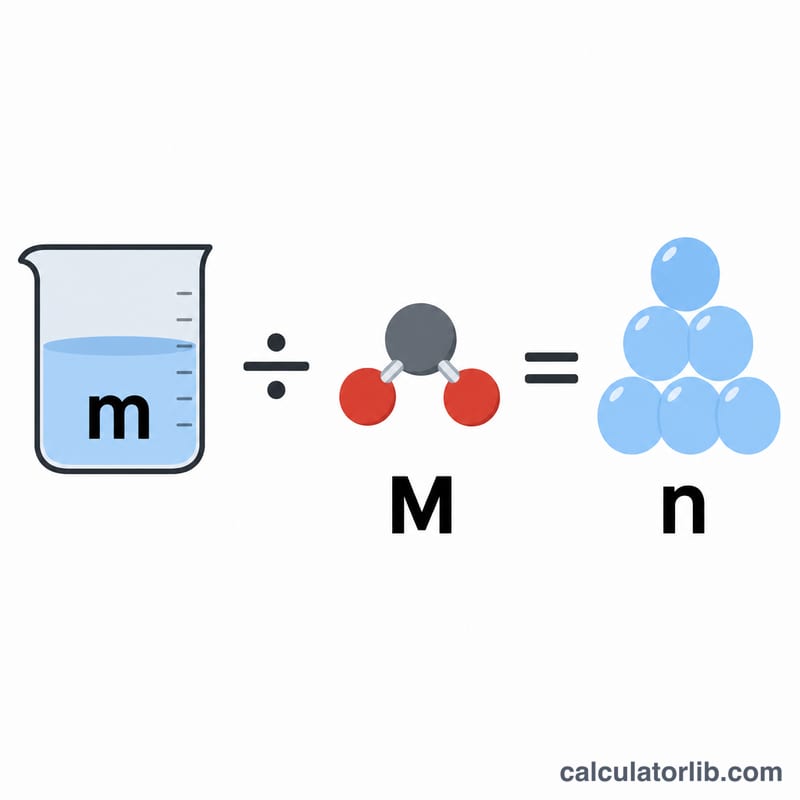
$$n = \frac{m}{M}$$where n is the amount of substance in moles, m is the mass in grams, and M is the molar mass in g/mol. The equation simply scales a mass by how heavy one mole of that substance is. Rearranged, you can also find mass (\(m = n \times M\)) or molar mass (\(M = m / n\)).
Worked Example
Suppose you have 36 g of water. Water's molar mass is 18.015 g/mol. Then $$n = \frac{36}{18.015} = 1.998 \text{ mol}$$ — almost exactly 2 moles of water, which corresponds to roughly \(1.2 \times 10^{24}\) molecules.
FAQ
What units should I use? Mass in grams and molar mass in g/mol so the result is in moles.
Where do I find molar mass? Add the atomic masses (from the periodic table) of every atom in the chemical formula.
Can I use it for elements? Yes — use the element's atomic mass as the molar mass (e.g. carbon = 12.011 g/mol).