
What is the Atoms to Moles Calculator?
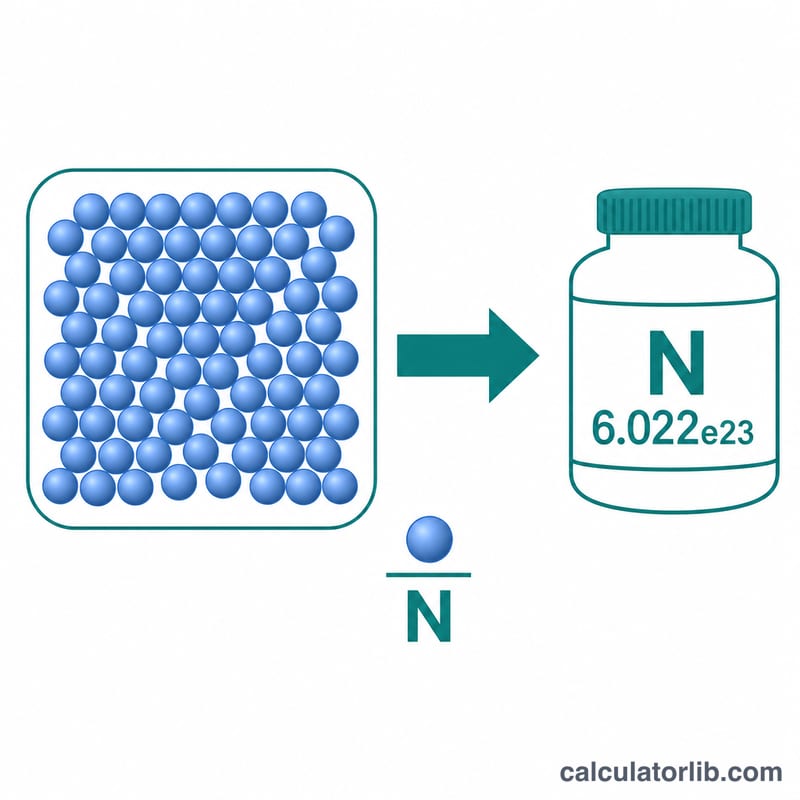
This calculator converts a count of individual particles — atoms, molecules, ions, or formula units — into an amount of substance measured in moles. Because chemists work with enormous numbers of particles, the mole is used as a convenient counting unit, just like a dozen means 12. One mole always contains Avogadro number of particles: \(6.022 \times 10^{23}\).
How to use it
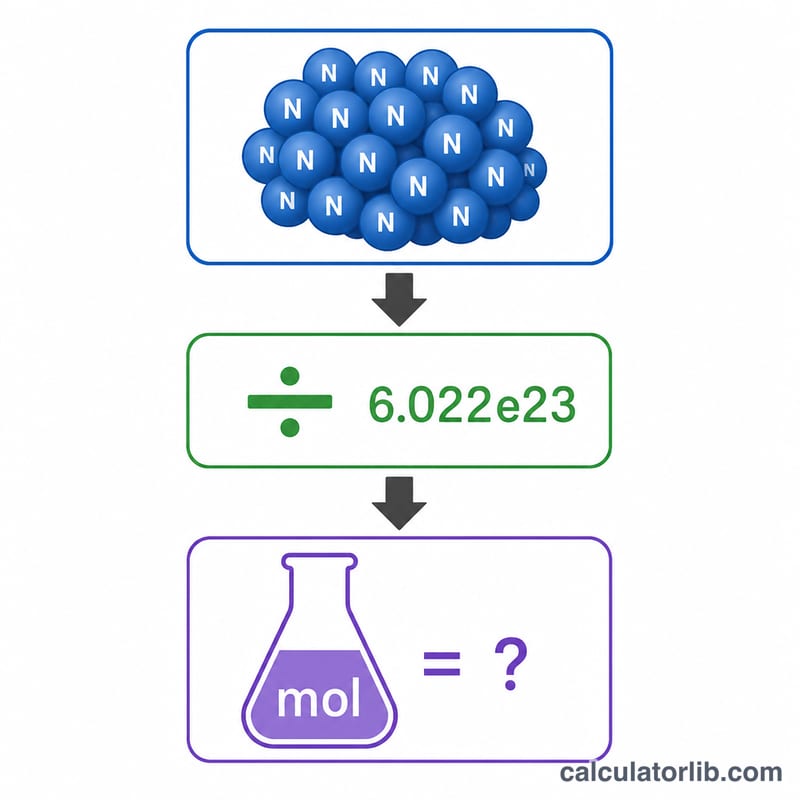
Enter the number of atoms or particles you have. The calculator divides that value by Avogadro number and returns the equivalent number of moles. You can enter very large numbers in scientific notation style, for example 1.2e24.
The formula explained
The conversion uses a single relationship:
$$\text{Moles} = \frac{\text{Number of atoms}}{6.022 \times 10^{23}}$$
Here \(6.022 \times 10^{23}\) /mol is Avogadro number (NA), the number of elementary entities in exactly one mole of a substance. Dividing your particle count by this constant scales the huge particle number down to a manageable amount in moles.
Worked example
Suppose you have \(1.2044 \times 10^{24}\) atoms of carbon. Dividing by Avogadro number: $$\frac{1.2044 \times 10^{24}}{6.022 \times 10^{23}} = 2 \text{ moles}$$ So that sample contains exactly 2 moles of carbon atoms.
Constants Used in This Calculation
The only constant required is the Avogadro constant, which links the number of particles to the amount of substance in moles.
| Constant | Symbol | Value | Unit |
|---|---|---|---|
| Avogadro constant (exact) | \(N_A\) | \(6.02214076 \times 10^{23}\) | mol⁻¹ |
| Avogadro constant (rounded) | \(N_A\) | \(6.022 \times 10^{23}\) | mol⁻¹ |
Since the 2019 redefinition of the SI base units, the mole is defined as exactly \(6.02214076 \times 10^{23}\) elementary entities. In other words, the Avogadro constant is now a fixed, exact value by definition rather than a measured quantity. This calculator uses the rounded value \(6.022 \times 10^{23}\ \text{mol}^{-1}\), which is accurate to four significant figures and sufficient for typical chemistry calculations.
FAQ
Does this work for molecules or ions too? Yes. The mole counts any elementary entity, so the same formula converts molecules, ions, electrons, or formula units to moles.
How do I go from moles back to atoms? Multiply the number of moles by \(6.022 \times 10^{23}\) to get the particle count.
What is Avogadro number? It is the defined number of particles in one mole, equal to \(6.022 \times 10^{23}\) per mole, linking the microscopic and macroscopic scales.