What is the mg/kg Dosage Calculator?
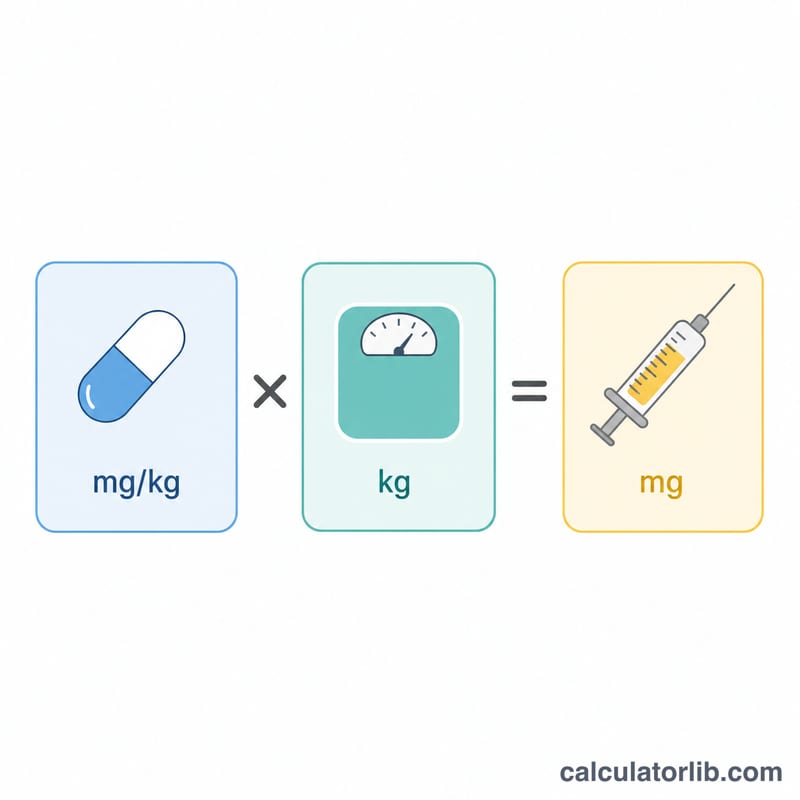
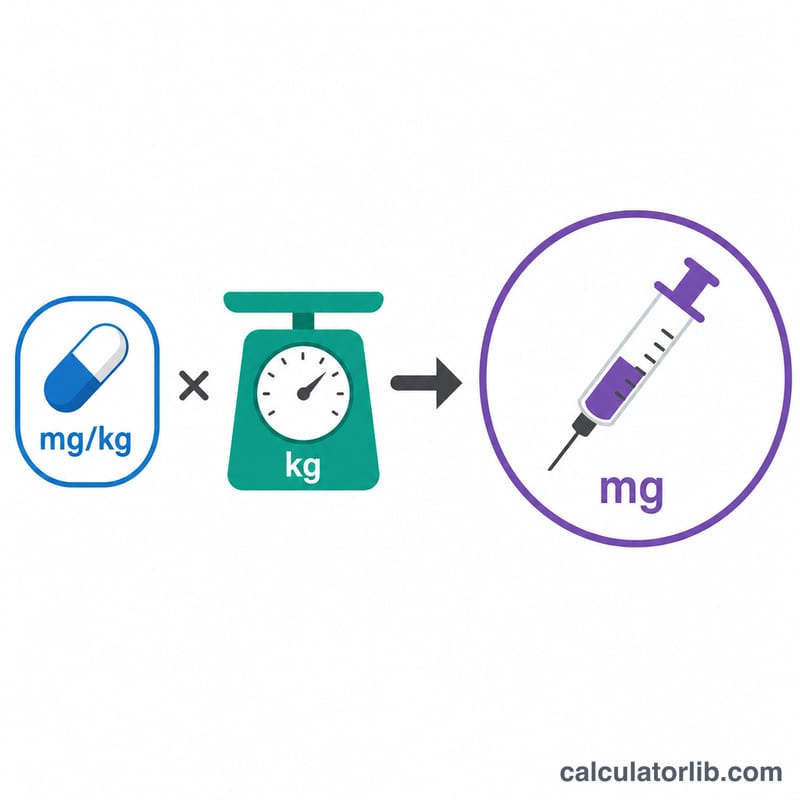
The mg/kg dosage calculator works out a weight-based medication dose by multiplying a prescribed dose rate (in milligrams per kilogram) by the patient body weight. Weight-based dosing is widely used in pediatrics, chemotherapy, anesthesia, and many antibiotic regimens because the appropriate amount of drug scales with body size.
This tool is a general arithmetic aid for education and quick estimation. It is not medical advice. Always confirm doses against the prescriber order, the drug label, and a clinical reference before administration.
How to use it
Enter the dose rate in mg/kg, the patient body weight, and choose kilograms or pounds (pounds are converted using 1 lb = 0.45359237 kg). Optionally add the number of doses per day to see the total daily dose, and a liquid concentration in mg/mL to see the volume to draw up per dose.
The formula explained
The core equation is $$\text{Dose (mg)} = \text{Dose per kg} \times \text{Body weight (kg)}$$ If a liquid concentration \(C\) (mg/mL) is supplied, the volume per dose is \(V = \text{Dose} \div C\). The total daily dose simply multiplies the single dose by the number of administrations per day.
Worked example
A child weighs 20 kg and the order is 15 mg/kg per dose. $$\text{Dose} = 15 \times 20 = 300 \text{ mg}$$ per administration. Given three doses per day, the daily total is \(300 \times 3 = 900\) mg/day. If the syrup is 100 mg/mL, the volume is \(300 \div 100 = 3\) mL per dose.
Pound to Kilogram Weight Conversion Table
Weight-based doses use kilograms. The exact definition is 1 lb = 0.45359237 kg, and the reverse factor is 1 kg ≈ 2.20462 lb. To convert, multiply pounds by 0.45359237, or divide pounds by 2.20462.
| Weight (lb) | Weight (kg) |
|---|---|
| 5 | 2.27 |
| 10 | 4.54 |
| 22 | 9.98 |
| 44 | 19.96 |
| 66 | 29.94 |
| 110 | 49.90 |
| 150 | 68.04 |
| 175 | 79.38 |
| 200 | 90.72 |
Example: \(150 \times 0.45359237 = 68.04\) kg (rounded to 2 decimals).
Safety note: mixing up lb and kg is a classic cause of dosing errors. Entering a weight in pounds as if it were kilograms makes the calculated dose about 2.2 times too high. Always check the unit selected before relying on a result.
Dose Comparison Across Weights and Dose Rates
The table below is generic arithmetic only. It is not drug-specific and is not a clinical recommendation. Each cell shows the single dose in mg, followed by the volume in mL for an illustrative concentration of 100 mg/mL (volume = dose ÷ concentration).
| Dose rate | 10 kg | 20 kg | 50 kg | 70 kg |
|---|---|---|---|---|
| 5 mg/kg | 50 mg (0.5 mL) | 100 mg (1 mL) | 250 mg (2.5 mL) | 350 mg (3.5 mL) |
| 10 mg/kg | 100 mg (1 mL) | 200 mg (2 mL) | 500 mg (5 mL) | 700 mg (7 mL) |
| 15 mg/kg | 150 mg (1.5 mL) | 300 mg (3 mL) | 750 mg (7.5 mL) | 1050 mg (10.5 mL) |
Worked check: at 10 mg/kg for a 50 kg body weight, \(10 \times 50 = \)500 mg. At 100 mg/mL, that is \(500 \div 100 = 5\) mL.
Real doses depend on the specific drug, indication, age, organ function and the prescriber's or label's instructions, and often have a maximum cap.
Key Terms in Weight-Based Dosing
- mg/kg: milligrams of drug per kilogram of body weight. Multiplying it by body weight in kg gives the dose in mg.
- Dose per administration (mg/kg per dose): the amount given each time the drug is taken. For example, 10 mg/kg per dose given 3 times means 3 separate doses of that size.
- mg/kg/day (divided doses): the total amount over 24 hours, which is then split across the number of administrations. For example, 30 mg/kg/day divided into 3 doses is 10 mg/kg per dose. Confusing per-dose and per-day figures can cause a several-fold error.
- Total daily dose: the sum of all doses in 24 hours, equal to the dose per administration × the number of doses per day.
- Concentration (mg/mL): the amount of drug in each milliliter of a liquid product. Volume to measure (mL) = dose (mg) ÷ concentration (mg/mL).
- Maximum dose cap: an upper limit, in mg per dose or per day, that applies regardless of what the mg/kg calculation gives. It is most relevant for heavier patients.
- Body weight (actual vs. ideal/adjusted): actual body weight is the measured weight. Ideal body weight is an estimate based on height and sex. Adjusted body weight is a value between the two, often used for some drugs in people whose actual weight is well above ideal. Which weight applies depends on the specific drug and its labeling.
This is general information, not professional advice. Confirm doses with a pharmacist, prescriber or the product labeling.
FAQ
Does it handle pounds? Yes — select "Pounds" and the weight is converted to kilograms automatically.
What if I leave frequency or concentration blank? Those rows are simply hidden; the single dose is still calculated.
Is this safe for clinical use? It is an estimation aid only. Verify every dose against authoritative sources and watch for maximum dose limits, which this tool does not enforce.