
What is cross multiplication?
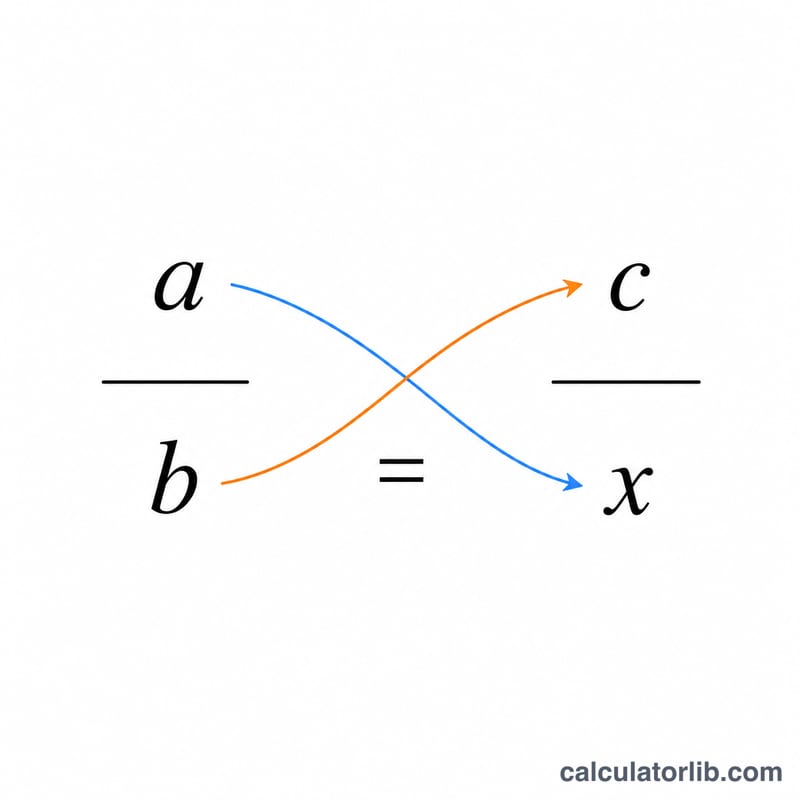
Cross multiplication is a technique for solving proportions — equations of the form \(a/b = c/d\) where two ratios are set equal. When one of the four terms is unknown, you can find it by multiplying diagonally across the equals sign. This calculator solves the proportion \(a/b = c/x\) for the missing term \(x\).
How to use this calculator
Enter the three known values: \(a\) and \(b\) form the first ratio, while \(c\) is the numerator of the second ratio whose denominator \(x\) is unknown. Press calculate and the tool returns \(x\) along with the cross product used to derive it. Any positive or negative real numbers are accepted.
The formula explained
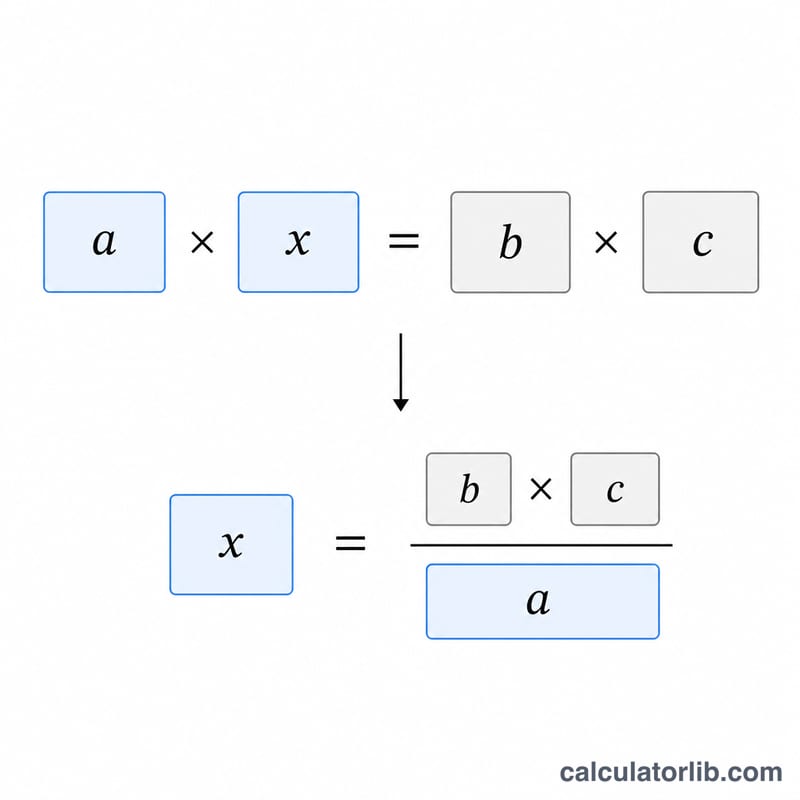
Starting from \(a/b = c/x\), multiply both sides by \(b\) and by \(x\) to clear the fractions. This gives the cross-product identity \(a \cdot x = b \cdot c\). Dividing both sides by \(a\) isolates the unknown:
$$\frac{a}{b} = \frac{c}{x} \;\Rightarrow\; x = \frac{b \times c}{a}$$Note that \(a\) must not be zero, otherwise the proportion has no finite solution.
Worked example
Suppose \(2/3 = 8/x\). Here \(a = 2\), \(b = 3\) and \(c = 8\). The cross product is \(b \cdot c = 3 \times 8 = 24\). Dividing by \(a\) gives
$$x = \frac{24}{2} = 12$$So the missing value is \(12\), and indeed \(2/3 = 8/12\) simplifies back to \(2/3\).
FAQ
What if a is zero? Division by zero is undefined, so the proportion cannot be solved for \(x\); the calculator returns \(0\) as a guard value.
Can I solve for a different position? Yes — just rearrange your problem so the unknown is the fourth term. Any proportion can be relabelled so the missing value plays the role of \(x\).
Does it work with decimals? Absolutely. Enter decimal or negative numbers and the cross-multiplication formula applies identically.