
What this calculator does
This tool solves a proportion of the form \(a/b = c/d\) for one unknown value. You lay the equation out as two equal fractions — Numerator 1 over Denominator 1 equals Numerator 2 over Denominator 2 — and put a letter such as \(x\) in whichever of the four positions you do not know. The other three positions must be real numbers (whole, decimal, or negative). The calculator finds the value of \(x\) that makes the two fractions exactly equal and shows the working in two complementary ways.
How to use it
Type three numbers and one letter into the four boxes. For example, to solve \(5/8 = x/24\), enter 5, 8, x and 24. Press calculate and the result box displays \(x = 15\) along with the cross-multiplication steps and the ratio steps. The unknown may sit in any position — numerator or denominator, left fraction or right fraction — and you may use any single letter; the answer echoes the letter you chose.
The formula explained
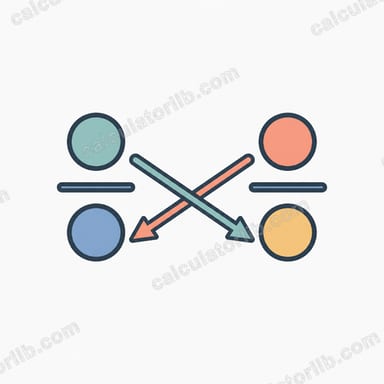
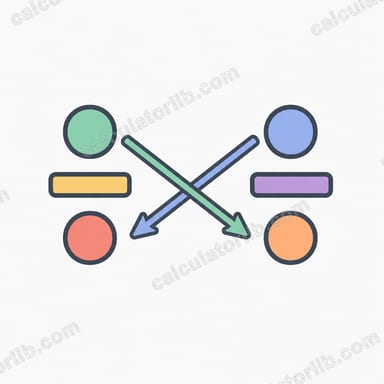
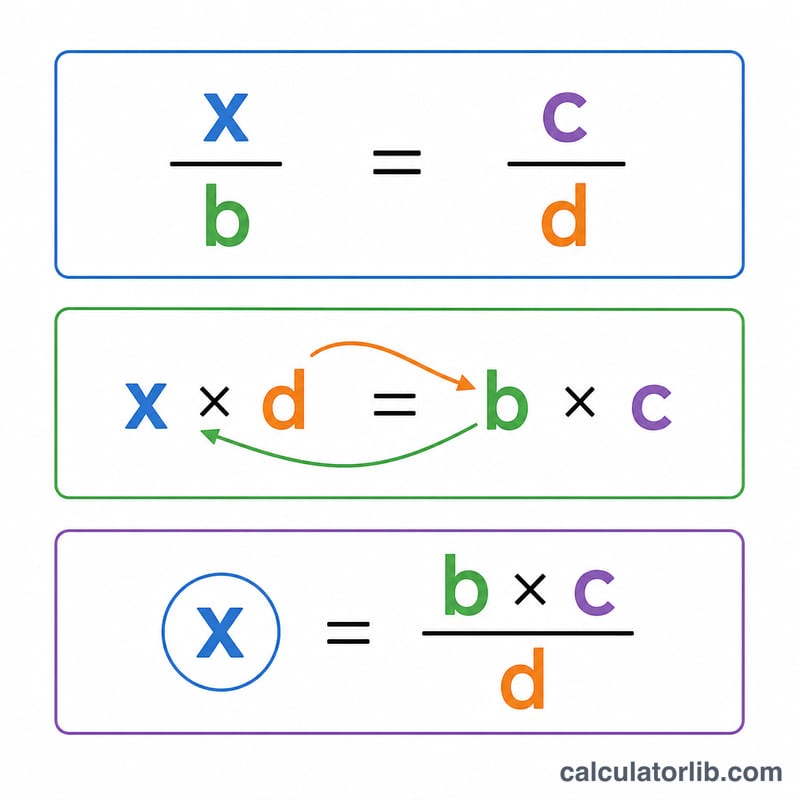
When two fractions are equal, their cross products are equal: \(a/b = c/d\) implies \(a \times d = b \times c\). This single identity lets you solve for any one missing term. If the numerator on the left is unknown, \(x = (b \times c) / d\). If a denominator is unknown, you divide the opposite diagonal product by the remaining known on the same line. The proportion method instead reads the multiplier between the two known related terms and applies it to the unknown's partner.
$$\frac{\text{Numerator 1}}{\text{Denominator 1}} = \frac{\text{Numerator 2}}{\text{Denominator 2}} \;\Longrightarrow\; \text{N}_1 \times \text{D}_2 = \text{D}_1 \times \text{N}_2$$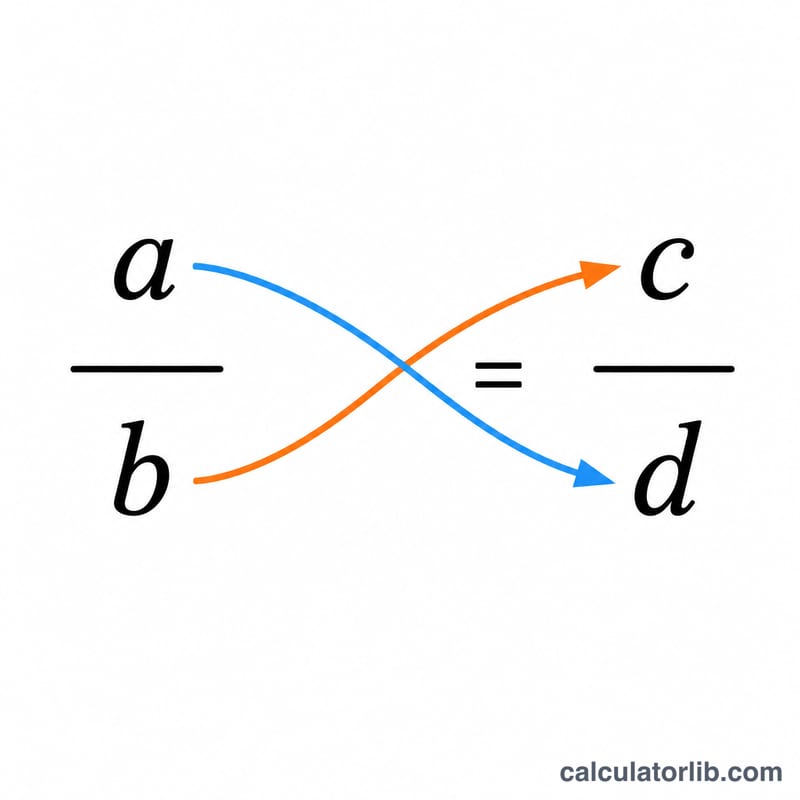
Worked example
Solve \(4/10 = x/15\). Cross multiply: \(4 \times 15 = 10 \times x\), which gives \(60 = 10x\), so
$$x = 60 / 10 = 6$$Check: \(4/10 = 0.4\) and \(6/15 = 0.4\). The two fractions match, confirming \(x = 6\).
FAQ
Can the answer be a decimal or negative? Yes. Inputs may be decimals or negatives and the solution is shown as a reduced decimal value.
What if I get "undefined"? A fraction cannot have a zero denominator, and some arrangements divide by zero while solving. In those cases the proportion has no valid solution and the tool reports "undefined".
How many unknowns can I have? Exactly one. If you leave zero or more than one letter, the calculator asks for three numbers and a single unknown.