
What is the Least Common Multiple?
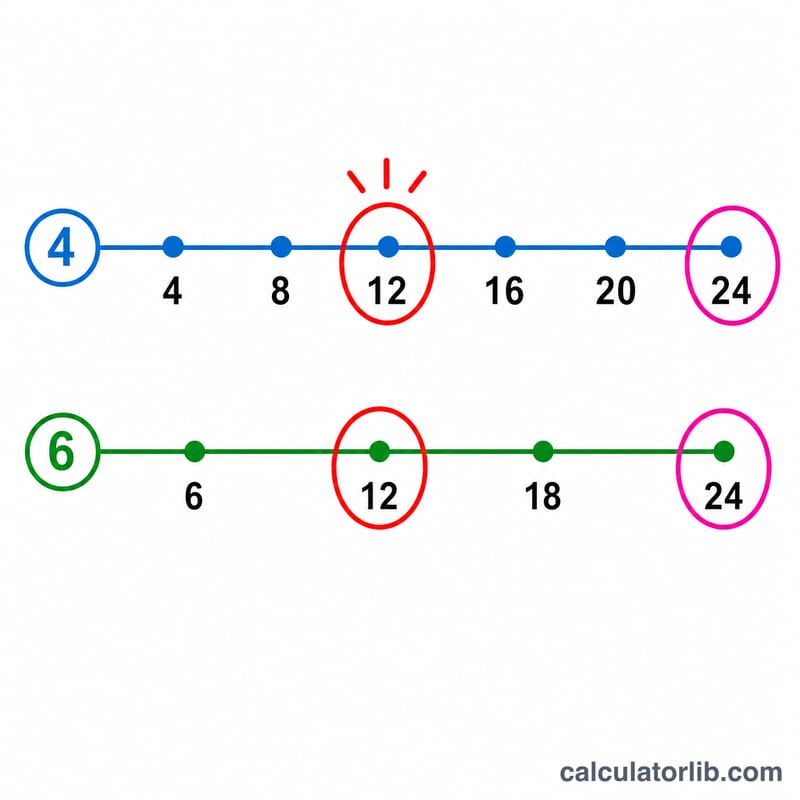
The Least Common Multiple (LCM) of a set of numbers is the smallest positive integer that every number in the set divides into evenly. It is also called the Lowest Common Multiple, and when used to add or subtract fractions it appears as the Least Common Denominator (LCD). The LCM is a pure mathematical quantity, so the same rules apply everywhere with no units involved.
How to use this calculator
Type two or more whole numbers into the input box, separated by spaces or commas, for example 12 15 75. Do not use a comma as a thousands separator inside a single number (enter 2500, not 2,500). Choose a method in the "Show Steps" dropdown if you want to see how the answer is reached, then read the LCM from the blue result box. Selecting a step method changes only the explanation, never the numeric answer.
The formula explained
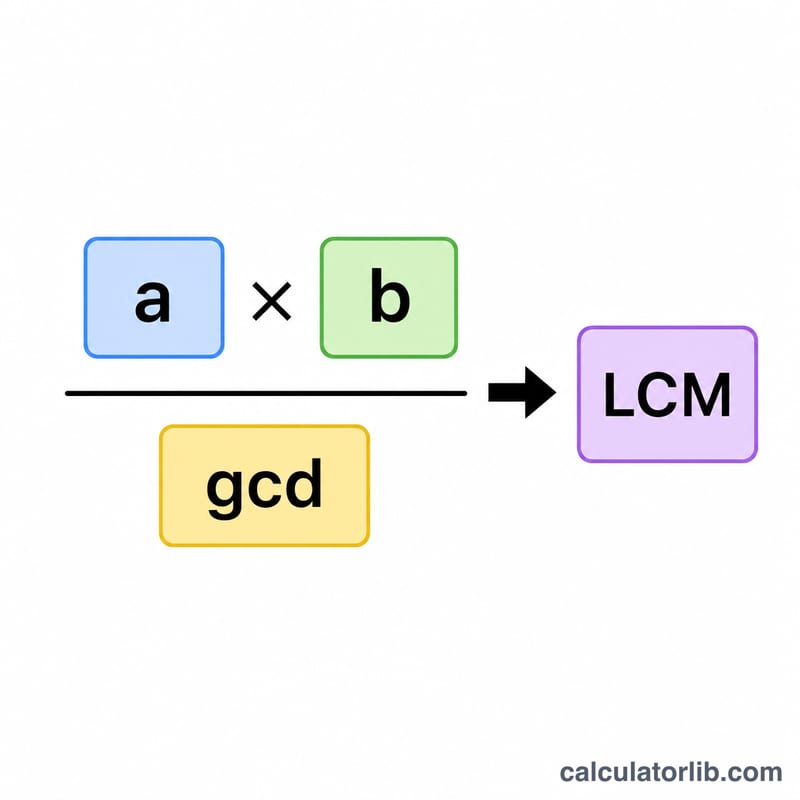
The calculator works pairwise using the relationship between the greatest common divisor (GCD) and the LCM: \(\text{LCM}(a, b) = a / \gcd(a, b) \times b\). The GCD itself is found with the Euclidean algorithm, repeatedly replacing the larger number by the remainder until it reaches zero. For more than two numbers it folds across the list: $$\text{LCM}(a, b, c) = \text{LCM}(\text{LCM}(a, b), c).$$ Dividing by the GCD before multiplying keeps the intermediate values small and prevents overflow.
Worked example
Find \(\text{LCM}(12, 15, 75)\). First \(\gcd(12, 15) = 3\), so $$\text{LCM}(12, 15) = 12 / 3 \times 15 = 60.$$ Next \(\gcd(60, 75) = 15\), so $$\text{LCM}(60, 75) = 60 / 15 \times 75 = 300.$$ Therefore \(\text{LCM}(12, 15, 75) = 300\). Checking by prime factorization: \(12 = 2^2 \times 3\), \(15 = 3 \times 5\), \(75 = 3 \times 5^2\). Taking the highest power of each prime gives $$2^2 \times 3 \times 5^2 = 4 \times 3 \times 25 = 300.$$
FAQ
Can it handle decimals? Yes. Every number is scaled by a power of ten until all are integers, the integer LCM is computed, then the result is scaled back. For example \(\text{LCM}(1.5, 2) = 6\).
What if I enter a 0? Zero is a multiple of every integer, so an LCM that includes 0 is conventionally 0.
How many numbers can I enter? At least two are required; there is no upper limit other than what fits on one line.