
What this calculator does
The Long Subtraction Calculator with Regrouping subtracts one whole number (Operand 2, the subtrahend) from another (Operand 1, the minuend) using the classic grade-school column method. Beyond the numeric answer it shows a full, human-readable walkthrough of every column, including exactly where and how you must "borrow" or regroup. It is an educational tool for students learning the standard subtraction algorithm and for parents and teachers checking homework.
How to use it
Enter the top number in Operand 1 and the number you are subtracting in Operand 2, then read the answer and the step-by-step explanation. Inputs are treated as whole numbers. If Operand 2 is larger than Operand 1, the calculator still returns the correct (negative) difference and notes that the result is negative.
The formula explained
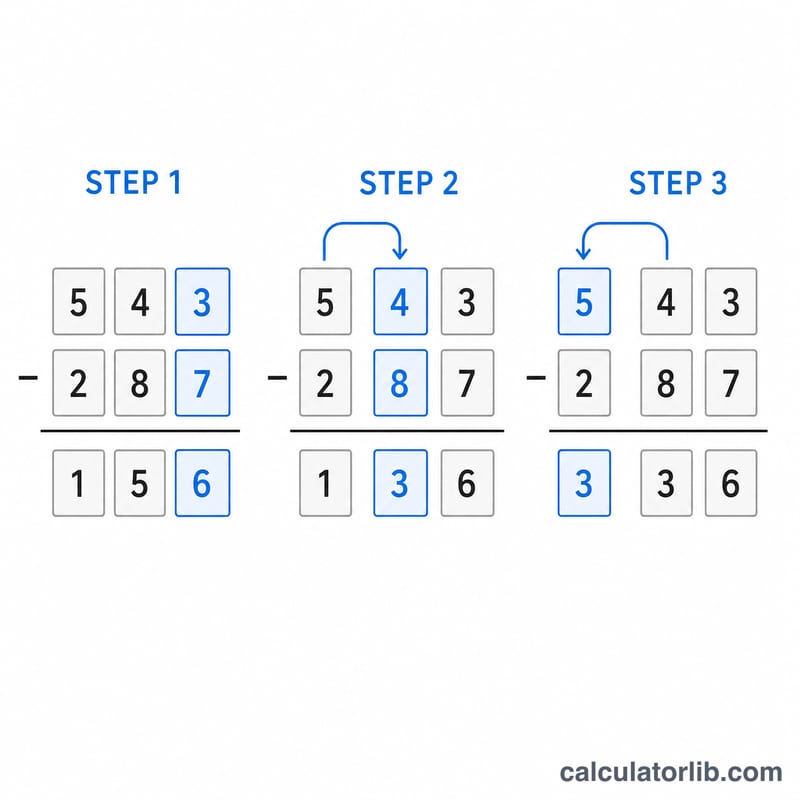
The core arithmetic is simply $$\text{Difference} = \text{Operand 1} - \text{Operand 2}$$ The interesting part is the presentation of the algorithm. Working right to left, each column subtracts the bottom digit from the top digit. When the top digit is smaller, you regroup: take 1 from the next non-zero column on the left and add 10 to the current column. If the borrow has to pass over columns containing 0, each of those zeros becomes 9 as the borrow cascades.
Worked example
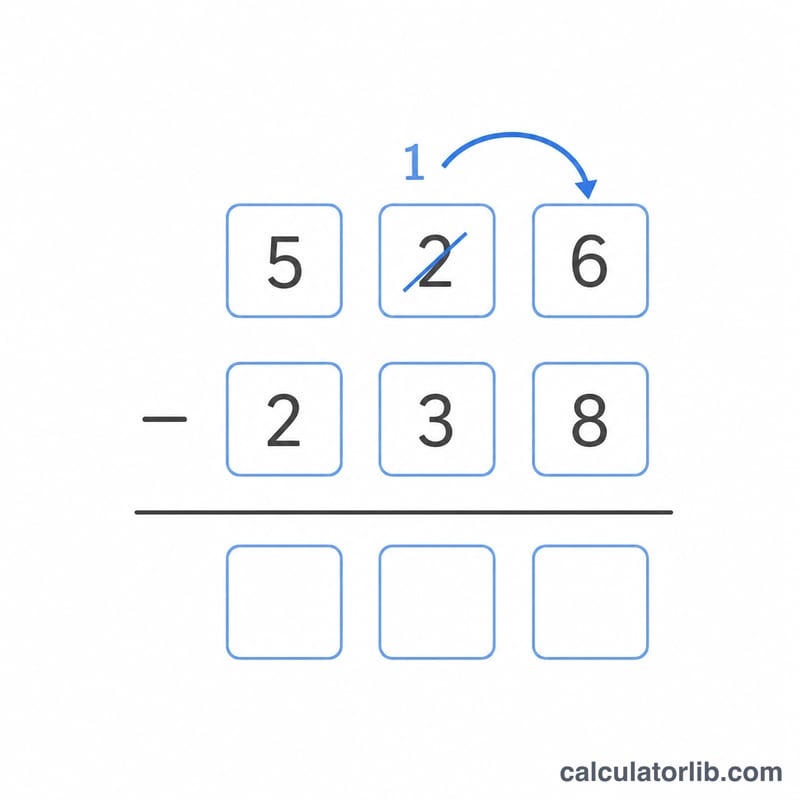
Take \(245 - 147\). Units: \(5 - 7\) is impossible, so borrow from the tens (4 becomes 3) making \(15 - 7 = 8\). Tens: now \(3 - 4\) is impossible, borrow from the hundreds (2 becomes 1) making \(13 - 4 = 9\). Hundreds: \(1 - 1 = 0\). Reading the digits gives 098, i.e. 98. Check: $$245 - 147 = 98$$
FAQ
What is regrouping? Regrouping (also called borrowing) is moving a unit of 10 from one place value to the next smaller one so a column subtraction becomes possible.
What happens with numbers like \(1000 - 1\)? The borrow cascades across the zeros: each 0 becomes 9 and the leading 1 becomes 0, giving 999.
Can I subtract a larger number from a smaller one? Yes. The calculator computes the negative result directly and tells you the answer is negative.