
What is the Subtraction with Borrowing Calculator?
This tool computes the difference between two whole numbers, the minuend (the top number you subtract from) minus the subtrahend (the number you subtract). It is presented as an Indian-style mental-math brain-training exercise: the digits are usually chosen so that one or more columns require borrowing (also called carry-down), which is exactly the skill the practice targets. The math itself is plain, universal arithmetic and works for any numbers.
How to use it
Enter the larger number in the Minuend field and the number you want to take away in the Subtrahend field, then read the Answer. Blank inputs are treated as zero. If the subtrahend is larger than the minuend, the answer is correctly shown as a negative number.
The formula explained
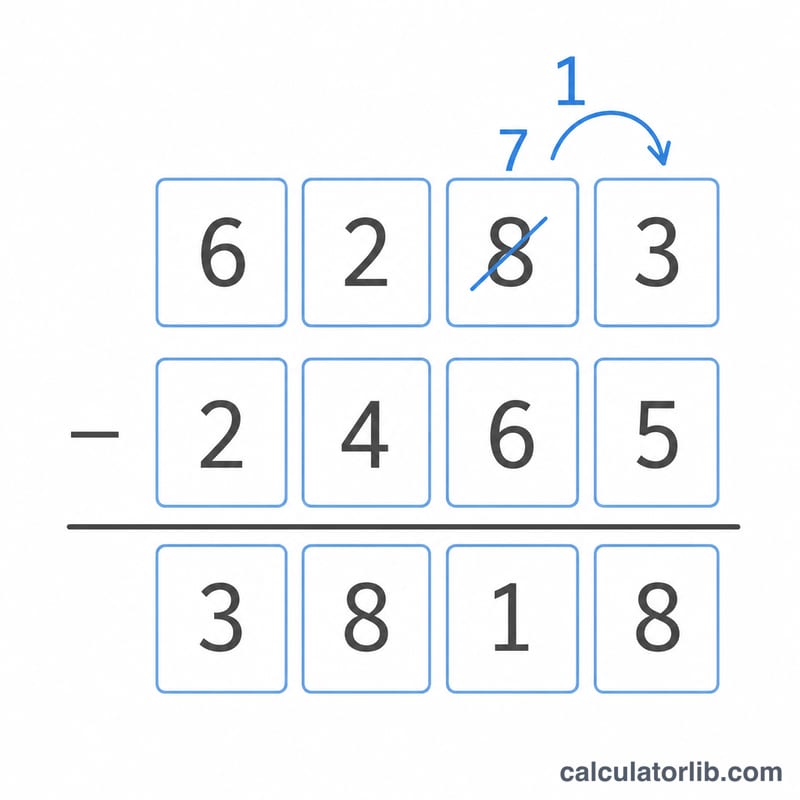
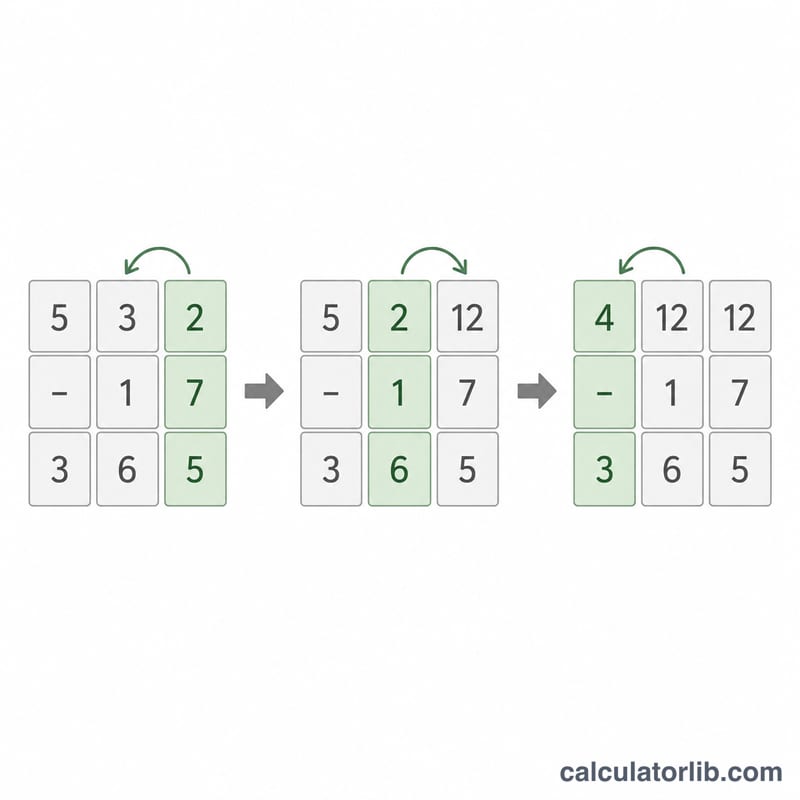
The result is simply $$\text{Difference} = \text{Minuend} - \text{Subtrahend}$$ The "with borrowing" wording does not change the formula; it only describes the column-by-column method. Working right to left, when a top digit is smaller than the bottom digit, you borrow 1 from the next-higher column (add 10 to the current digit and reduce the next top digit by 1).
Worked example
Take \(5825 - 1875\). Units: \(5 - 5 = 0\). Tens: \(2 - 7\) needs a borrow, so \(12 - 7 = 5\). Hundreds: after borrowing, \(7 - 8\) needs a borrow, so \(17 - 8 = 9\). Thousands: after borrowing, \(4 - 1 = 3\). Reading the digits gives 3950, so $$5825 - 1875 = 3950$$
FAQ
What does borrowing mean? When a digit on top is smaller than the digit below it, you "borrow" 10 from the next column to the left so the subtraction in that column becomes possible.
Can the answer be negative? Yes. If you subtract a larger number from a smaller one, the calculator returns a negative difference, for example \(3 - 5 = -2\).
Does it work with decimals? Yes. The same formula applies to decimals, though the borrowing exercise is designed around whole numbers.