
What this calculator does
This tool computes the total hardness of water from its dissolved calcium and magnesium content. Hardness is expressed as the equivalent mass of calcium carbonate (CaCO3) in milligrams per liter (mg/L), often called "American hardness." This is the international convention used in water quality reporting and is not specific to any one country. It is handy for reading the mineral table printed on bottled-water labels when the hardness value itself is not stated.
How to use it
Enter the calcium content and magnesium content of the water, both in mg/L (milligrams per liter). Many bottle labels list mineral content per 100 mL instead of per liter — if so, multiply the printed value by 10 before entering it here. Click calculate to get the total hardness and the WHO soft/hard classification.
The formula explained
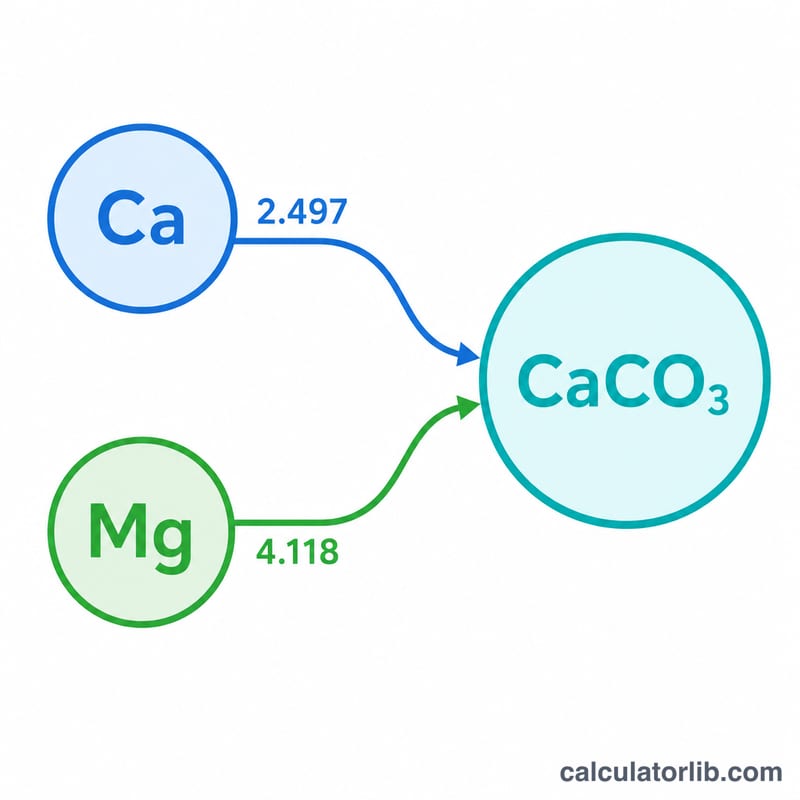
The calculation is a simple weighted sum: $$\text{Hardness} = \text{Calcium} \times 2.497 + \text{Magnesium} \times 4.118$$ The multipliers convert the mass of each dissolved ion into the equivalent mass of CaCO3 (molar mass ≈ 100.09 g/mol). For calcium the ratio is \(100.09 / 40.08 \approx 2.497\), and for magnesium it is \(100.09 / 24.31 \approx 4.118\). There is no division and no other unit conversion needed.
Worked example
Suppose a water contains 30 mg/L calcium and 20 mg/L magnesium. Then $$\text{hardness} = 30 \times 2.497 + 20 \times 4.118 = 74.91 + 82.36 = 157.27 \text{ mg/L as CaCO3}.$$ Since 157.27 falls in the 120–180 band, the water is classified as Hard.
WHO classification bands
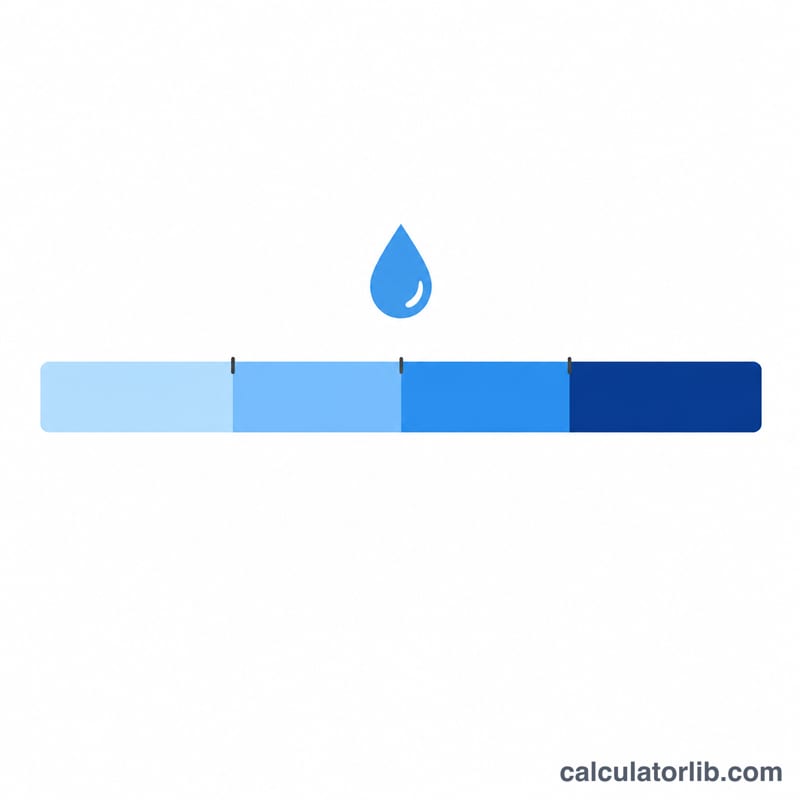
Soft: below 60 mg/L. Moderately hard: 60 to under 120 mg/L. Hard: 120 to under 180 mg/L. Very hard: 180 mg/L and above.
FAQ
My label shows mg per 100 mL — what do I enter? Multiply by 10 to convert to mg/L. For example \(3 \text{ mg/100 mL} = 30 \text{ mg/L}\).
Is mg/L the same as ppm? Yes, for dilute water \(1 \text{ mg/L} \approx 1 \text{ ppm}\), so you can use either interchangeably.
Which water is better for cooking? Soft water suits brewing tea and cooking rice, while harder water is often preferred for stewing meat. Preference varies by cuisine and taste.