
What Is Moisture Content?
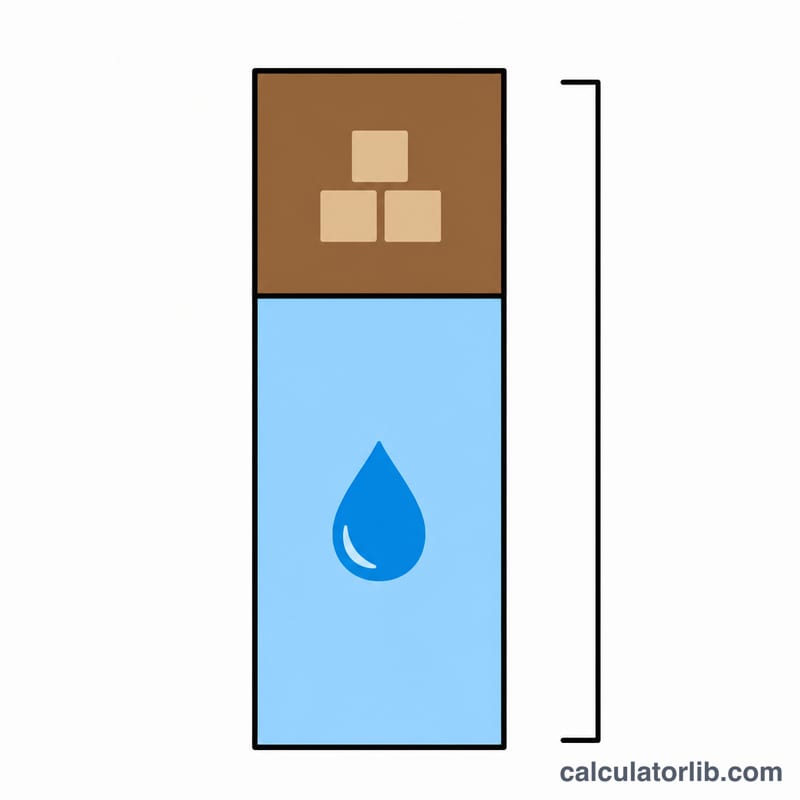
Moisture content is the proportion of water held in a material, expressed as a percentage of mass. It is a fundamental measurement in soil science, wood drying, food processing, agriculture and many laboratory procedures. This calculator converts a sample's wet mass and oven-dry mass into a moisture content percentage on either a dry basis or a wet basis.
How to Use This Calculator
Weigh your sample before drying to get the wet (initial) mass, then dry it completely (typically in an oven) and weigh it again to get the dry mass. Enter both values in the same unit (grams, kilograms, pounds — it cancels out), choose your basis, and read the moisture content. The calculator also shows the mass of water that was removed.
The Formula Explained
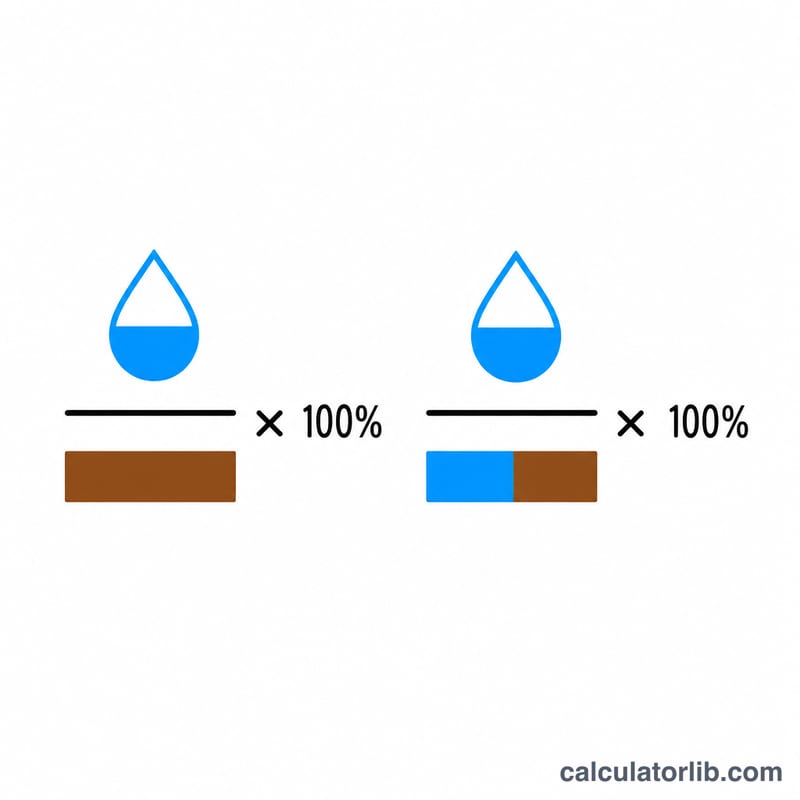
The water in a sample equals the difference between wet and dry mass. Dividing by the dry mass gives the dry-basis value, while dividing by the wet mass gives the wet-basis value:
Dry basis:
$$\text{MC} = \frac{\text{Wet mass} - \text{Dry mass}}{\text{Dry mass}} \times 100\%$$Wet basis:
$$\text{MC} = \frac{\text{Wet mass} - \text{Dry mass}}{\text{Wet mass}} \times 100\%$$Dry basis can exceed 100% (because the water can outweigh the solids), whereas wet basis is always between 0% and 100%.
Worked Example
Suppose a soil sample weighs 120 g wet and 100 g after oven drying. Water removed = \(120 - 100 = 20\text{ g}\). On a dry basis:
$$\frac{20}{100} \times 100 = \mathbf{20\%}$$On a wet basis:
$$\frac{20}{120} \times 100 \approx \mathbf{16.67\%}$$FAQ
Which basis should I use? Soil and wood are usually reported on a dry basis; foods and crops are often reported on a wet basis. Always state which one you used.
Why is my dry-basis value over 100%? That is normal — if the water weighs more than the solids, dry-basis moisture exceeds 100%.
Do the units matter? No. As long as the wet and dry masses use the same unit, the ratio is unitless and the percentage is correct.