
What the GC Content Calculator Does
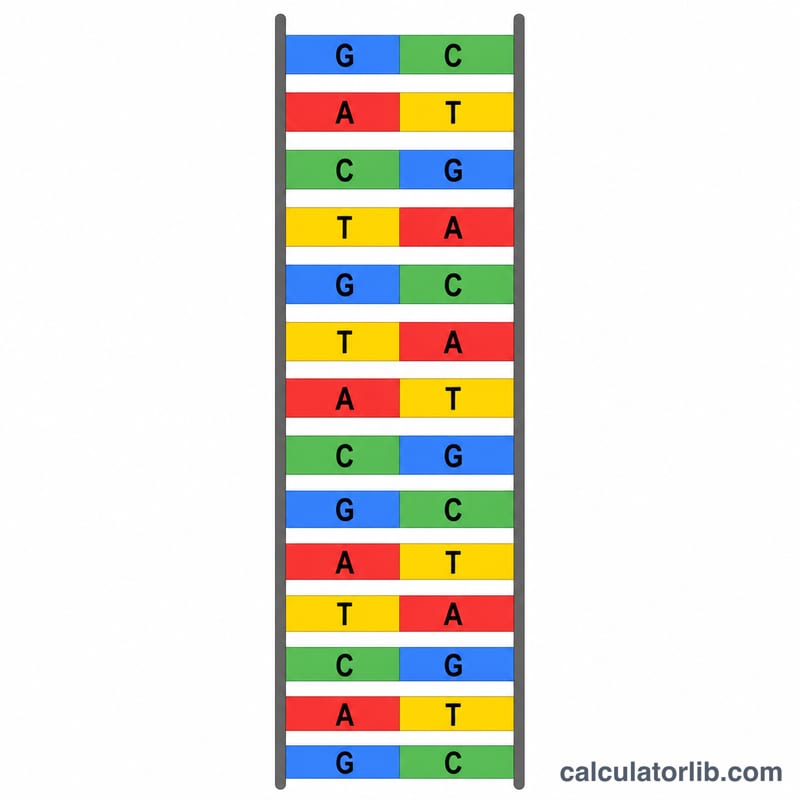
This tool calculates the GC content of any DNA sequence — the percentage of bases that are either guanine (G) or cytosine (C). GC content is a fundamental measure in molecular biology used to compare genomes, design PCR primers, and predict the melting temperature and stability of double-stranded DNA. Because G–C pairs are joined by three hydrogen bonds (versus two for A–T pairs), sequences richer in G and C tend to be more thermally stable.
How to Use It
- DNA Sequence: Paste or type your sequence using the letters A, T, G and C.
- The input is not case-sensitive — "atgc" and "ATGC" produce the same result.
- Any characters that aren't A, T, G or C (spaces, numbers, N, line breaks) are automatically stripped out before calculation, and the calculator reports how many invalid characters it removed.
For example, entering ATGCATGCATGC gives an instant percentage.
The Formula
The calculator counts the G and C bases in your cleaned sequence and divides by the total number of valid bases:
$$\text{GC\%} = \frac{N_G + N_C}{N_G + N_A + N_T + N_C} \times 100$$
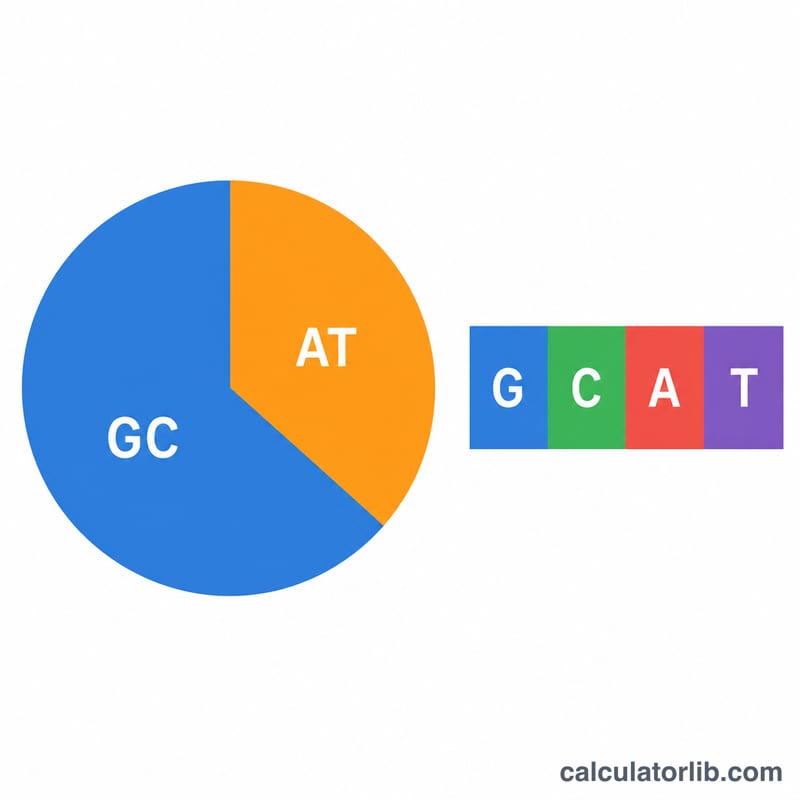
It also reports the complementary AT content using the same logic with A and T counts. If no valid bases are present, the result is simply 0.
Worked Example
Take the example sequence ATGCATGCATGC:
- Total bases = 12
- Count of G = 3, Count of C = 3, so GC count = 6
- GC Content = $$(6 \div 12) \times 100 = 50\%$$ 50%
- AT count = 6, so AT Content = 50%
A balanced sequence like this has equal GC and AT content.
Frequently Asked Questions
Why does GC content matter? It affects DNA stability and melting temperature, helps identify gene-rich regions, and is used when designing primers so they bind reliably during PCR.
What happens to invalid characters? Letters like N, U, gaps or whitespace are removed automatically. Only A, T, G and C are kept and counted, so spaces in pasted sequences won't distort your result.
Does it accept RNA sequences? The calculator only recognises DNA bases (A, T, G, C). Uracil (U) from RNA would be filtered out, so convert U to T first for an accurate reading.