
What Is the % w/v to mg/mL Calculator?
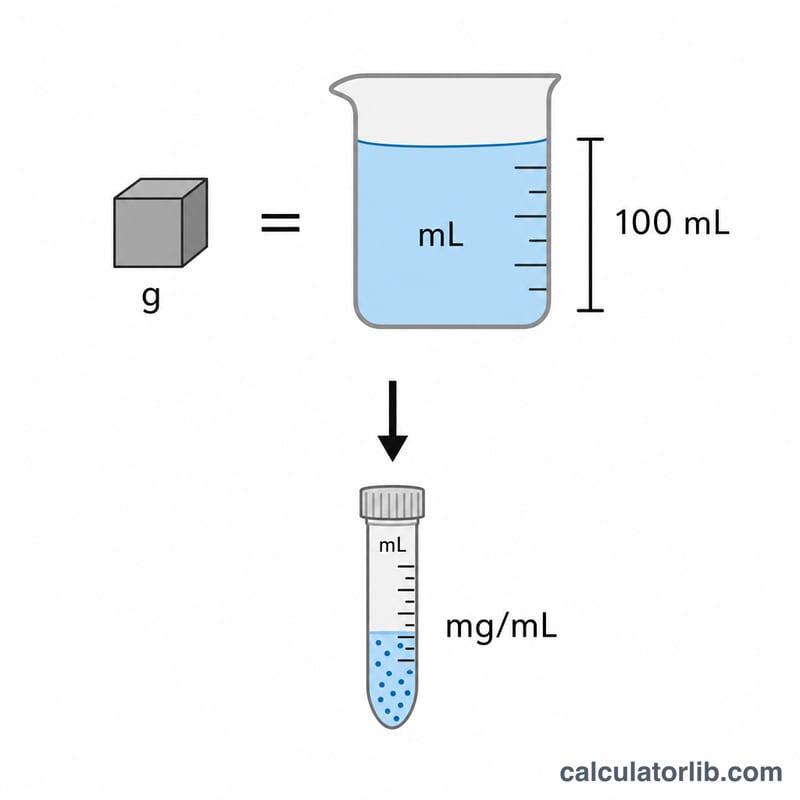
Percent weight/volume (% w/v) is a common way to express the concentration of a solute dissolved in a liquid, widely used in pharmacy, chemistry labs, and medicine. It tells you how many grams of solute are present in 100 mL of solution. This calculator converts any % w/v value into milligrams per milliliter (mg/mL), the unit most often needed for dosing and lab work.
How to Use It
Enter your concentration as a percent (for example, 0.9 for normal saline, or 2 for a 2% solution) and the calculator instantly returns the equivalent concentration in mg/mL. No need to remember the conversion factor.
The Formula Explained
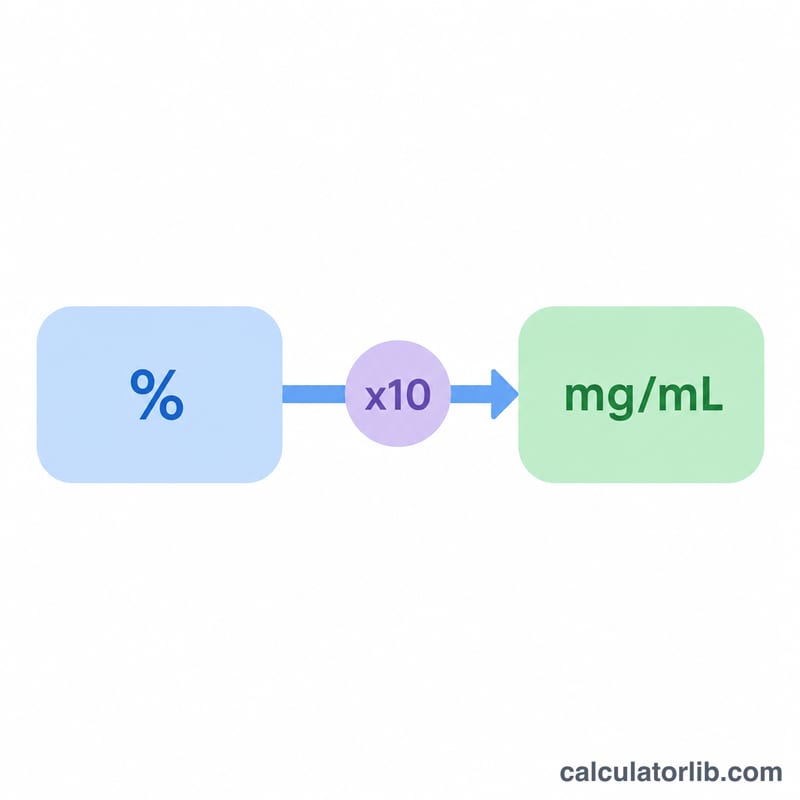
By definition, 1% w/v equals 1 gram of solute per 100 mL of solution. Since 1 gram = 1000 mg, that is 1000 mg per 100 mL, which simplifies to 10 mg/mL. Therefore the conversion is simply:
$$\text{Concentration (mg/mL)} = \text{Concentration (\% w/v)} \times 10$$
Worked Example
Consider 0.9% w/v sodium chloride (normal saline). Multiply $$0.9 \times 10 = 9 \text{ mg/mL}.$$ So normal saline contains 9 mg of sodium chloride per milliliter. Similarly, a 5% dextrose solution is $$5 \times 10 = 50 \text{ mg/mL}.$$
FAQ
Why multiply by 10? Because % w/v is grams per 100 mL and we convert grams to mg (\(\times 1000\)) then divide by 100 mL, giving a net factor of 10.
Can I go the other way? Yes — divide mg/mL by 10 to get % w/v. For example, \(50 \text{ mg/mL} \div 10 = 5\% \text{ w/v}\).
Does this work for any solute? Yes, % w/v and mg/mL are both mass-per-volume units, so the conversion factor of 10 applies regardless of the substance.