
What is the pH Calculator from Concentration?
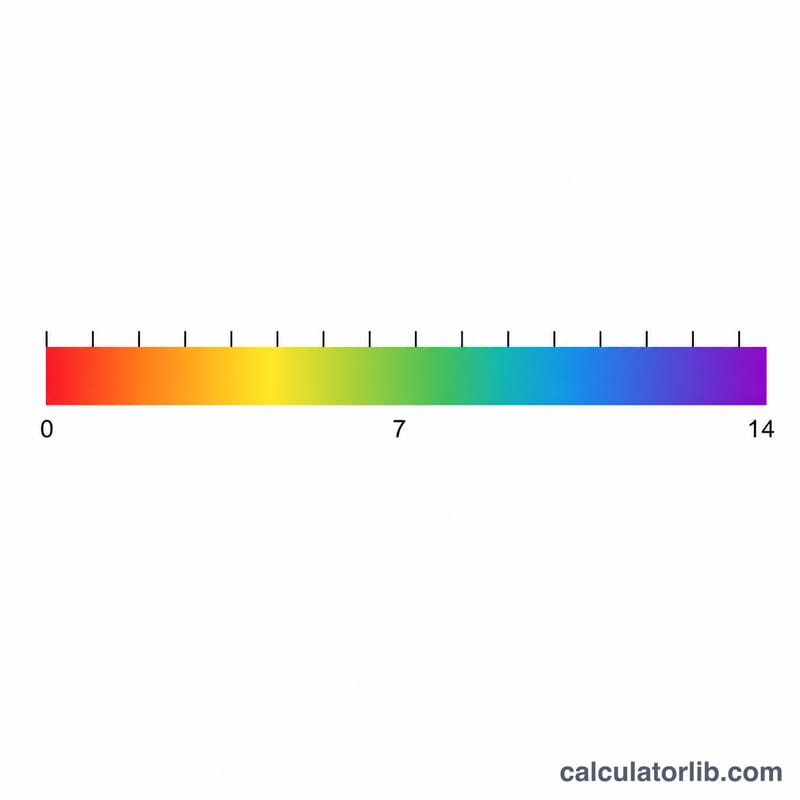
This calculator converts a hydrogen ion concentration, written [H+] and measured in moles per liter (mol/L), into a pH value. pH is a measure of how acidic or basic an aqueous solution is. The scale typically runs from 0 to 14: values below 7 are acidic, exactly 7 is neutral, and above 7 is basic (alkaline). This tool is universal and applies to any aqueous solution at standard conditions (25 degrees Celsius).
How to use it
Enter the hydrogen ion concentration in mol/L. You can type small numbers in decimal form (for example 0.0001) or scientific shorthand as a decimal. Click calculate and the tool returns the pH, the corresponding pOH, and the hydroxide ion concentration [OH-]. A label tells you whether the solution is acidic, neutral, or basic.
The formula explained
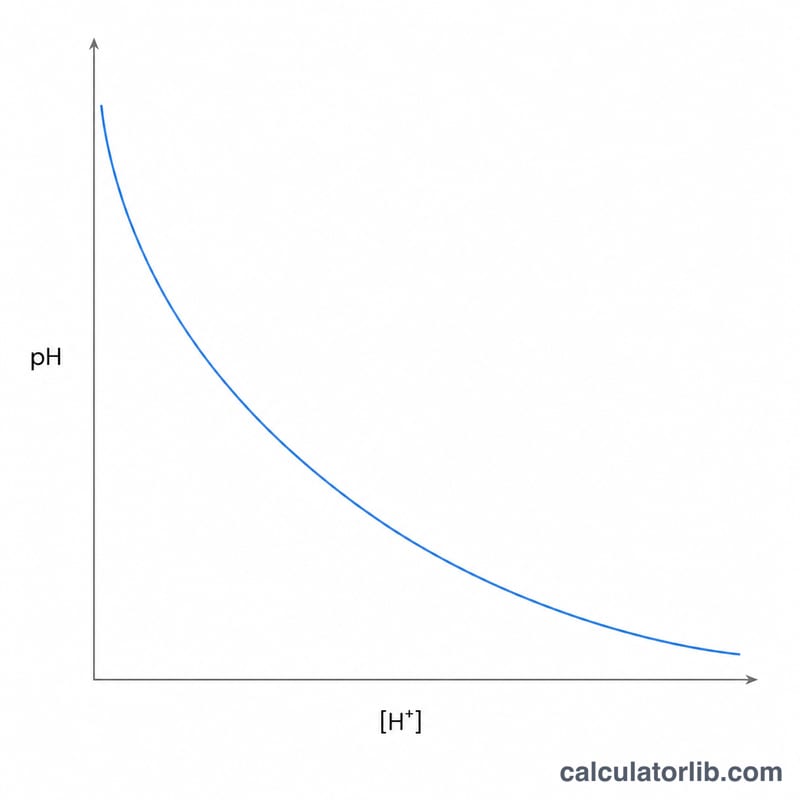
The core equation is $$\text{pH} = -\log_{10}\left(\text{[H}^{+}\text{] (mol/L)}\right)$$ Because hydrogen ion concentrations are often very small numbers, the logarithm compresses them into a convenient scale. A tenfold change in [H+] changes pH by exactly one unit. The companion relationship \(\text{pOH} = 14 - \text{pH}\) holds at 25 degrees Celsius, where the ion product of water Kw equals \(1.0 \times 10^{-14}\).
Worked example
Suppose a solution has \([\text{H}^{+}] = 0.0001\) mol/L (that is \(1 \times 10^{-4}\)). Then $$\text{pH} = -\log_{10}(0.0001) = -(-4) = 4$$ The \(\text{pOH} = 14 - 4 = 10\), and \([\text{OH}^{-}] = 10^{-10} = 1 \times 10^{-10}\) mol/L. The solution is acidic.
FAQ
What if [H+] is exactly 1 mol/L? Then \(\text{pH} = -\log_{10}(1) = 0\), the most acidic value on the standard scale.
Can pH be negative or above 14? Yes. Very concentrated strong acids can give a negative pH, and strong bases can exceed 14; the 0-14 range is just typical, not a hard limit.
Why does pH change by 1 for a 10x change? Because the formula uses a base-10 logarithm, each factor of 10 in concentration shifts pH by one whole unit.