
What Is the RNA Concentration Calculator?
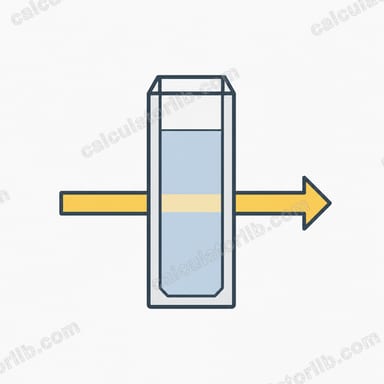
This calculator estimates the concentration of an RNA sample from its absorbance at 260 nm (A260) measured on a UV spectrophotometer such as a NanoDrop. It uses the standard extinction-based conversion factor for single-stranded RNA, where an A260 of 1.0 corresponds to approximately 40 ng/µL of RNA. The tool is universal and applies to any lab worldwide.
How to Use It
Enter the measured A260 value, the dilution factor used before reading (use 1 if the sample was read undiluted), and optionally the sample volume in microliters to compute the total RNA yield. The calculator returns concentration in ng/µL (equivalent to µg/mL) and the total amount of RNA recovered.
The Formula Explained
RNA concentration (ng/µL):
$$\text{Concentration} = \text{A260} \times 40 \times \text{Dilution} \;\;\text{(ng/}\mu\text{L)}$$The factor 40 is the empirically derived extinction coefficient for single-stranded RNA at 260 nm in a 1 cm pathlength cell. Total yield (µg):
$$\text{Yield (}\mu\text{g)} = \frac{\left(\text{A260} \times 40 \times \text{Dilution}\right) \times \text{Volume }(\mu\text{L})}{1000}$$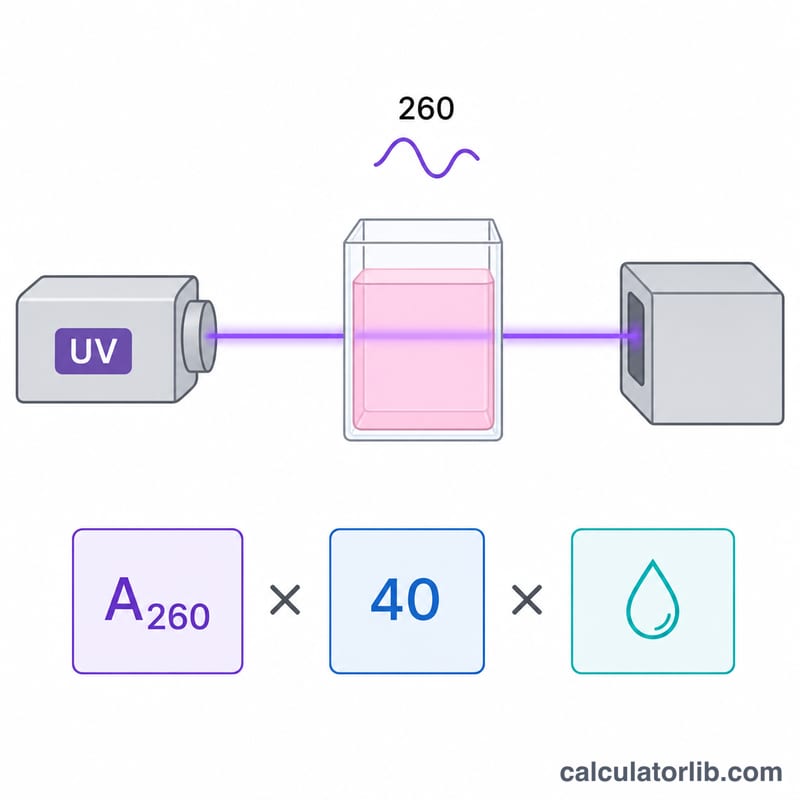
Worked Example
Suppose A260 = 0.25, dilution factor = 50, and volume = 100 µL.
$$\text{Concentration} = 0.25 \times 40 \times 50 = 500 \;\text{ng/}\mu\text{L}$$$$\text{Yield} = \frac{500 \times 100}{1000} = 50 \;\mu\text{g of RNA}$$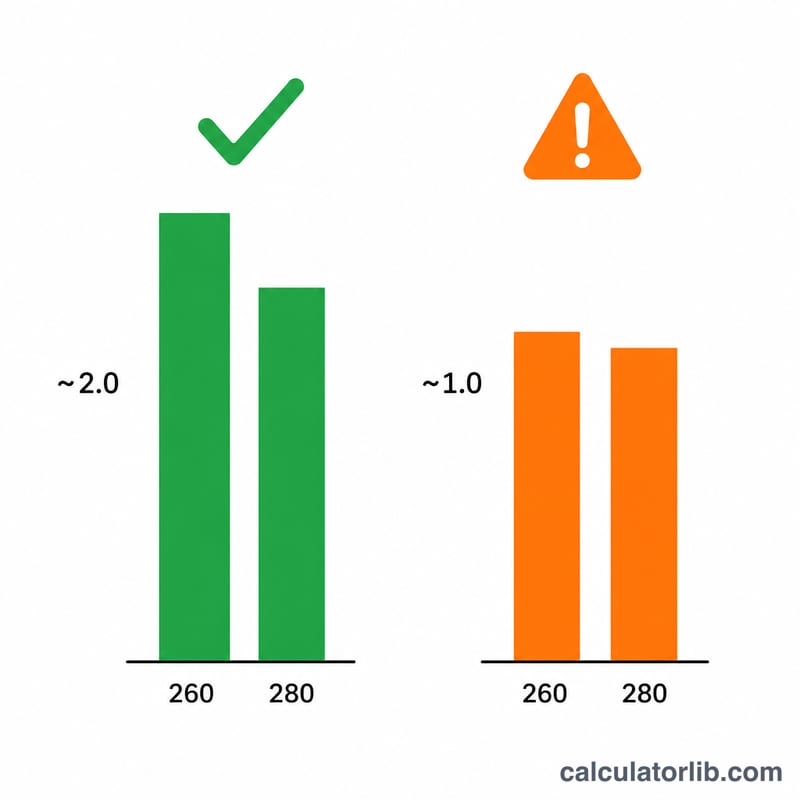
FAQ
Why 40 and not 50? The factor 50 is used for double-stranded DNA; single-stranded RNA absorbs slightly differently, so 40 ng/µL per A260 unit is the accepted constant.
What about purity? A260 alone gives concentration; check the A260/A280 ratio (~2.0 for pure RNA) and A260/A230 to assess contamination.
Does pathlength matter? The factor assumes a standard 1 cm pathlength. Modern microvolume instruments normalize readings to 1 cm automatically.