
What is the EC to TDS Calculator?
This tool converts a water sample's electrical conductivity (EC) into total dissolved solids (TDS), expressed in parts per million (ppm, equivalent to mg/L). Because dissolved salts and minerals carry electric current, EC and TDS are closely related, and a simple conversion factor links them. The calculator is universal and works for drinking water, aquariums, hydroponics, and laboratory testing.
How to use it
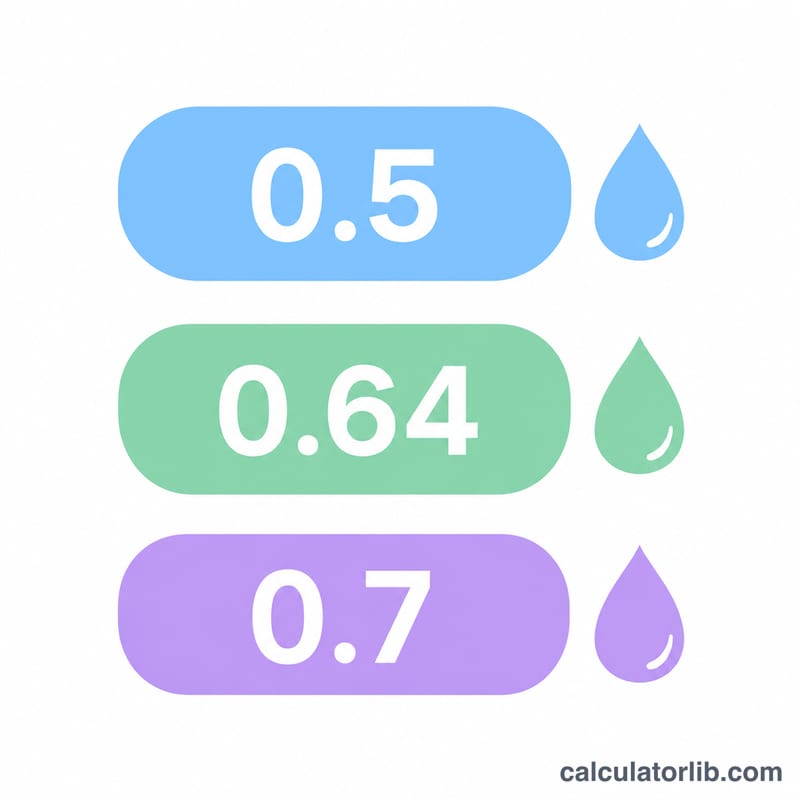
Enter your EC reading, choose whether it is in µS/cm or mS/cm, then pick a conversion factor. Most TDS meters use 0.5 (NaCl/US 500 scale), 0.64 (EU 640 scale), or 0.7 (442/hydroponic scale). The result shows TDS in ppm along with the EC value in both units.
The formula explained
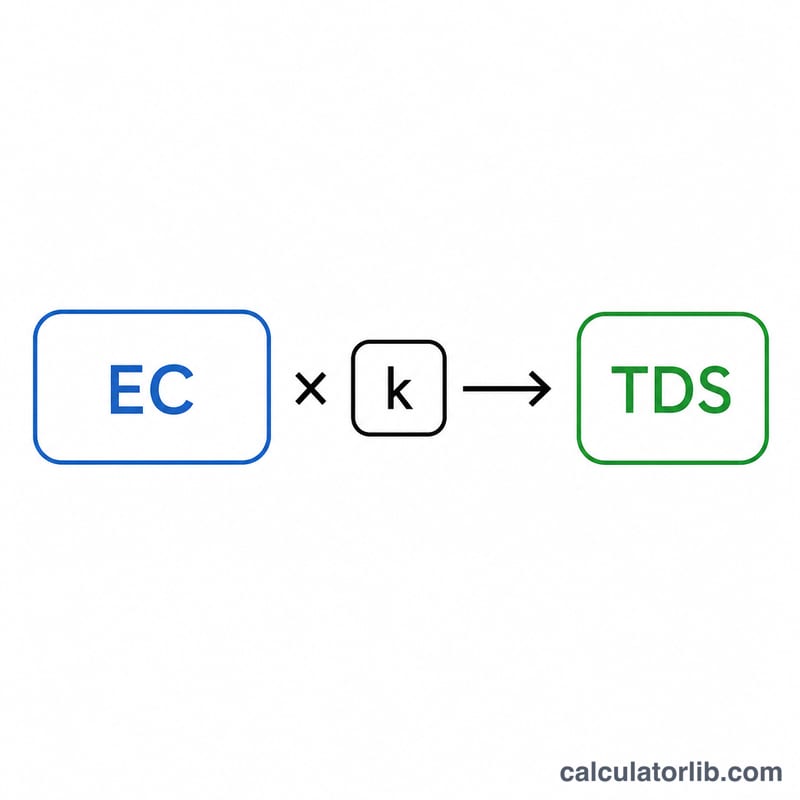
The core relationship is $$\text{TDS (ppm)} = \text{EC (µS/cm)} \times k$$ where k is the conversion factor between 0.5 and 0.7. If your meter reads in mS/cm, the value is first multiplied by 1000 to get µS/cm. The factor depends on the dominant ions in your water and the calibration standard your meter uses, so match it to your meter's setting for the most accurate result.
Worked example
Suppose your EC meter reads 1500 µS/cm and you use the 0.64 factor. $$\text{TDS} = 1500 \times 0.64 = 960 \text{ ppm}$$ If you switched to the 0.5 factor, the same reading would convert to 750 ppm — showing why the factor matters.
FAQ
Which factor should I use? Use the one your meter is calibrated to: 0.5 (NaCl), 0.64 (EU), or 0.7 (442/hydroponics). When in doubt, 0.64 or 0.5 are common defaults.
Is ppm the same as mg/L? For dilute water solutions, yes — \(1 \text{ ppm} \approx 1 \text{ mg/L}\).
Why isn't EC to TDS exact? Different dissolved substances conduct differently, so the conversion is an estimate. For precise TDS you must evaporate and weigh the residue.