
What Is the Unemployment Rate?
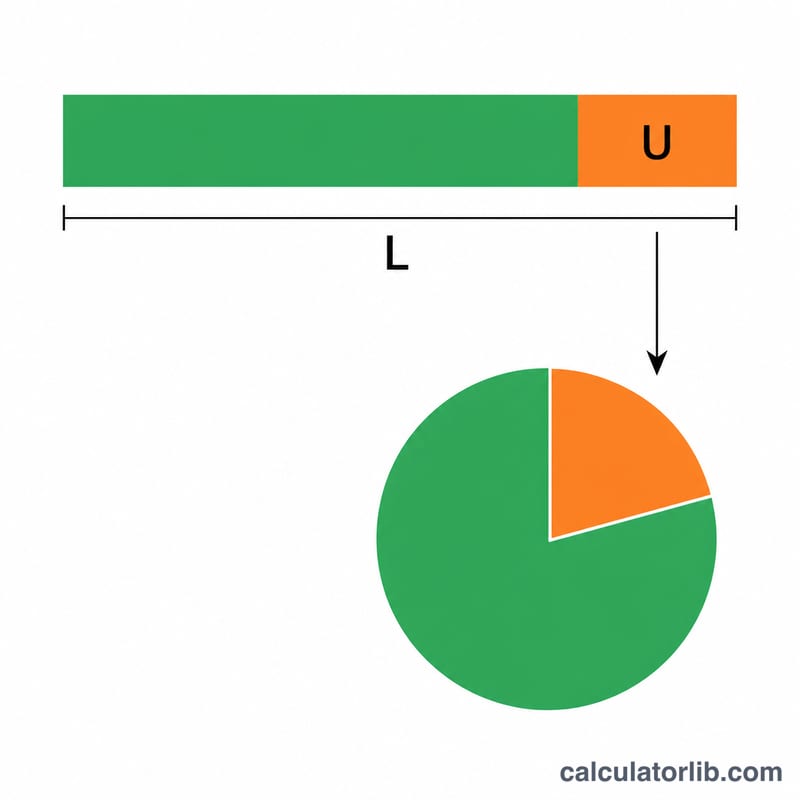
The unemployment rate measures the share of a country's labor force that is jobless but actively seeking and available for work. It is one of the most closely watched economic indicators because it reflects the health of the labor market. This calculator works for any economy or region — simply supply the number of unemployed people and the total labor force.
How to Use This Calculator
Enter two numbers: the count of unemployed people and the total labor force (everyone employed plus everyone unemployed and looking for work). The calculator returns the unemployment rate as a percentage, along with the number of employed people and the employment rate.
The Formula Explained
The core formula is simple:
$$\text{Unemployment Rate} = \frac{\text{Unemployed People}}{\text{Total Labor Force}} \times 100\%$$The labor force excludes people who are not seeking work (such as retirees, full-time students, and discouraged workers), so the rate only counts those actively in the job market.
Worked Example
Suppose a country has 6,000,000 unemployed people and a total labor force of 160,000,000. The unemployment rate is $$6{,}000{,}000 \div 160{,}000{,}000 \times 100 = \mathbf{3.75\%}$$ That means 154,000,000 people are employed, an employment rate of 96.25%.
FAQ
Does the labor force include everyone of working age? No. It only includes people who are employed or actively looking for work. Those not seeking work are outside the labor force.
Why is my country's official rate slightly different? Statistical agencies use survey methodology and specific definitions of "actively seeking," so official figures may differ from a simple ratio.
What is a healthy unemployment rate? Many economists consider a "natural" rate of roughly 4–5% normal, reflecting frictional and structural unemployment even in a strong economy.