

What Is the Mortality Rate Calculator?
The mortality rate (or death rate) measures how many deaths occur within a given population over a period of time, usually one year. Because raw death counts mean little without context, the rate is scaled to a standard population size — commonly per 1,000 or per 100,000 people — so that populations of different sizes can be compared fairly. This universal calculator works for any country, region, age group, or disease.
How to Use It
Enter the total number of deaths, the total population at risk, and choose the multiplier you want the rate expressed against. The calculator divides deaths by population and multiplies by your chosen scale. It also shows the equivalent percentage so you can interpret the result either way.
The Formula Explained
The crude mortality rate is calculated as:
$$\text{Mortality Rate} = \frac{\text{Deaths}}{\text{Population}} \times \text{Multiplier}$$
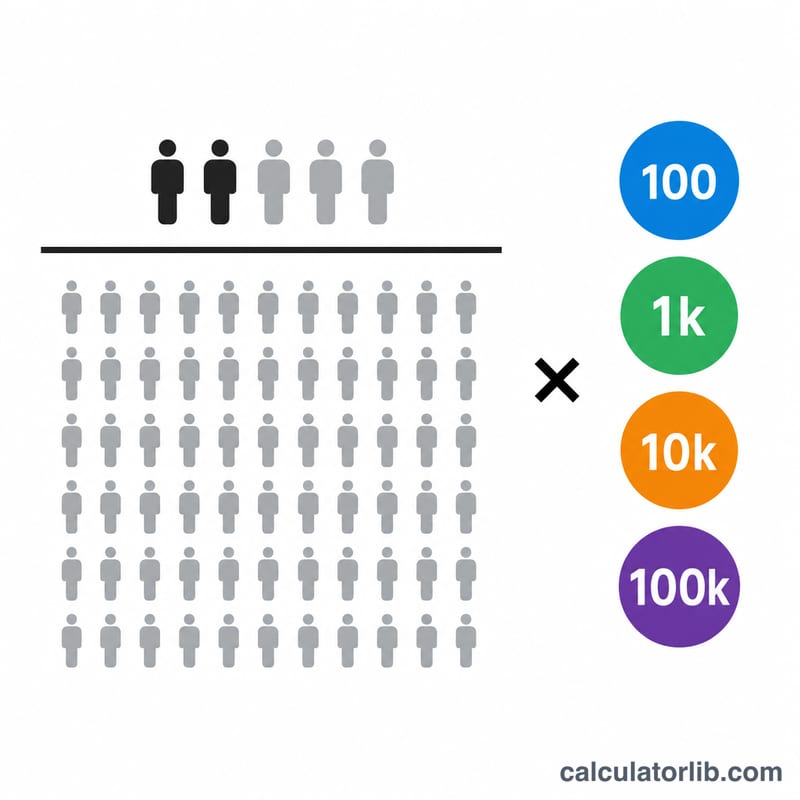
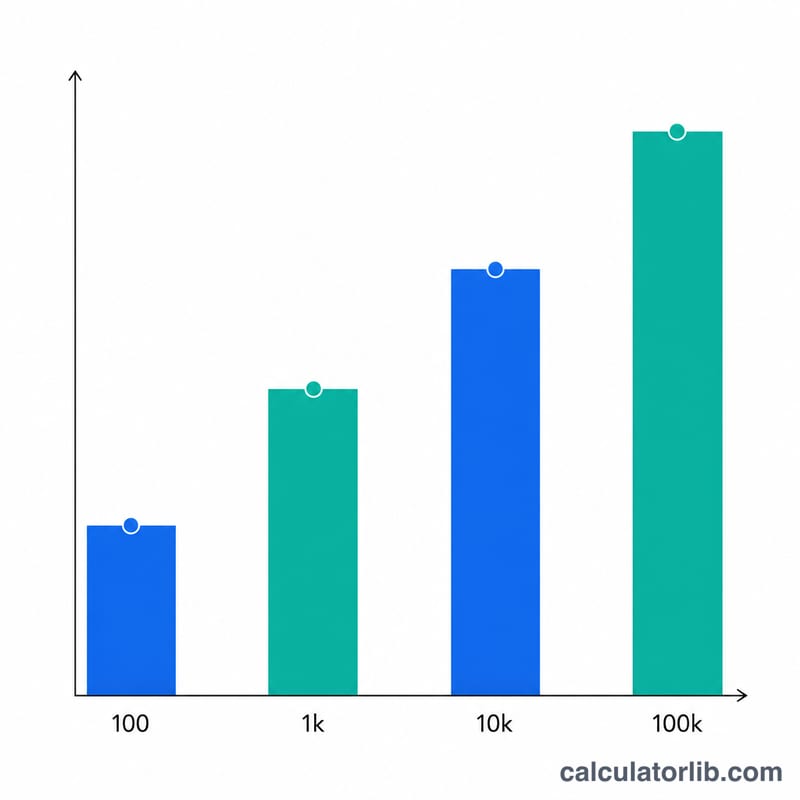
The multiplier converts the small fraction into a readable whole number. For example, a "per 100,000" rate makes rare events easier to discuss than a tiny decimal.
Worked Example
Suppose a city of 1,000,000 people recorded 500 deaths in a year. Choosing a multiplier of 1,000:
$$\text{Rate} = \left(\frac{500}{1{,}000{,}000}\right) \times 1{,}000 = 0.5 \text{ deaths per 1,000 people.}$$ As a percentage that is \(0.05\%\).
FAQ
What is the difference between crude and age-specific mortality rates? The crude rate uses the whole population. Age-specific rates restrict the deaths and population to a single age group, giving a more precise picture.
Which multiplier should I use? Use per 1,000 for general populations, and per 100,000 for relatively rare causes such as specific diseases or accidents.
Is this the same as the case fatality rate? No. The case fatality rate divides deaths by the number of diagnosed cases, while mortality rate divides deaths by the total population.