
What the Growth Rate Calculator Does
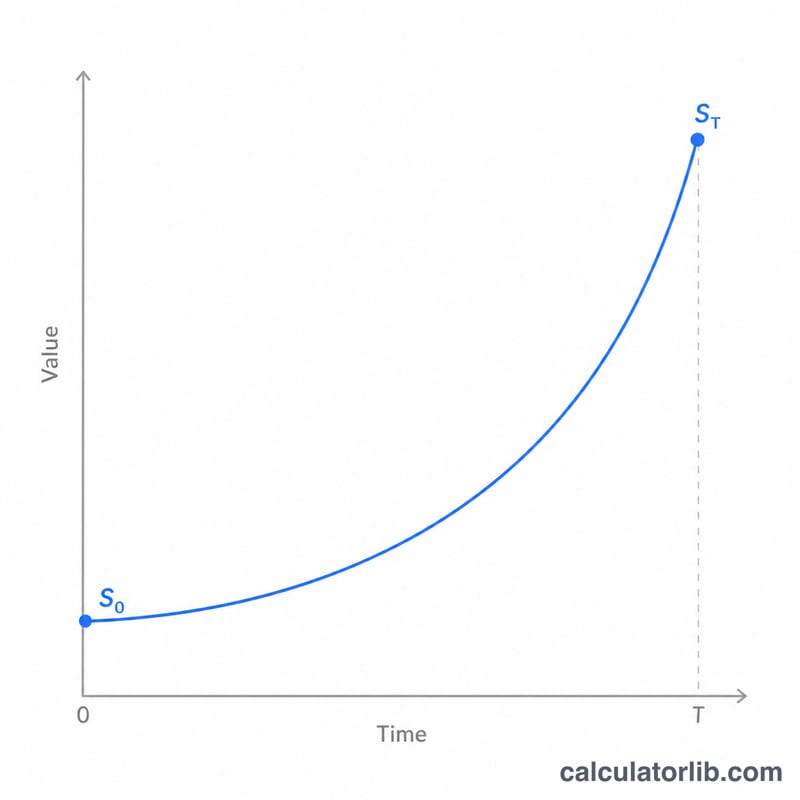
This calculator measures how fast a value has grown between two points in time. You enter a starting amount, an ending amount, and the number of years in between, and it returns the compound annual growth rate (CAGR) along with several supporting figures: total growth amount, average annual growth amount, total percent change, and the time it would take to double at that rate. It works for investments, revenue, population, website traffic, or any quantity that grows over time.
The Three Inputs
- Initial Value – the amount at the beginning of the period (for example, your investment at the start).
- Final Value – the amount at the end of the period.
- Time Period (years) – how many years separate the two values.
The Formula Explained
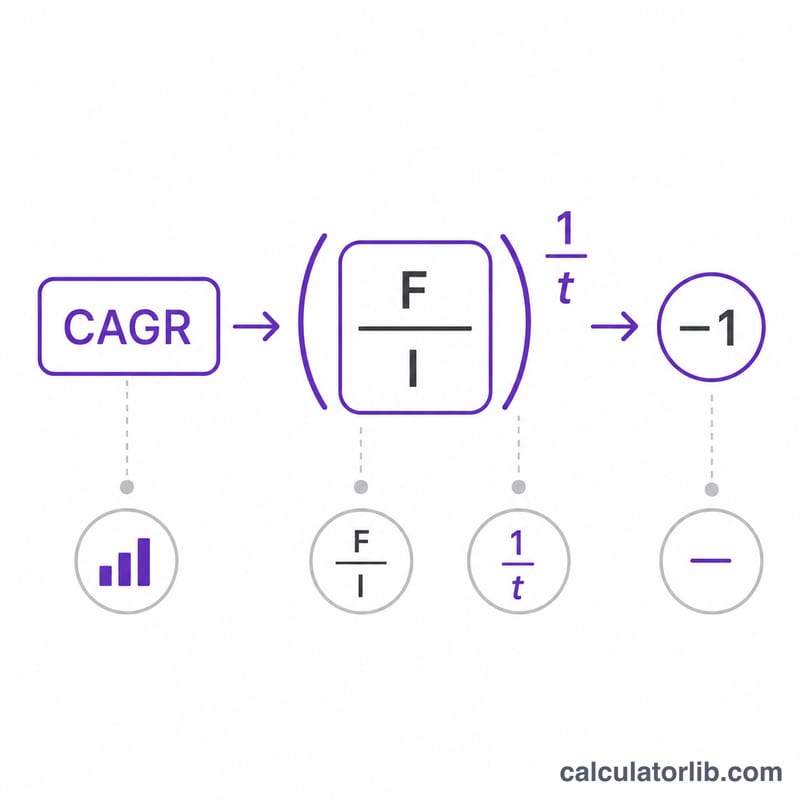
The headline compound annual growth rate is calculated as:
Growth Rate = (Final Value ÷ Initial Value)(1 ÷ Time Period) − 1
This smooths the overall change into a single steady yearly rate, as if the value grew by the same percentage every year. The calculator also derives:
- Total growth amount = Final Value − Initial Value
- Annual growth amount = (Final Value − Initial Value) ÷ Time Period (a simple straight-line average per year)
- Total percent change = (Final Value − Initial Value) ÷ Initial Value
- Time to double = ln(2) ÷ ln(1 + Growth Rate)
Worked Example
Suppose an investment grows from an Initial Value of $10,000 to a Final Value of $16,000 over a Time Period of 5 years.
- CAGR = (16,000 ÷ 10,000)(1/5) − 1 = 1.60.2 − 1 ≈ 0.0986, or 9.86% per year
- Total growth amount = 16,000 − 10,000 = $6,000
- Annual growth amount = 6,000 ÷ 5 = $1,200 per year
- Total percent change = 6,000 ÷ 10,000 = 60%
- Time to double = ln(2) ÷ ln(1.0986) ≈ 7.4 years
Frequently Asked Questions
Why is CAGR different from the total percent change? CAGR is an annualized rate, while total percent change covers the entire period. In the example, 60% total spread over 5 years equals about 9.86% compounded each year, not 12%.
What does "time to double" mean? It estimates how many years the value needs to double at the calculated CAGR, using logarithms. A 9.86% rate doubles money in roughly 7.4 years.
Can I use negative growth? Yes. If the Final Value is lower than the Initial Value, the growth rate will be negative, indicating decline. Note that time to double is only meaningful for positive growth rates.