
What Is a Conversion Rate?
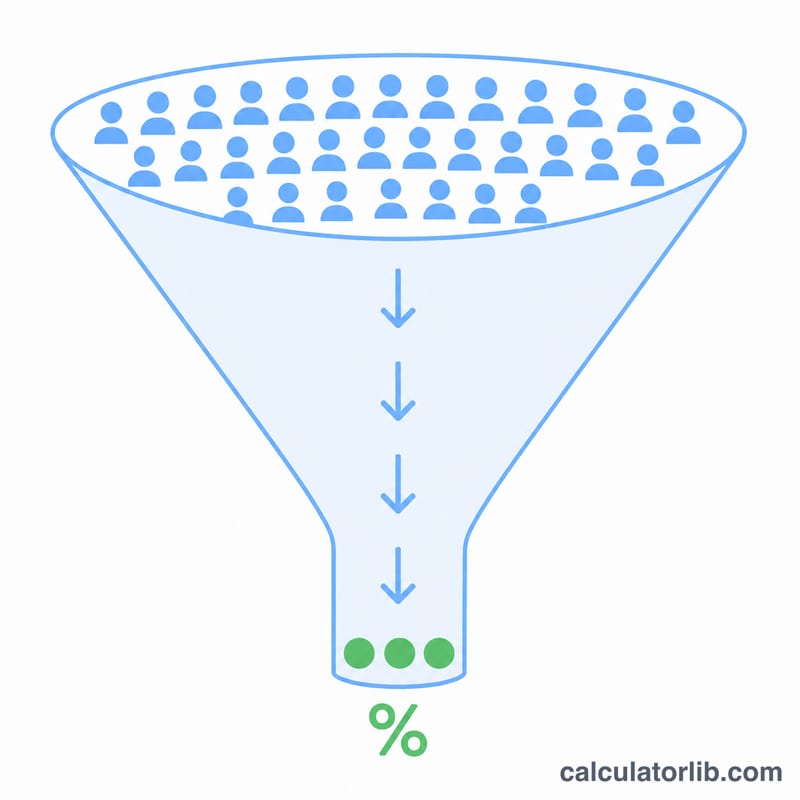
A conversion rate measures the percentage of people who take a desired action — such as making a purchase, signing up for a newsletter, or filling out a form — out of the total number of visitors or users. It is one of the most important metrics in digital marketing, sales, e-commerce, and advertising because it directly reflects how effectively your website, landing page, or campaign turns interest into action.
How to Use This Calculator
Enter the number of conversions (people who completed the action) and the total number of visitors (everyone who could have converted). The tool instantly returns your conversion rate as a percentage, along with the number of non-converting visitors so you can see the full picture.
The Formula Explained
The calculation is straightforward:
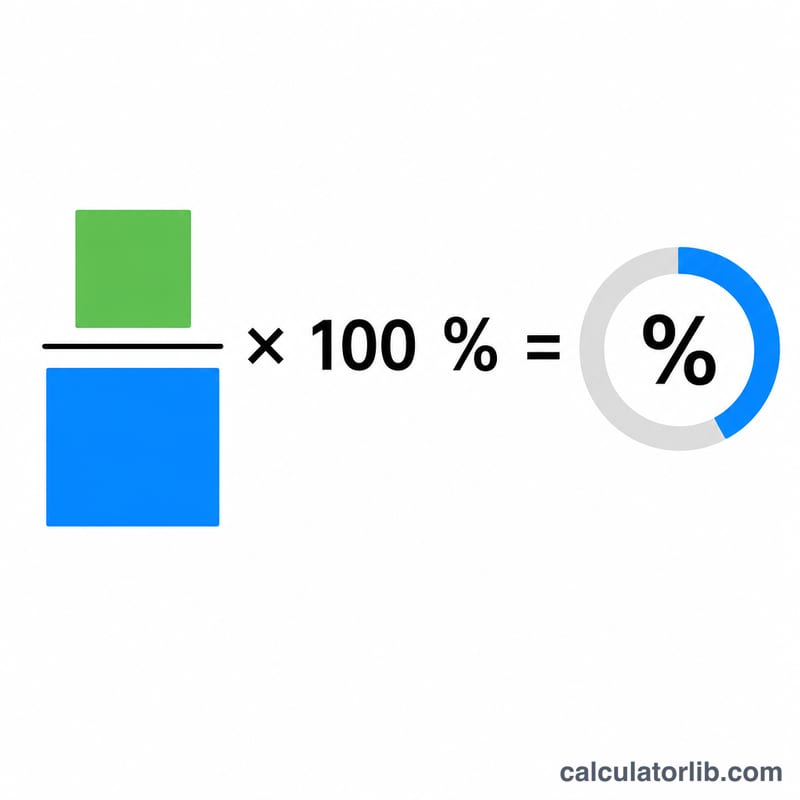
$$\text{Conversion Rate (\%)} = \frac{\text{Conversions}}{\text{Visitors}} \times 100$$
You divide conversions by total visitors to get the proportion that converted, then multiply by 100 to express it as a percentage. A higher percentage means a more effective page or campaign.
Worked Example
Suppose your online store had 1,000 visitors last week and 50 of them placed an order. Your conversion rate is $$(50 \div 1{,}000) \times 100 = 5\%$$ That means 5 out of every 100 visitors became customers, while 950 visitors did not convert. Tracking this number over time helps you measure whether changes to your site or marketing are improving results.
FAQ
What is a good conversion rate? It varies by industry, but for e-commerce a typical rate is 2–4%. Landing pages and lead-generation forms often see higher rates. Compare against your own historical data and industry benchmarks.
Can the conversion rate exceed 100%? Normally no, since you cannot have more conversions than visitors. If it does, it usually means visitors are being counted as unique while conversions include repeat actions.
What counts as a "conversion"? Any action you define as a goal: a sale, sign-up, download, click, or call. Pick one clear goal per measurement for accurate tracking.