
What is the Click-to-Conversion (CTC) Rate?
The Click-to-Conversion (CTC) rate, also called the conversion rate from clicks, is a core digital marketing metric. It tells you what share of the people who clicked your ad, link, or listing went on to complete a desired action — a purchase, sign-up, lead form, or download. A higher CTC rate means your landing page and offer are doing a good job of turning interest into action.
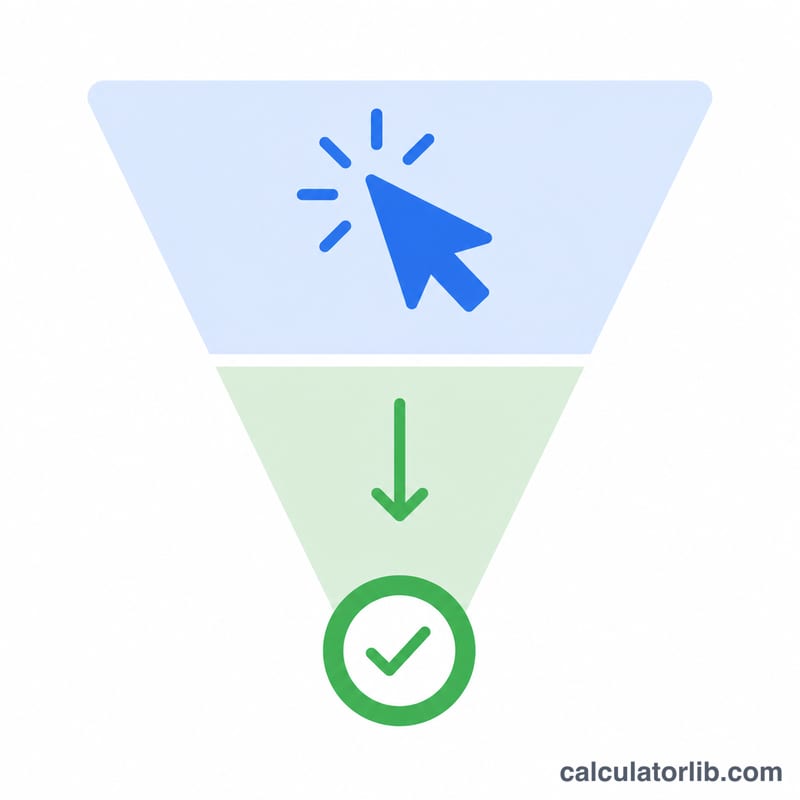
How to Use This Calculator
Enter the number of conversions (completed actions) and the number of clicks (total clicks received). The calculator divides conversions by clicks and multiplies by 100 to express the result as a percentage. Both inputs are plain counts, so no units are needed.
The Formula Explained
The calculation is simple:
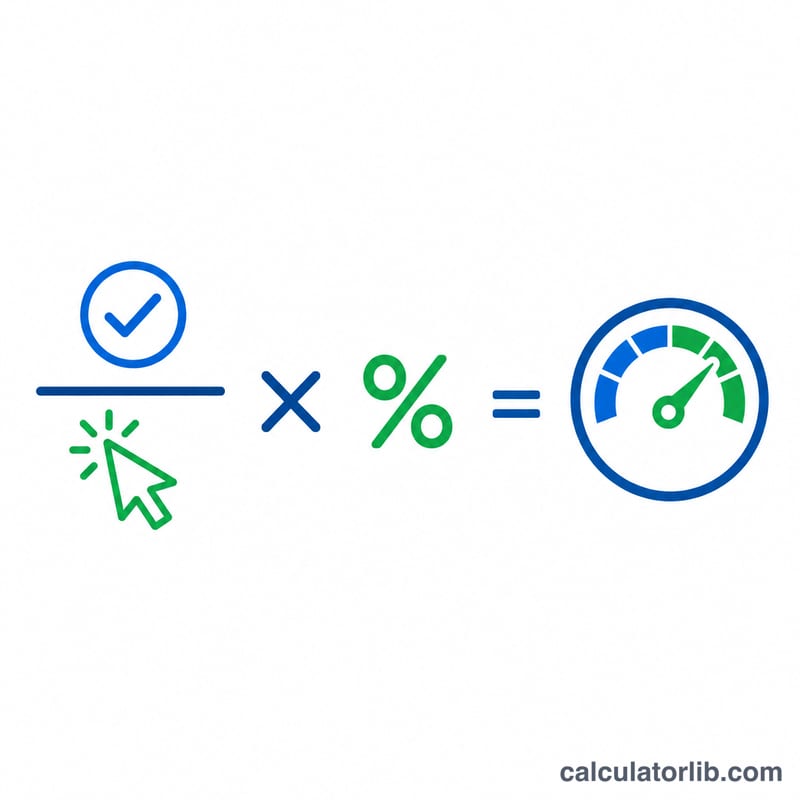
$$\text{CTC rate (\%)} = \frac{\text{conversions}}{\text{clicks}} \times 100$$
Dividing conversions by clicks gives the proportion that converted; multiplying by 100 turns that proportion into a percentage. If clicks is zero the rate is undefined, so the calculator returns 0 in that case to avoid dividing by zero.
Worked Example
Suppose you received 100 clicks and recorded 3 conversions. The CTC rate is $$\frac{3}{100} \times 100 = 3\%$$ — three percent of clicks converted. For a busier campaign with 25 conversions from 500 clicks, the rate is $$\frac{25}{500} \times 100 = 5\%$$.
FAQ
What is a good CTC rate? It varies widely by industry and channel, but many online campaigns see conversion rates between 1% and 5%. Compare against your own historical baseline rather than a universal benchmark.
Can the rate exceed 100%? Normally conversions are fewer than clicks, keeping the result between 0% and 100%. With certain attribution or tracking models conversions can outnumber clicks, producing a rate above 100% — the formula still applies, but it usually signals a measurement quirk worth checking.
How is CTC different from click-through rate (CTR)? CTR measures clicks per impression (how many viewers clicked), while CTC measures conversions per click (how many clickers converted). They describe different stages of the funnel.