
What Is Email Click-Through Rate?
Email click-through rate (CTR) measures how many recipients clicked at least one link in your email campaign relative to how many emails were successfully delivered. It is one of the most important engagement metrics in email marketing because it reflects whether your content, offer, and call-to-action actually motivated readers to act — not just open the message.
How to Use This Calculator
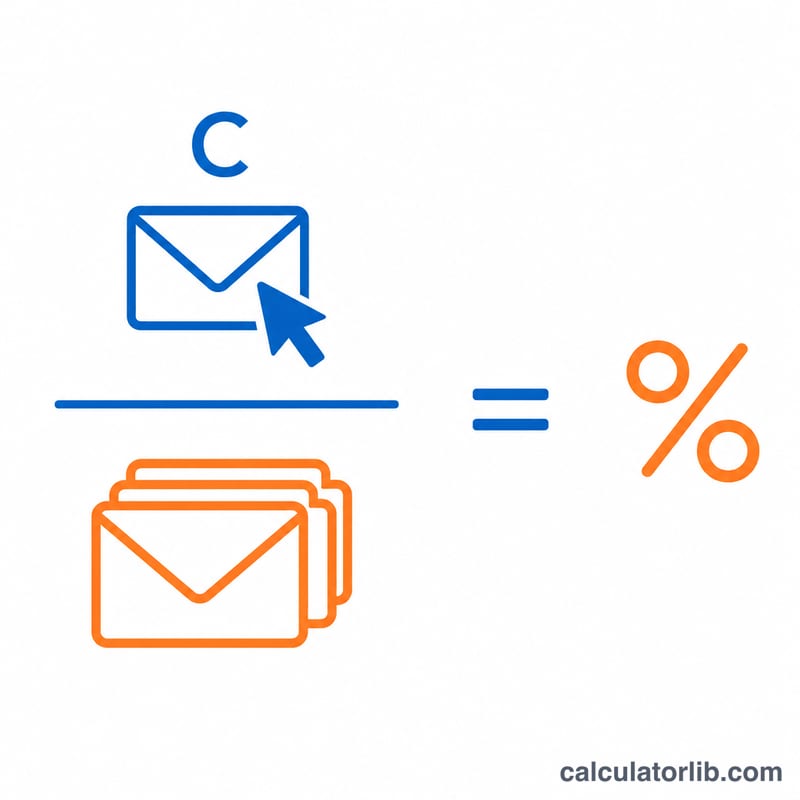
Enter two numbers: the count of unique clicks (recipients who clicked at least once, avoiding double-counting people who click multiple times) and the number of emails delivered (emails sent minus bounces). The calculator divides clicks by delivered emails and multiplies by 100 to express the result as a percentage.
The Formula Explained
The calculation is simple:
$$\text{CTR} = \frac{\text{Unique Clicks}}{\text{Emails Delivered}} \times 100\%$$
Using delivered rather than sent emails gives a fairer denominator because bounced messages never reached an inbox. Using unique clicks rather than total clicks prevents enthusiastic individuals from inflating the rate.
Worked Example
Suppose a campaign delivered 5,000 emails and recorded 150 unique clicks. The CTR is $$(150 \div 5{,}000) \times 100 = 3\%.$$ That means 3 out of every 100 people who received the email clicked a link.

FAQ
What is a good email CTR? It varies by industry, but a typical benchmark is roughly 2%–5%. Compare against your own historical averages for the most useful insight.
How is CTR different from click-to-open rate? CTR uses emails delivered as the denominator, while click-to-open rate (CTOR) uses emails opened, isolating how compelling your content was for people who actually read it.
Should I use unique or total clicks? Use unique clicks for CTR so a few highly engaged readers don't skew the metric.