
What Is WACC?
The Weighted Average Cost of Capital (WACC) is the average rate a company expects to pay to finance its assets, blending the cost of equity and the after-tax cost of debt in proportion to how much of each it uses. WACC is widely used as the discount rate in discounted cash flow (DCF) valuation and as a hurdle rate for evaluating new investments — a project that returns more than the WACC creates value, while one that returns less destroys it.
How to Use This Calculator
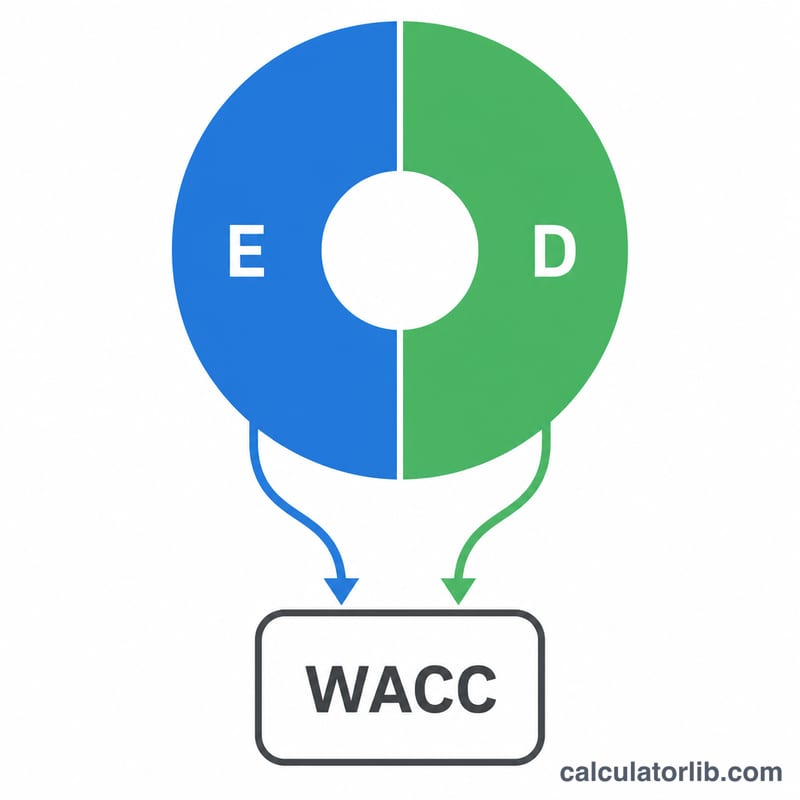
Enter the market value of your equity (E) and debt (D), the cost of equity (Re), the cost of debt (Rd), and the corporate tax rate. The calculator computes the capital weights, applies the tax shield to debt, and returns your blended WACC as a percentage along with a full breakdown of each component's contribution.
The Formula Explained
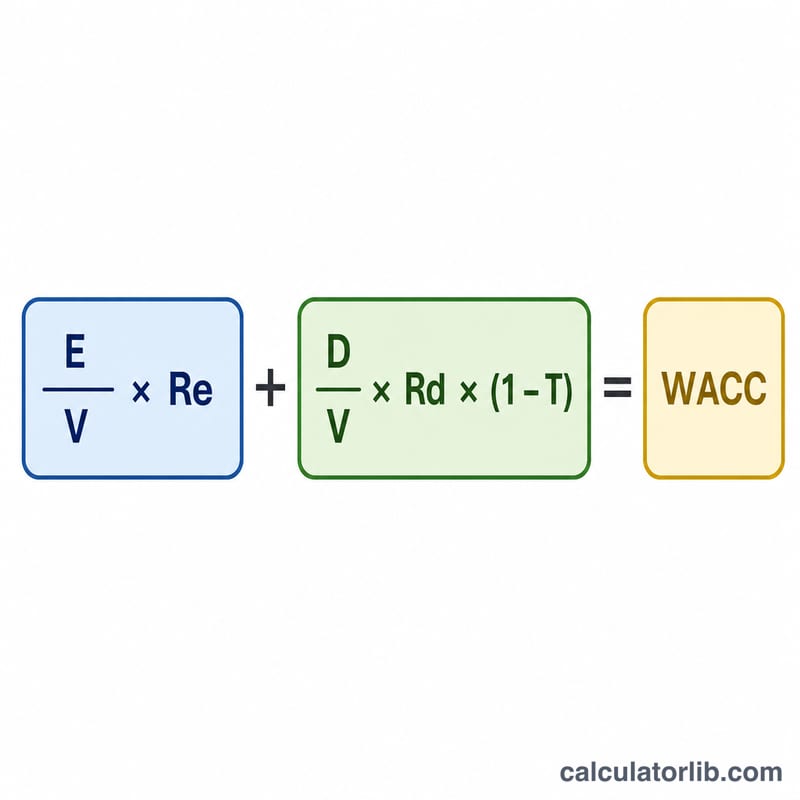
$$\text{WACC} = \left(\frac{E}{V}\times R_e\right) + \left(\frac{D}{V}\times R_d \times (1 - T)\right)$$ Here \(V = E + D\) is total capital. The fractions \(E/V\) and \(D/V\) are the weights of equity and debt. The \((1 - T)\) term reflects the tax deductibility of interest payments, which lowers the effective cost of debt — known as the tax shield.
Worked Example
Suppose a firm has equity of $600,000 and debt of $400,000, so \(V = \$1{,}000{,}000\). The cost of equity is 10%, the cost of debt is 6%, and the tax rate is 25%. The equity weight is 0.6 and the debt weight is 0.4. $$\text{WACC} = (0.6 \times 10\%) + (0.4 \times 6\% \times 0.75) = 6\% + 1.8\% = 7.8\%$$
FAQ
Should I use market or book values? Market values of equity and debt are preferred because they reflect current investor expectations and opportunity cost.
Why is debt multiplied by (1 − Tax)? Interest expense is tax-deductible, so debt effectively costs less than its stated rate. This after-tax cost is what enters WACC.
What is a "good" WACC? It varies by industry and risk. Lower WACC generally means cheaper financing, but the meaningful test is whether your returns exceed it.