
What Is Engagement Rate?
Engagement rate is the most widely used metric for measuring how much your audience interacts with your content. Instead of looking at raw like counts — which favor accounts with huge followings — engagement rate normalizes interactions against your audience size, giving a fair percentage you can compare across posts, accounts, and platforms like Instagram, TikTok, Facebook, X, and LinkedIn.
How to Use This Calculator
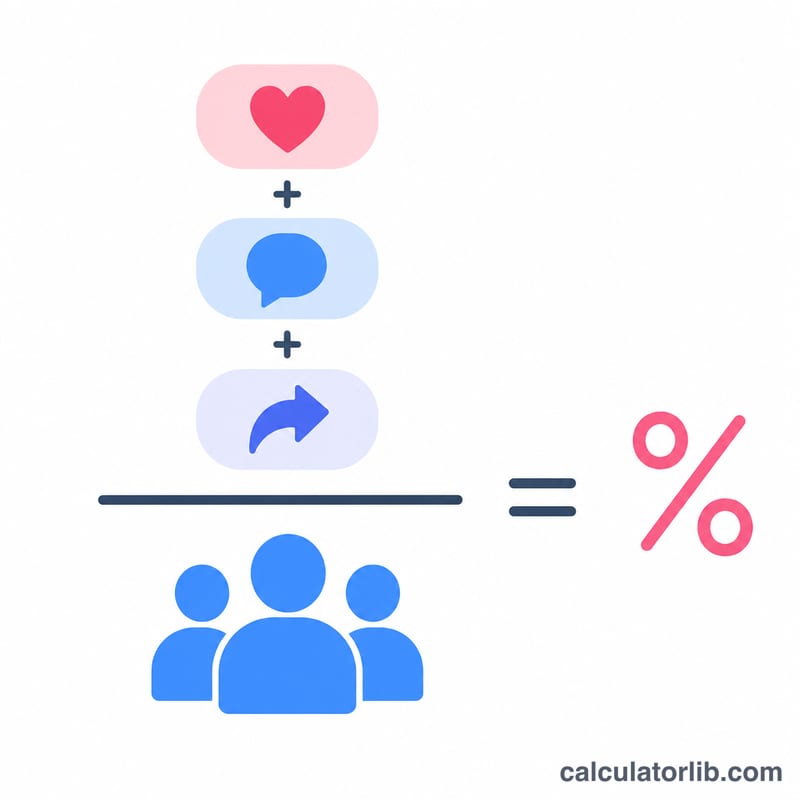
Enter the number of likes, comments, and shares a post received, then enter your total follower count. The calculator adds the three interaction types into total engagements, divides by followers, and multiplies by 100 to give a percentage. Use it per post, or average several posts for a more reliable benchmark.
The Formula Explained
The core equation is
$$\text{Engagement Rate} = \frac{\text{Likes} + \text{Comments} + \text{Shares}}{\text{Followers}} \times 100\%$$The numerator captures every meaningful interaction, while dividing by followers turns it into a per-audience-member figure. Multiplying by 100 converts the decimal into the familiar percentage marketers report.
Worked Example
Suppose a post earned 1,200 likes, 85 comments, and 40 shares from an account with 25,000 followers. Total engagements = \(1{,}200 + 85 + 40 = 1{,}325\). Engagement rate =
$$\frac{1{,}325}{25{,}000} \times 100 = \mathbf{5.3\%}$$That is considered strong, since typical rates range from roughly 1% to 5% depending on platform and niche.
FAQ
What is a good engagement rate? Benchmarks vary, but 1–3% is average, 3–6% is good, and above 6% is excellent for most platforms.
Should I use followers or reach? This tool uses followers, the most common method. If you have reach or impressions data, you can substitute it for a per-view rate.
Why is my rate low with many followers? Larger accounts usually see lower percentage engagement because not every follower sees or interacts with each post.