

What Is TRIR?
The Total Recordable Incident Rate (TRIR) is a key workplace safety metric used widely in the United States under OSHA reporting requirements, and adopted internationally as a benchmark. It expresses the number of OSHA-recordable injuries and illnesses per 100 full-time employees over a one-year period, making it easy to compare safety performance across companies of different sizes.
The Formula
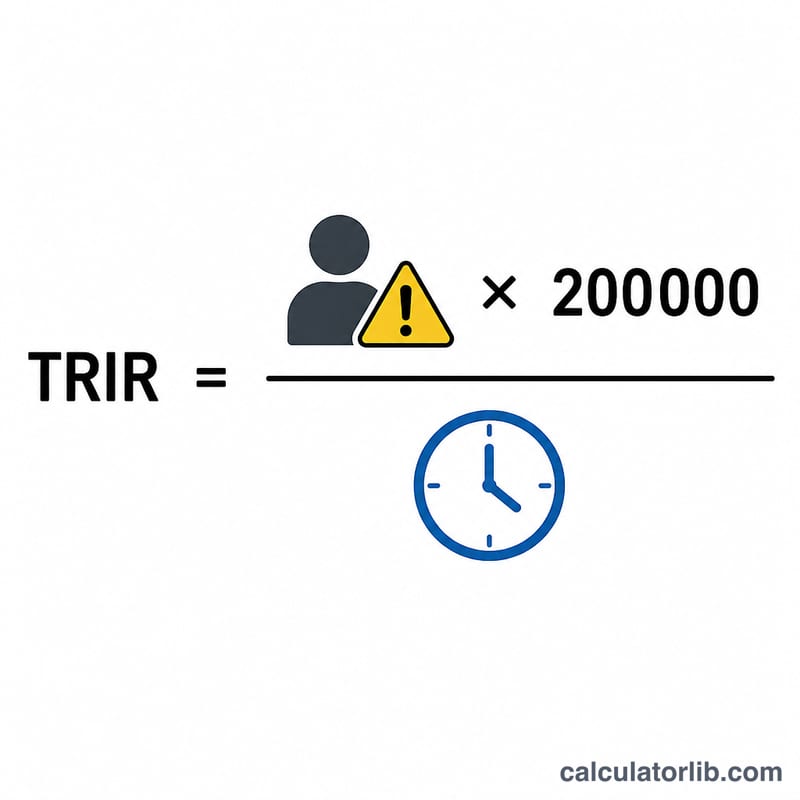
TRIR is calculated as:
$$\text{TRIR} = \frac{\text{Number of Recordable Incidents} \times 200{,}000}{\text{Total Hours Worked}}$$
The constant 200,000 represents the hours 100 employees would work in a year (100 workers × 40 hours × 50 weeks). This normalization lets you compare a small crew to a large workforce on the same scale.
How to Use This Calculator
Enter the total number of OSHA-recordable incidents your organization logged during the period, then enter the total hours worked by all employees in that same period. The calculator instantly returns your TRIR. A lower number is better; many industries target a TRIR below 3.0, and world-class programs aim under 1.0.
Worked Example
Suppose a company recorded 5 recordable incidents and its employees worked a combined 1,000,000 hours in the year. $$\text{TRIR} = \frac{5 \times 200{,}000}{1{,}000{,}000} = \frac{1{,}000{,}000}{1{,}000{,}000} = \mathbf{1.0}$$ This means roughly one recordable incident per 100 full-time workers.
FAQ
What counts as a recordable incident? Under OSHA, a recordable incident is a work-related injury or illness resulting in death, days away from work, restricted duty, medical treatment beyond first aid, or loss of consciousness.
Is a good TRIR the same in every industry? No. Acceptable TRIR varies by sector; construction and manufacturing typically have higher averages than office-based industries. Compare against your specific NAICS industry benchmark.
Why 200,000 hours? It standardizes the rate to 100 full-time-equivalent employees working a full year, so companies of any size can be compared fairly.