

What It Does
The Annual Salary per Hour Calculator converts a yearly salary into an equivalent hourly wage. This is useful for comparing salaried jobs against hourly positions, evaluating contract or freelance rates, and understanding the real value of your time. By accounting for how many hours you actually work each week and how many weeks you work each year, it gives a more accurate hourly figure than a fixed assumption.
How to Use It
Enter your gross annual salary, the number of hours you work per week, and the number of weeks you work per year. A standard full-time year is often assumed to be 40 hours per week for 52 weeks (2,080 hours). If you take unpaid leave, reduce the weeks accordingly. Click calculate to see your hourly rate along with the total hours you work each year.
The Formula Explained
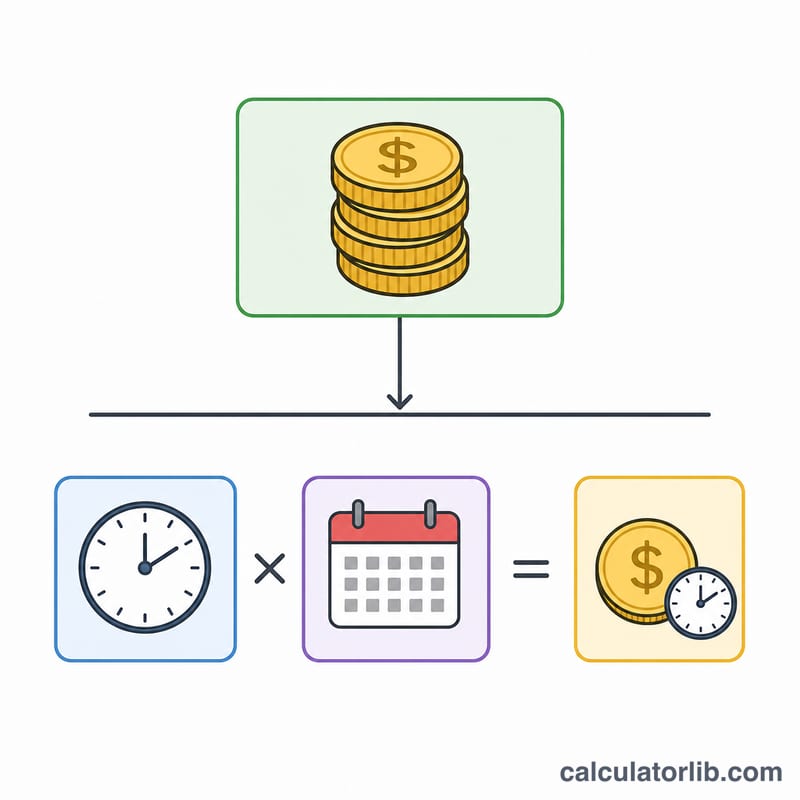
The calculation is straightforward: $$\text{Hourly Rate} = \frac{\text{Annual Salary}}{\text{Hours per Week} \times \text{Weeks per Year}}$$. The denominator gives the total number of hours you work in a year. Dividing your salary by that total spreads your pay evenly across every working hour.
Worked Example
Suppose you earn $52,000 a year and work 40 hours per week for 52 weeks. Total hours = \(40 \times 52 = 2{,}080\). Hourly rate = \(52{,}000 \div 2{,}080 = \$25.00\) per hour. If you instead worked only 48 weeks (taking 4 unpaid weeks off), total hours = \(1{,}920\) and your effective rate rises to about $27.08 per hour.
Understanding Your Hourly Rate
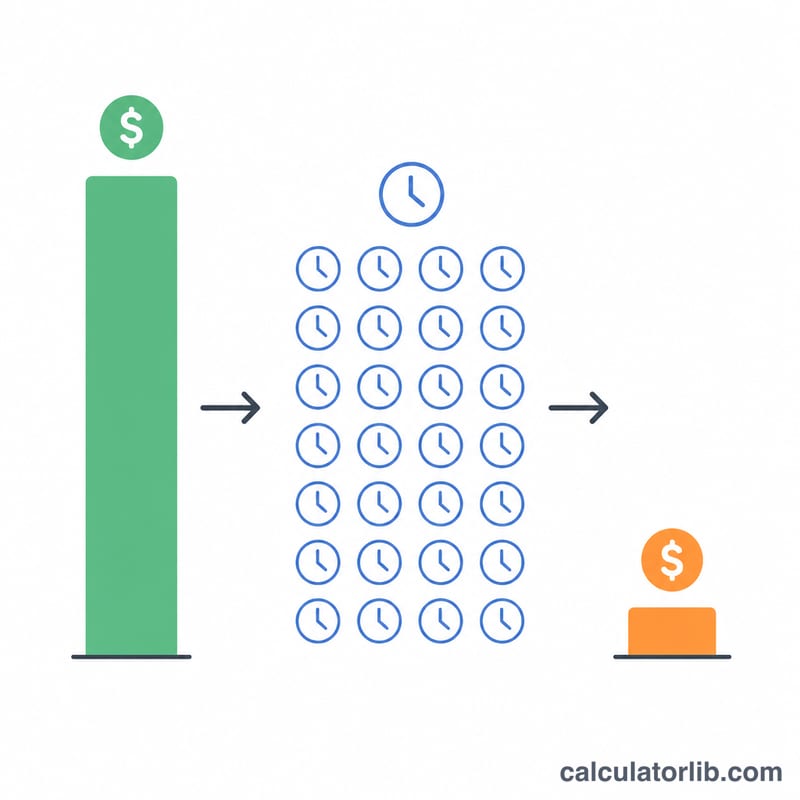
The figure this calculator produces is a pre-tax, straight-line average. It spreads your total annual pay evenly across every hour you expect to work, regardless of when those hours actually fall. It is a useful planning number, but it is not the same as a wage you would be quoted for a job paid by the hour.
The 2,080-hour standard. Full-time work in the United States is conventionally modeled as 40 hours per week for 52 weeks, which equals 2,080 hours per year. Dividing a salary by 2,080 gives the most common "salary-to-hourly" benchmark — for example, a $52,000 salary works out to exactly $25.00 per hour. Many people use this 2,080 shortcut, but it assumes you are effectively paid for all 52 weeks, including any vacation.
Why fewer paid weeks raises the rate. If you enter fewer weeks per year — for instance because you take several weeks of unpaid leave or only work a portion of the year — the same salary is being earned over fewer hours, so each hour is worth more. A $52,000 salary spread over 48 weeks instead of 52 produces a higher effective rate because the denominator (total hours) is smaller. This is why a salaried worker with generous paid time off has a higher true value per hour actually worked than the simple 2,080 calculation suggests.
What this number leaves out. When comparing your computed rate to a quoted hourly wage, remember that the salary-based figure excludes several things:
- Benefits such as health insurance, retirement contributions, and paid leave, which add real value that an hourly wage may not include.
- Overtime premiums — salaried exempt employees generally do not earn extra for hours beyond 40, whereas non-exempt hourly workers earn at least 1.5× their rate. If you work overtime, see a double-time and overtime pay calculator.
- Taxes — this is gross (pre-tax) pay. Your take-home rate is lower after income tax, Social Security, and Medicare. To estimate net pay, try a monthly take-home pay calculator.
Use the result as an apples-to-apples reference point for comparing offers and budgeting, but adjust for benefits, overtime, and taxes before treating it as your real earning power per hour.
FAQ
Should I use gross or net salary? Use your gross (pre-tax) annual salary for a comparable hourly rate, since hourly wages are also quoted before tax.
What weeks per year should I enter? Use 52 for a simple full-year estimate, or subtract any unpaid weeks off to reflect your actual working time.
Does this include overtime? No. This gives a straight-line average hourly rate based on your regular hours and does not factor in overtime premiums.