

What Is the Biweekly to Annual Salary Calculator?
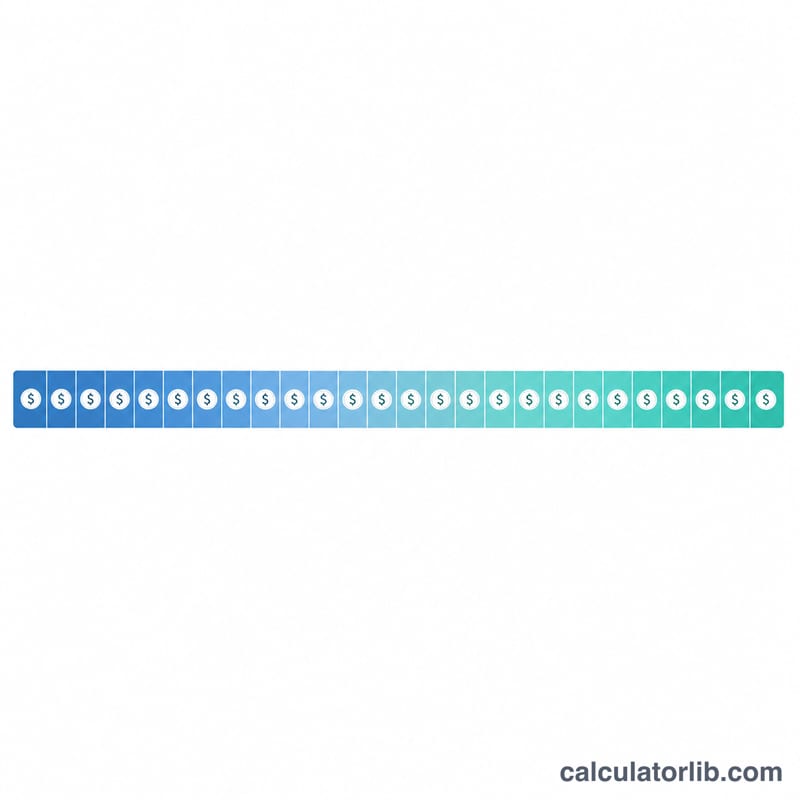
If you're paid every two weeks, this calculator turns a single biweekly paycheck into a full-year salary figure. Because there are 52 weeks in a year and a biweekly schedule pays once every two weeks, you receive 26 paychecks per year. Multiplying your biweekly pay by 26 gives your gross annual salary. This is useful for budgeting, loan applications, salary comparisons, and verifying job offers.
How to Use It
Enter the gross amount of one biweekly paycheck (before taxes and deductions) into the field and submit. The calculator returns your annual salary along with your equivalent weekly pay and average monthly income. Use gross pay for salary comparisons; if you enter net (take-home) pay, the results reflect take-home instead.
The Formula Explained
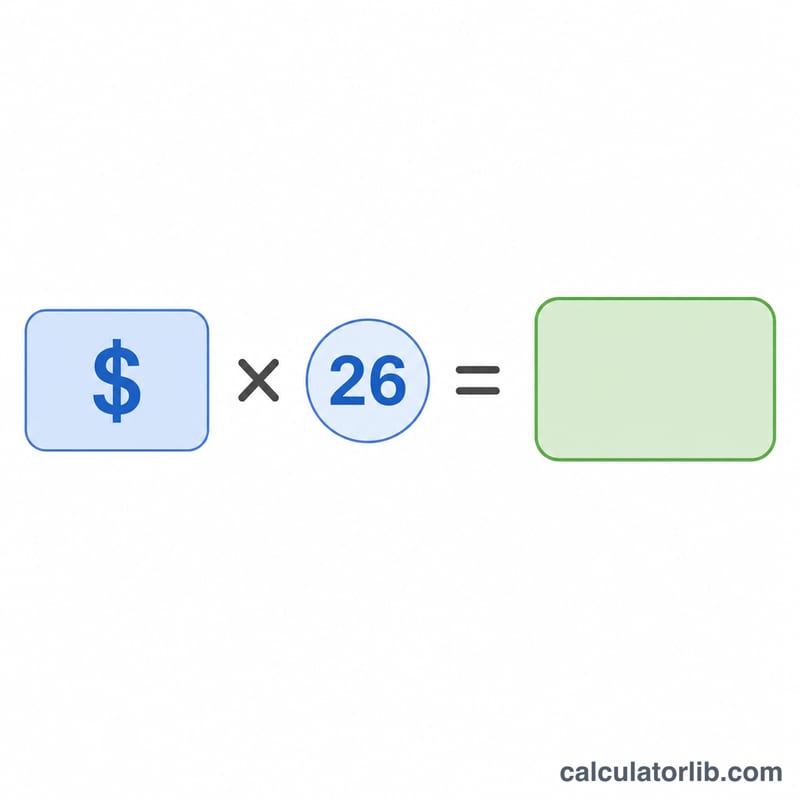
The core equation is simply \(\text{Annual Salary} = \text{Biweekly Pay} \times 26\).
$$\text{Annual Salary} = \text{Biweekly Pay} \times 26$$A biweekly schedule means a payment every 14 days, and \(365 \div 14 \approx 26.07\), which rounds to 26 standard pay periods. The calculator also derives weekly pay (biweekly \(\div\) 2) and average monthly pay (annual \(\div\) 12).
Worked Example
Suppose you earn $2,000 per biweekly paycheck. Your annual salary is
$$\$2{,}000 \times 26 = \$52{,}000$$Your weekly pay is $1,000, and your average monthly income is \(\$52{,}000 \div 12 \approx \$4{,}333.33\).
FAQ
Why 26 and not 24? Biweekly means every two weeks (26 paychecks), while semi-monthly means twice a month (24 paychecks). Be sure you're on a biweekly schedule.
What about the occasional 27-paycheck year? Because 26 pay periods slightly under-count a calendar year, some years contain 27 biweekly paychecks. This calculator uses the standard 26 for typical annualized estimates.
Is this gross or net? The result matches whatever you entered. For salary comparisons, enter gross (pre-tax) pay.