

What Is the Job Offer Comparison Calculator?
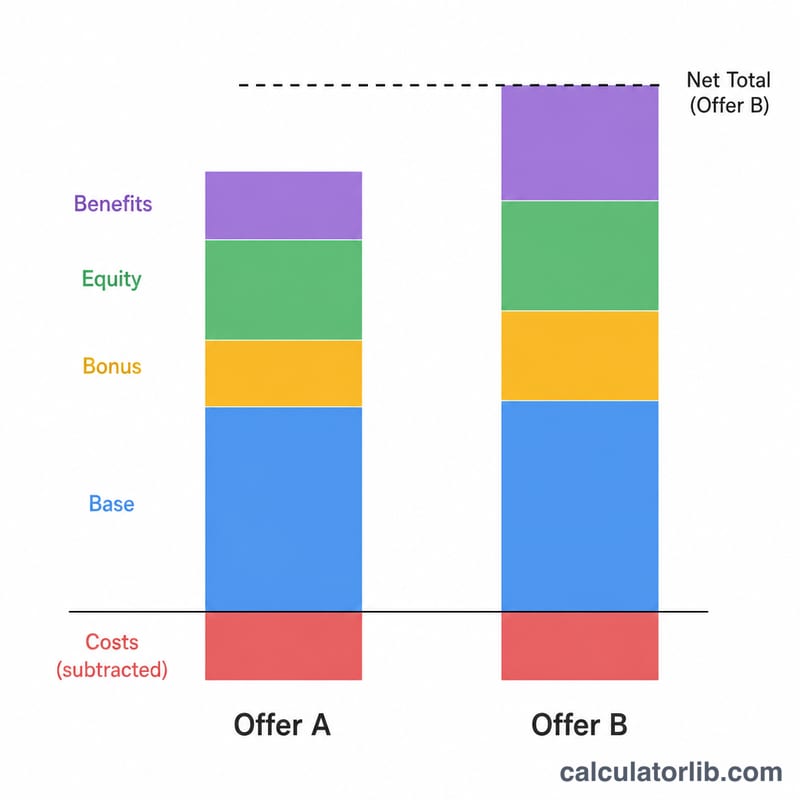
When you receive a job offer, the headline base salary rarely tells the whole story. Bonuses, equity grants, employer-paid benefits, and hidden costs like a longer commute can swing the real value of an offer by tens of thousands per year. This calculator rolls every component into a single, comparable number — your total annual compensation — so you can line up competing offers side by side and decide objectively.
How to Use It
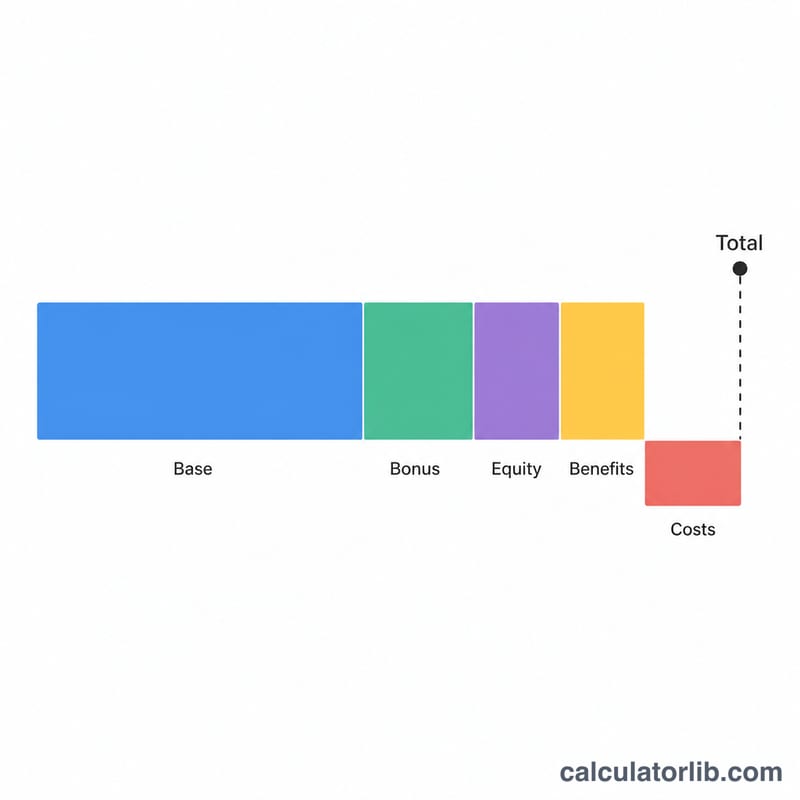
Enter the annual figures for each field: your base salary, expected annual bonus, the yearly value of equity (for example, a 4-year grant divided by four), the dollar value of benefits such as employer 401(k) match and health premiums, and any extra annual costs the job creates. The calculator adds the income components and subtracts the costs to show the offer's effective yearly value. Run it once per offer and compare the totals.
The Formula Explained
The math is a simple net sum: $$\text{Total} = \text{Base} + \text{Bonus} + \text{Equity} + \text{Benefits} - \text{Costs}$$ Income items add to the total, while costs reduce it. Annualizing equity and benefits keeps everything on a per-year basis so two offers with very different structures become directly comparable.
Worked Example
Suppose an offer has a $90,000 base, a $10,000 bonus, $20,000 of equity per year, $8,000 in benefits, and $5,000 in commuting and relocation costs. The total is $$90{,}000 + 10{,}000 + 20{,}000 + 8{,}000 - 5{,}000 = 123{,}000$$ per year. A second offer with a higher base but no equity and bigger costs might come out lower — exactly the kind of insight this tool surfaces.
FAQ
How do I value equity? Divide the total grant by its vesting period (e.g. a $80,000 grant over 4 years is $20,000/year), and consider whether you believe the share price.
What counts as benefits? Employer retirement match, health/dental premiums the company pays, free meals, transit subsidies, and similar perks with a dollar value.
Should I subtract taxes? This tool compares pre-tax compensation. For an after-tax comparison, reduce each component by your expected marginal tax rate before entering it.