
What Is the Loan Term Calculator?
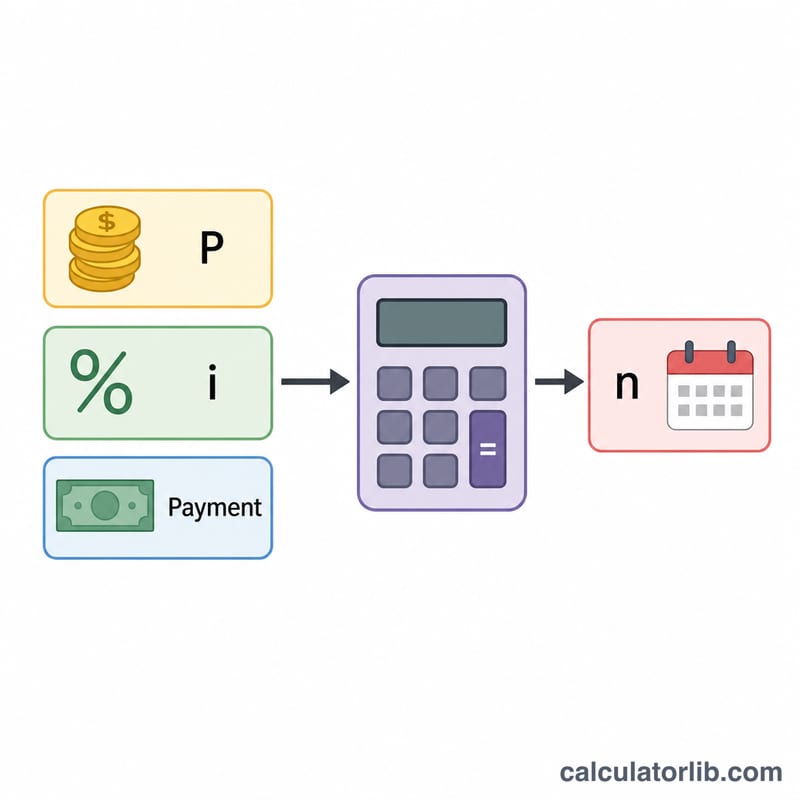
The Loan Term Calculator tells you how long it will take to pay off a loan based on three things: the amount you borrowed, the annual interest rate, and the fixed monthly payment you make. Instead of asking "what is my payment?", this tool flips the standard amortization formula to answer "how many months until I'm debt-free?". It works for personal loans, auto loans, mortgages, student loans, and credit card balances.
How to Use It
Enter the loan amount (principal), the annual interest rate as a percentage, and the monthly payment you intend to make. The calculator returns the number of months and years to repay, plus the total amount paid and total interest over the life of the loan. If your payment is smaller than the monthly interest charge, the loan can never be repaid and the tool will warn you to raise the payment.
The Formula Explained
The term is derived from the amortization equation by solving for the number of periods \(n\):
$$n = \dfrac{-\ln\!\left(1 - \dfrac{P \cdot i}{\text{Payment}}\right)}{\ln(1 + i)}$$, where \(i\) is the monthly interest rate equal to the annual rate divided by 12, and \(P\) is the principal. When the interest rate is zero, the term simplifies to \(\text{principal} \div \text{payment}\).
Worked Example
Suppose you borrow $20,000 at 6% annual interest and pay $400 per month. The monthly rate is \(i = 0.06 \div 12 = 0.005\). Then $$n = \frac{-\ln(1 - (20000 \times 0.005) / 400)}{\ln(1.005)} = \frac{-\ln(1 - 0.25)}{\ln(1.005)} = \frac{-\ln(0.75)}{0.0049875} \approx \frac{0.287682}{0.0049875} \approx 57.68 \text{ months}$$, or about 4.8 years. Total paid \(\approx \$23{,}073\) and total interest \(\approx \$3{,}073\).
FAQ
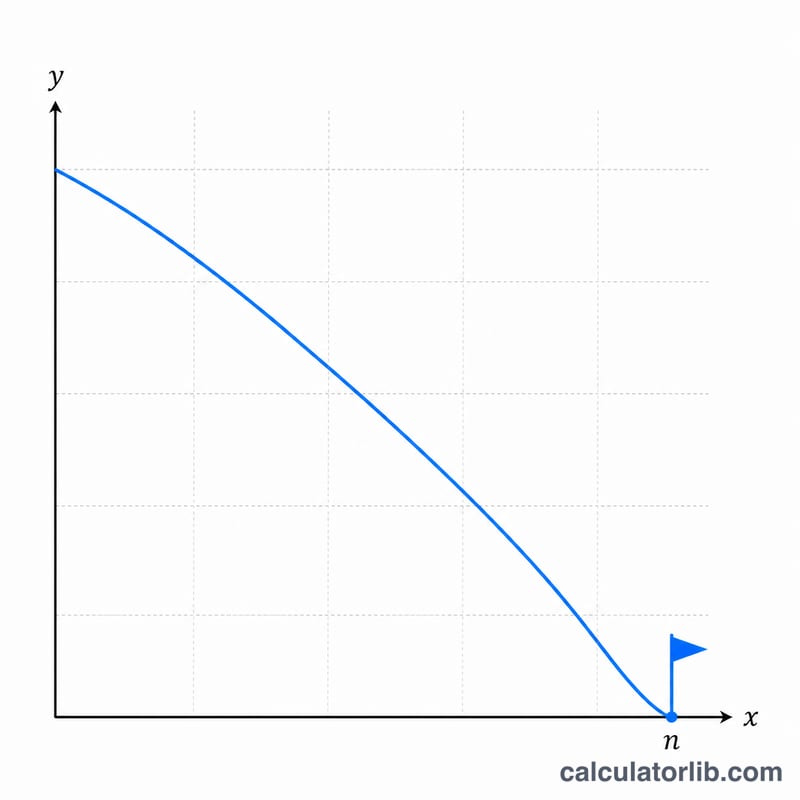
Why does my payment have to exceed the interest? If your monthly payment only covers (or doesn't cover) the interest accruing each month, the principal never shrinks, so the loan would last forever.
Does paying more shorten the term? Yes. Even small increases in the monthly payment significantly reduce the number of months and the total interest paid.
Is the answer exact? The formula gives a precise mathematical term; real loans round to whole payments, so your final payment may be slightly smaller than the others.