
What Is APR?
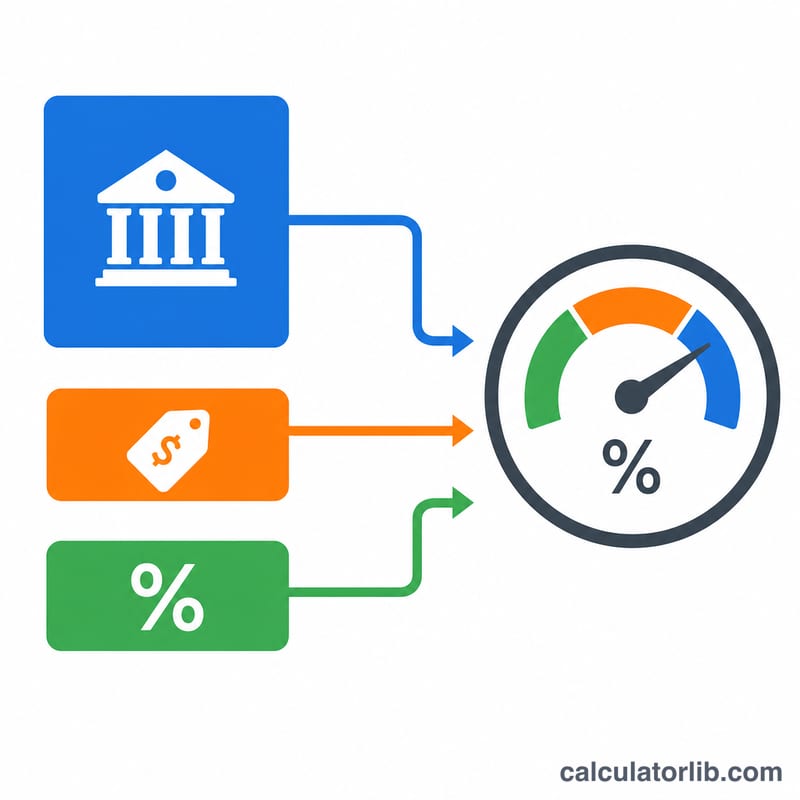
The Annual Percentage Rate (APR) is a single yearly figure that captures the true cost of borrowing. Unlike the headline interest rate, APR also accounts for upfront fees such as origination charges, processing fees, and points. Because it combines both interest and fees, APR lets you compare loans on an apples-to-apples basis, even when one lender advertises a low rate but stacks on heavy fees.
How to Use This Calculator
Enter the loan amount (principal), the stated annual interest rate, the loan term in years, and the total upfront fees. The calculator estimates total interest over the life of the loan, adds your fees to produce the total finance charge, and expresses that charge as an annualized percentage of the principal.
Note: this tool uses a simplified add-on model, which spreads cost evenly across the term. It is great for quick comparisons but is not the exact actuarial APR that regulators require for amortizing loans — that calculation solves for the rate iteratively.
The Formula Explained
APR ≈ [(Fees + Total Interest) / Principal] / Term × 100. First we compute total interest as \(\text{Principal} \times \text{Rate} \times \text{Term}\). We add the fees, divide by the principal to get the total cost ratio, then divide by the number of years and multiply by 100 to annualize it into a percentage.
$$\text{APR} = \frac{\text{Fees} + \text{Loan} \times \frac{\text{Rate}}{100} \times \text{Term}}{\text{Loan} \times \text{Term}} \times 100$$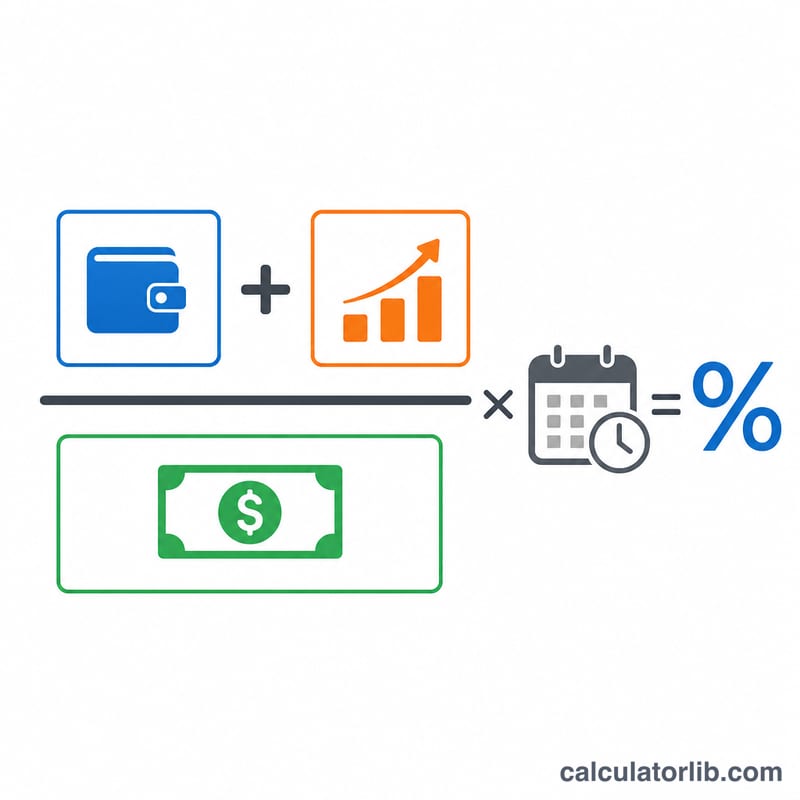
Worked Example
Borrow $10,000 at 8% for 5 years with $300 in fees. Total interest = \(10{,}000 \times 0.08 \times 5 = \$4{,}000\). Adding the $300 fee gives a finance charge of $4,300. Dividing by principal: \(4{,}300 / 10{,}000 = 0.43\). Dividing by 5 years and multiplying by 100 gives an estimated APR of 8.6% — higher than the 8% stated rate because of the fees.
$$\text{APR} = \frac{300 + 10{,}000 \times \frac{8}{100} \times 5}{10{,}000 \times 5} \times 100 = 8.6\%$$Interpreting Your APR Result
Your APR result will normally be higher than the stated (nominal) interest rate. That gap exists because the APR accounts for upfront fees — origination charges, points, and similar costs — that the stated rate ignores. If there were no fees at all, this simplified APR would equal the stated rate.
The size of the gap is the key signal:
- Small APR-vs-rate gap (a fraction of a percent): light upfront costs, or fees spread over a long term.
- Large APR-vs-rate gap (a point or more): heavy upfront fees relative to the amount borrowed, or a short term that concentrates those fees into fewer years.
Because APR rolls fees into the annual figure, it is the more honest basis for comparing two loan offers than the headline rate alone — a loan with a lower stated rate but high fees can carry a higher APR than a loan with a higher stated rate and no fees.
One important caveat: this calculator uses a simplified add-on method, which assumes the full principal is outstanding for the entire term. For a loan you pay down over time (an amortizing loan), the average outstanding balance is lower, so the regulated actuarial APR required under truth-in-lending rules is computed differently and will generally differ from — and often be higher than — this add-on estimate. Treat this result as a quick comparison and screening tool, not as the official APR a lender must disclose.
This is general educational information, not personalized financial advice. Consult the lender's official disclosure documents and a qualified professional before making borrowing decisions.
Key Terms & Definitions
- APR (Annual Percentage Rate)
- The yearly cost of borrowing expressed as a percentage, combining interest and certain fees into a single comparable number. It is designed to make loans easier to compare than the stated rate alone.
- Nominal / Stated Interest Rate
- The headline interest rate quoted on the loan, applied to the principal. It excludes fees, so it understates the true cost of credit whenever fees are charged.
- Principal
- The amount of money actually borrowed — the loan balance on which interest is charged, before fees are added.
- Loan Term
- The length of time over which the loan is repaid, typically expressed in years (or months). A shorter term concentrates fixed fees into fewer periods, raising the APR.
- Origination Fee
- A one-time charge by the lender for processing and setting up the loan, often a percentage of the principal. It is a common component of the fees folded into APR.
- Points
- Upfront fees paid to the lender, each typically equal to 1% of the loan amount, often paid to secure a lower interest rate. Points are part of the finance charge and raise the APR.
- Finance Charge
- The total dollar cost of credit, including interest plus most fees, over the life of the loan. APR is essentially this charge re-expressed as an annualized percentage.
- Add-on APR vs Actuarial APR
- The add-on method (used by this calculator) assumes the full principal stays outstanding the whole term and simply spreads total interest plus fees across the loan — a quick estimate. The actuarial APR, required by truth-in-lending regulations, reflects the declining balance of an amortizing loan and is computed by solving for the rate that equates the loan's payments to its net proceeds; the two figures usually differ.
FAQ
Why is APR higher than the interest rate? Because APR rolls fees into the cost, so any upfront charge pushes the APR above the nominal rate.
Is this the exact APR lenders quote? No. Regulated APR for amortizing loans is found by solving for the rate that equates payments to the net loan amount. This simplified add-on version is for quick estimates and comparisons.
What counts as a fee? Origination fees, points, processing or admin charges paid at closing — generally any required cost beyond pure interest.