
What Is the Required Interest Rate Calculator?
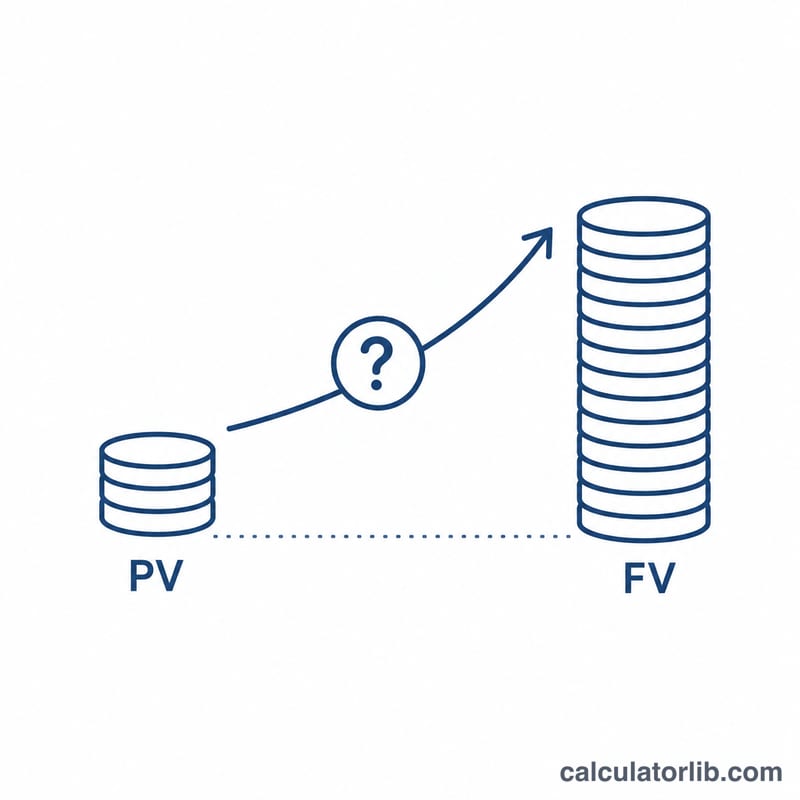
This tool tells you the constant compound interest rate you must earn each period to grow a known present sum (PV) into a desired target amount (FV) over a fixed number of periods (n). It rearranges the standard compound-growth equation to solve for the rate instead of the future value, which is invaluable for goal-based planning.
How to Use It
Enter three values: the money you have today (PV), the amount you want to reach (FV), and how many periods you have to get there (n — typically years, but it can be months or any consistent period). The calculator returns the required rate as a percentage per period, the rate as a decimal, and the total growth multiple FV/PV.
The Formula Explained
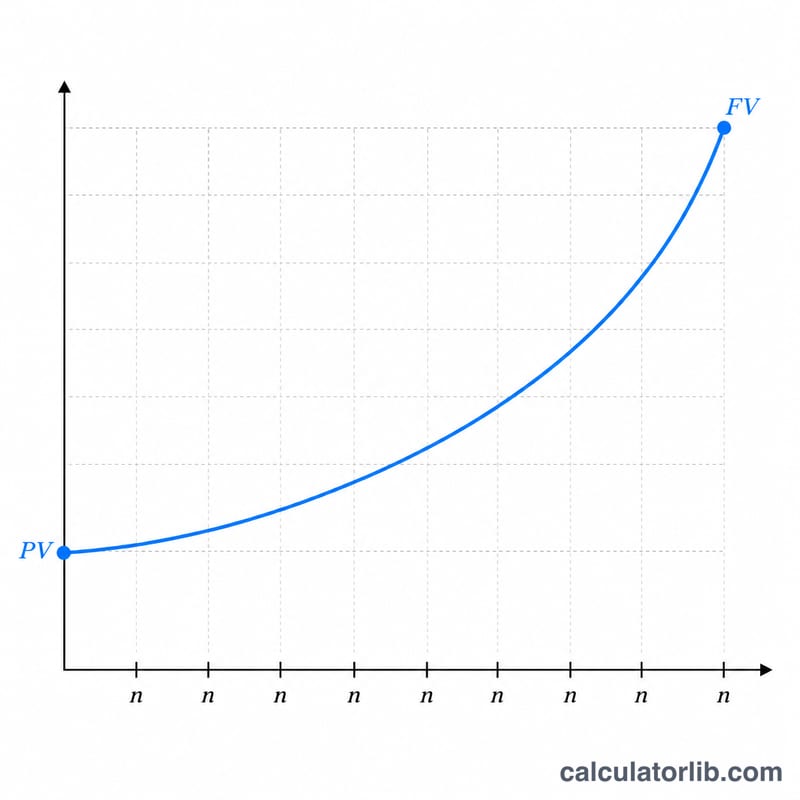
The future value of a lump sum is \(\text{FV} = \text{PV} \times (1 + r)^{n}\). Solving for \(r\) gives
$$r = \left(\frac{\text{FV}}{\text{PV}}\right)^{\frac{1}{n}} - 1$$The ratio \(\text{FV}/\text{PV}\) is the total growth you need; raising it to the power \(1/n\) converts that total growth into a per-period growth factor, and subtracting 1 turns the factor into a rate.
Worked Example
Suppose you have $10,000 and want $20,000 in 10 years. Then \(\text{FV}/\text{PV} = 2\), and
$$r = 2^{\frac{1}{10}} - 1 = 1.071773 - 1 = 0.071773$$or about 7.18% per year. So you would need roughly a 7.18% annual return to double your money in a decade — consistent with the "Rule of 72" (\(72 \div 7.2 \approx 10\)).
FAQ
What if my periods are months? Then the result is a monthly rate. Multiply by 12 for an approximate annual nominal rate, or use \((1+r)^{12}-1\) for the effective annual rate.
Does this account for deposits or contributions? No. This formula is for a single lump sum with no additional cash flows. For recurring contributions you need an annuity-based rate-of-return calculation.
Can the rate be negative? Yes — if your target is lower than your present sum, the required "rate" is negative, indicating a decline.