
What Is the Effective Interest Rate?
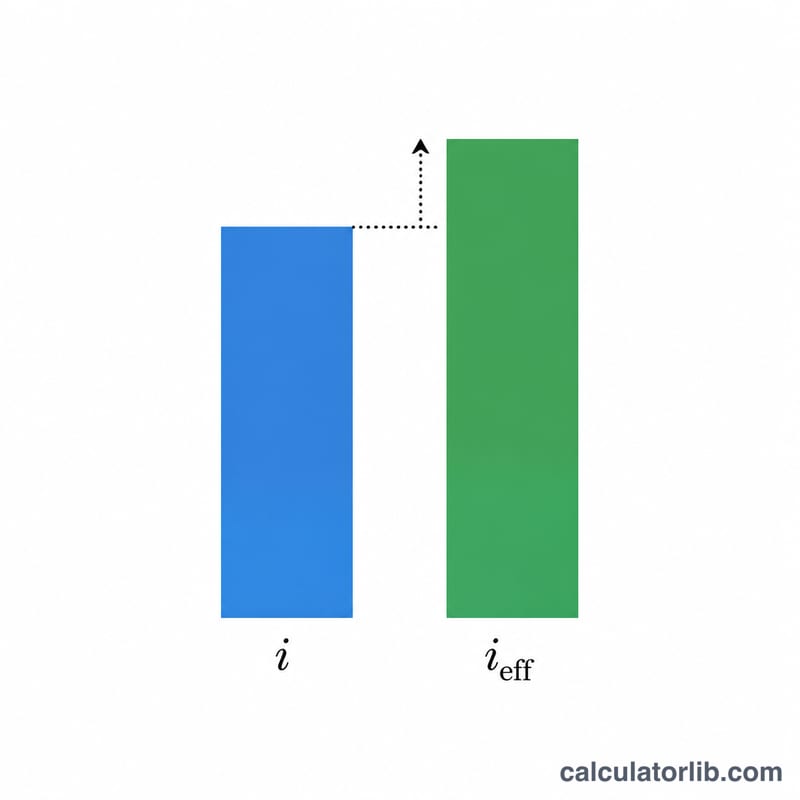
The effective interest rate — also called the effective annual rate (EAR) or annual percentage yield (APY) — is the true annual rate of interest you actually pay or earn once the effect of compounding is taken into account. Two loans or savings accounts can quote the same nominal rate yet behave very differently if one compounds monthly and the other annually. This calculator converts any nominal annual rate into its effective equivalent so you can compare products on a level playing field.
How to Use It
Enter the nominal annual interest rate as a percentage, then choose how often interest compounds (annually, semi-annually, quarterly, monthly, weekly, or daily). The calculator instantly returns the effective annual rate. The more frequently interest compounds, the higher the effective rate climbs above the nominal rate.
The Formula Explained
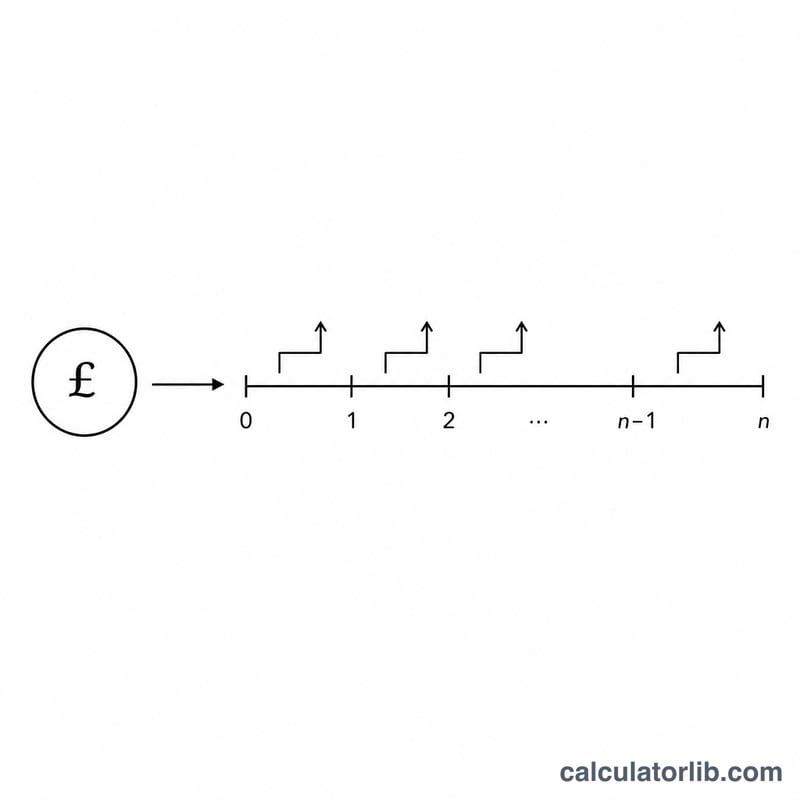
The effective annual rate is computed as $$i_{\text{eff}} = \left(1 + \frac{i}{n}\right)^{n} - 1$$ where \(i\) is the nominal annual rate expressed as a decimal and \(n\) is the number of compounding periods per year. Dividing \(i\) by \(n\) gives the rate per period; raising the growth factor to the power \(n\) compounds it across the whole year; subtracting 1 isolates the interest portion.
Worked Example
Suppose a credit card advertises a 12% nominal annual rate that compounds monthly (\(n = 12\)). Then \(i = 0.12\), and \(i/n = 0.01\). The effective rate is $$\left(1 + 0.01\right)^{12} - 1 = 1.126825 - 1 = 0.126825$$ or about 12.6825%. So the true cost of borrowing is closer to 12.68% per year, not 12%.
FAQ
Is the effective rate always higher than the nominal rate? Yes, whenever there is more than one compounding period per year. With annual compounding (\(n = 1\)), the effective and nominal rates are identical.
What is the difference between APR and APY? APR (annual percentage rate) is typically the nominal rate, while APY (annual percentage yield) reflects compounding and equals the effective rate calculated here.
What happens with continuous compounding? As \(n\) grows toward infinity, the effective rate approaches \(e^{i} - 1\), a slightly higher limit than daily compounding.