
What Is Elastic Potential Energy?
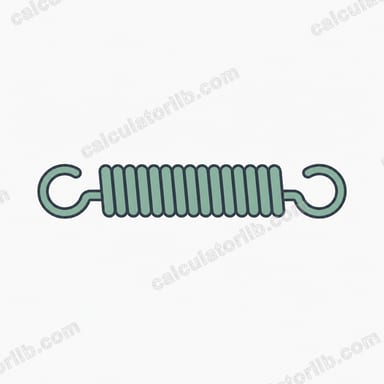
Elastic potential energy is the energy stored in an elastic object — such as a spring, rubber band, or bungee cord — when it is stretched or compressed from its natural length. As long as the material obeys Hooke's law, this stored energy can later be released to do work, like launching a projectile or returning a spring to rest. This calculator works for any system that behaves like an ideal spring.
How to Use the Calculator
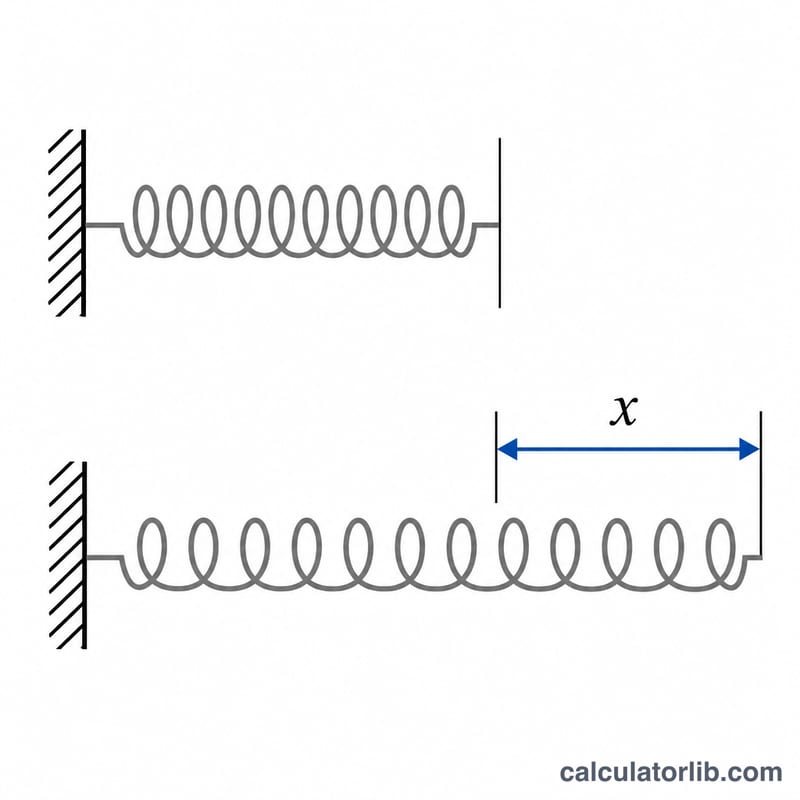
Enter two values: the spring constant k (in newtons per metre, N/m), which measures how stiff the spring is, and the displacement x (in metres, m), which is how far the spring is stretched or compressed from equilibrium. The calculator returns the stored elastic potential energy in joules (J).
The Formula Explained
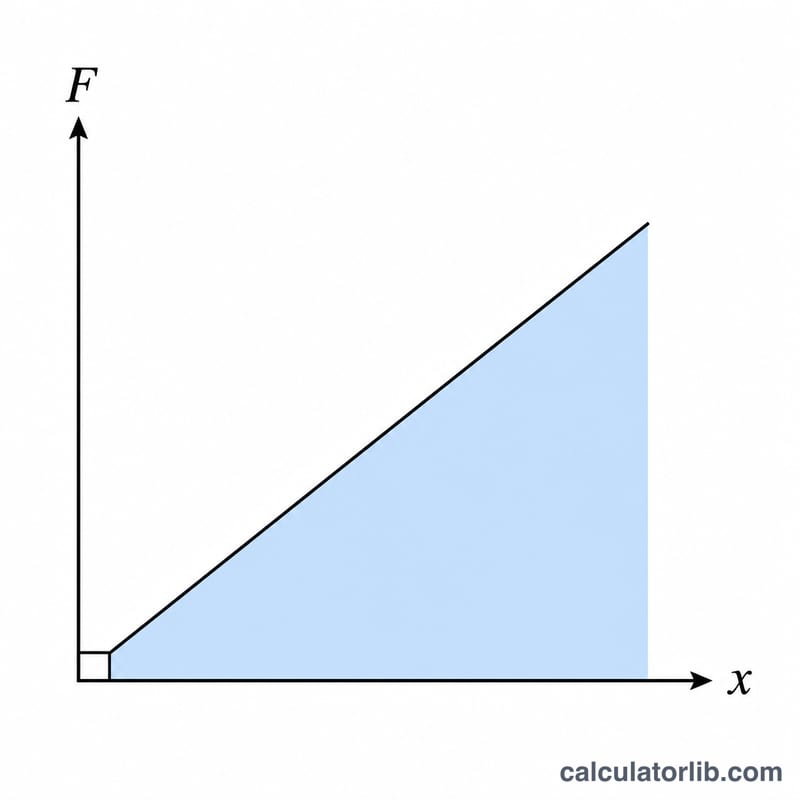
The equation is $$PE = \frac{1}{2} \times k \times x^2$$ The factor of one-half arises because the restoring force grows linearly from zero to \(kx\) as the spring is displaced, so the average force over the displacement is \(\frac{1}{2}kx\). Multiplying that average force by the displacement \(x\) gives the work done — and hence the energy stored. Because \(x\) is squared, doubling the displacement quadruples the stored energy.
Worked Example
Suppose a spring with constant \(k = 200 \text{ N/m}\) is compressed by \(x = 0.5 \text{ m}\). Then $$PE = \frac{1}{2} \times 200 \times (0.5)^2 = 0.5 \times 200 \times 0.25 = 25 \text{ joules}$$ That stored energy could, for example, propel a small mass when the spring is released.
FAQ
Does it matter if the spring is stretched or compressed? No. Because \(x\) is squared, the stored energy is the same for equal amounts of stretch or compression.
What units should I use? Use N/m for \(k\) and metres for \(x\) to get energy in joules. Mixing units (e.g. centimetres) will give an incorrect result.
Is this valid for large stretches? Only while Hooke's law holds. Beyond a material's elastic limit the force is no longer linear and the formula no longer applies.