
What Are Equivalent Fractions?
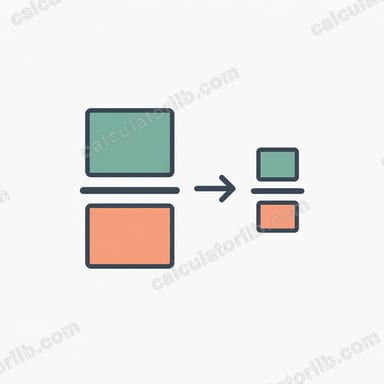
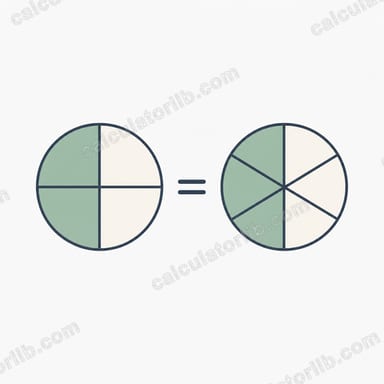
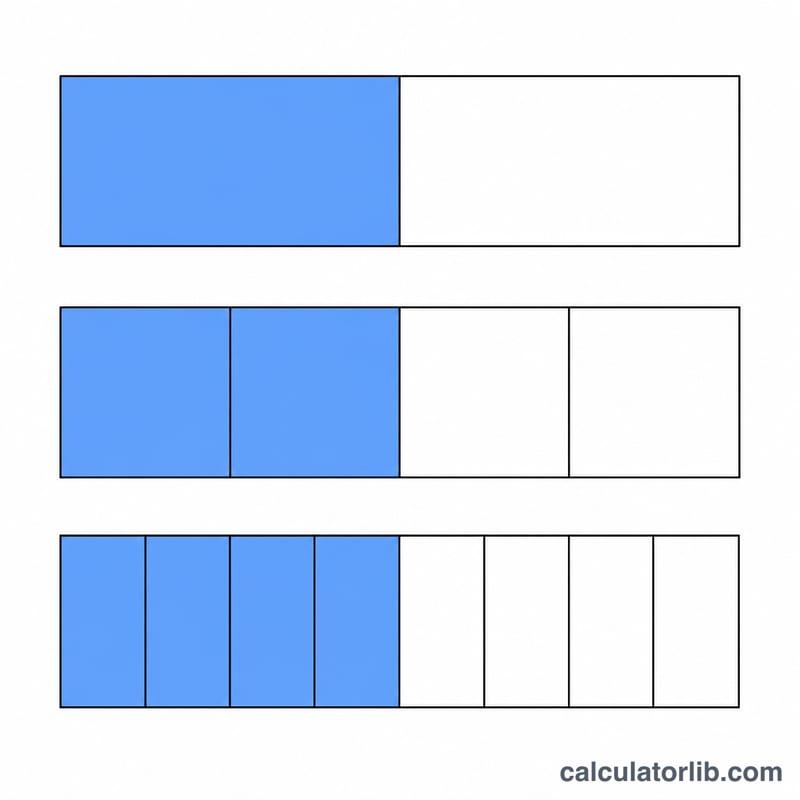
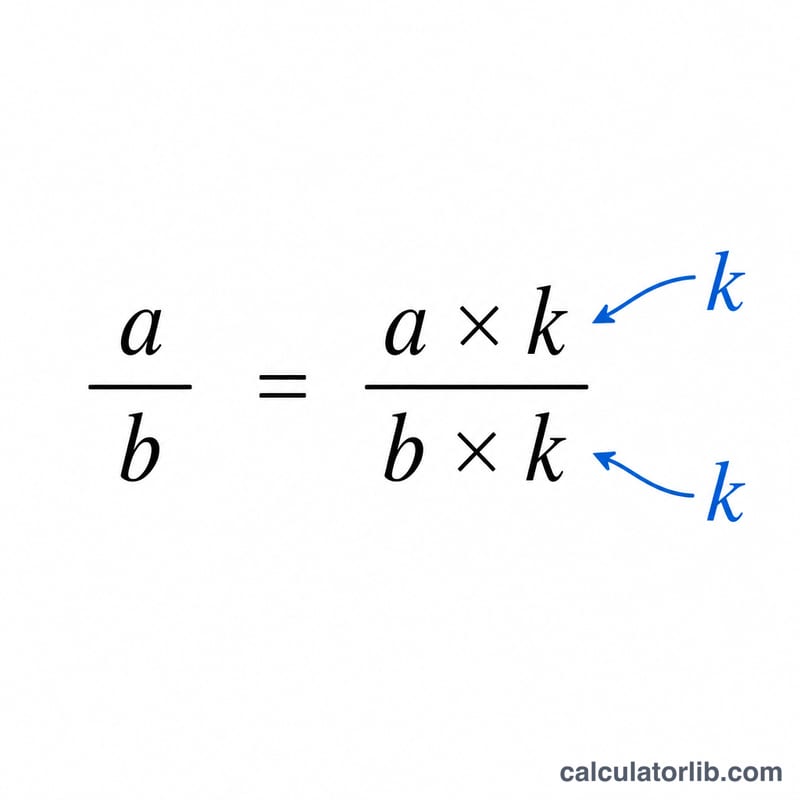
Equivalent fractions are different fractions that represent the same value. For example, 1/2, 2/4, and 3/6 all describe the same portion of a whole. They are created by multiplying (or dividing) both the numerator and the denominator by the same non-zero number, which keeps the ratio unchanged.
How to Use This Calculator
Enter the numerator (top number) and denominator (bottom number) of your fraction, then choose how many equivalent fractions you want to generate. The calculator multiplies both parts by 1, 2, 3, and so on, producing a clean list of equal fractions. It also shows the simplest form by dividing both parts by their greatest common divisor.
The Formula Explained
The core rule is $$\frac{a}{b} = \frac{a \times k}{b \times k}, \quad k = 1, 2, 3, \dots$$ for any positive integer \(k\). Because you multiply the top and bottom by the same factor \(k\), the fraction's overall value stays the same. Setting \(k = 1\) returns the original fraction, \(k = 2\) doubles both parts, and so on.
Worked Example
Take the fraction \(2/3\) and request 4 equivalent fractions. Multiplying by \(k = 1, 2, 3, 4\) gives: $$\frac{2}{3} = \frac{4}{6} = \frac{6}{9} = \frac{8}{12}$$ Each one equals roughly \(0.6667\), confirming they are all equivalent. Since the GCD of 2 and 3 is 1, the simplest form remains \(2/3\).
FAQ
Can equivalent fractions be simplified? Yes — every set of equivalent fractions reduces to one simplest form, found by dividing by the GCD: $$\frac{a}{b} = \frac{a \div \gcd(a,b)}{b \div \gcd(a,b)}$$
Do equivalent fractions have the same decimal value? Yes. Since they represent the same ratio, they convert to the same decimal.
What if my denominator is 0? A denominator of zero is undefined, so make sure the bottom number is not 0.