
What Is an Equivalent Interest Rate?
Two interest rates are equivalent when they produce exactly the same amount of growth over the same period, even though they are compounded at different frequencies. A rate of 6% compounded monthly does not grow money at the same speed as 6% compounded annually — to compare them fairly you must convert one to the other. This calculator restates a nominal annual rate from its original compounding frequency into an equivalent rate on a different (target) frequency.
How to Use It
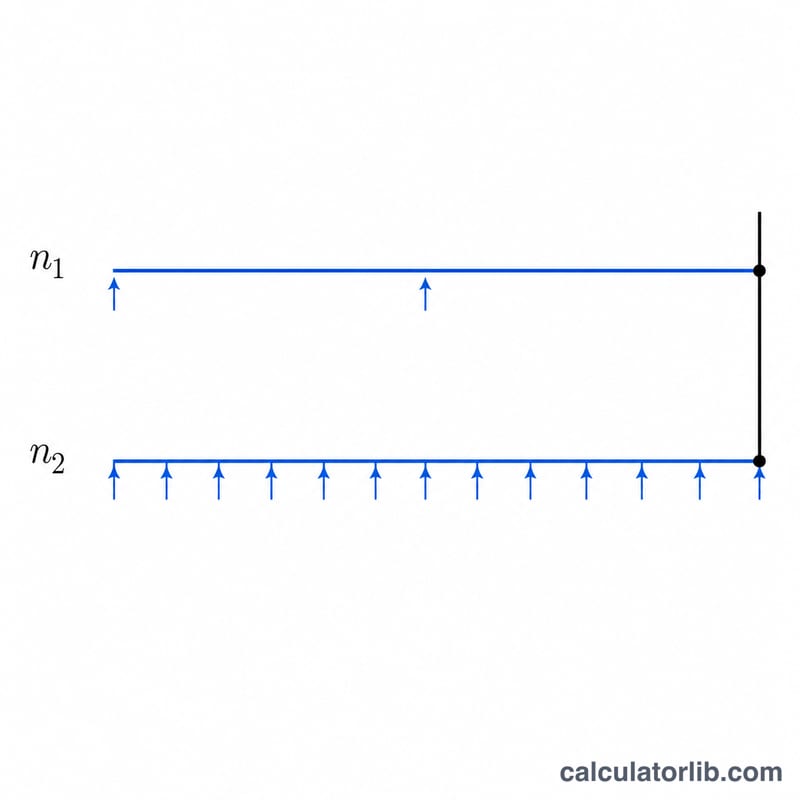
Enter the original nominal annual interest rate as a percentage, the number of times it currently compounds per year (\(n_1\)), and the target number of compounding periods per year (\(n_2\)). For example, monthly = 12, quarterly = 4, semi-annual = 2, and annual = 1. The calculator returns the equivalent rate per target period and the equivalent nominal annual rate.
The Formula Explained
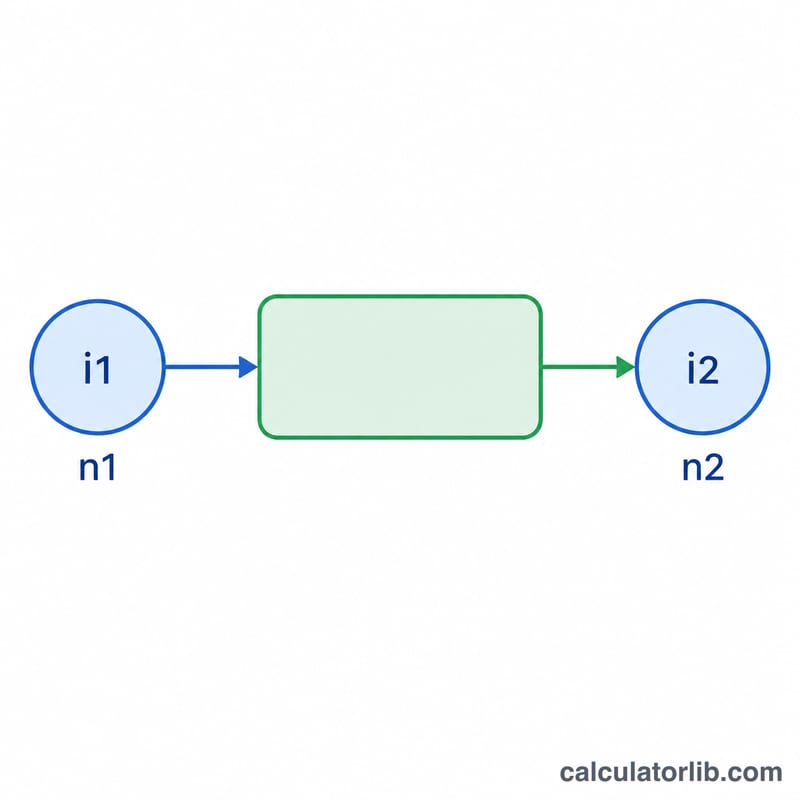
The core equation is $$i_2 = \left(1 + \frac{i_1}{n_1}\right)^{n_1/n_2} - 1$$ Here \(i_1\) is the original nominal annual rate written as a decimal, \(i_1/n_1\) is the rate earned in one original period, and raising it to the power \(n_1/n_2\) stretches that growth to fit one target period. Multiplying \(i_2\) by \(n_2\) converts the per-period figure back into an annual nominal rate.
Worked Example
Suppose a loan quotes 6% compounded monthly (\(i_1 = 0.06\), \(n_1 = 12\)) and you want the equivalent rate compounded annually (\(n_2 = 1\)). The monthly rate is \(0.06/12 = 0.005\). Then $$i_2 = (1.005)^{12/1} - 1 = 1.005^{12} - 1 \approx 0.0616778$$ or about 6.16778% per year. So 6% monthly is equivalent to roughly 6.17% annually.
FAQ
Is this the same as effective annual rate? When the target frequency is annual (\(n_2 = 1\)), the equivalent rate equals the effective annual rate (EAR).
Can \(n_2\) be larger than \(n_1\)? Yes — converting from annual to monthly simply uses an exponent below 1, producing a smaller per-period rate.
Why convert rates at all? Comparing financial products fairly requires putting their rates on the same compounding basis before judging which is cheaper or more profitable.