What This Interest Rate Calculator Does
This Simple Interest Rate Calculator turns a single interest payment into a percentage rate — and then shows you that rate across three time frames: daily, monthly, and annual. Instead of guessing what a charge or earning really costs you over time, you enter two numbers and immediately see how they translate into comparable rates. It works for any currency, since the result is a percentage and not tied to a particular country's regulations.
The Inputs You Enter
- Principal Amount — the base sum the interest is calculated on (for example, the loan balance or amount invested).
- Interest Payment — the actual interest amount paid or earned for one period.
- Payment period — choose Per Day, Per Month, or Per Year to tell the calculator what time span your interest payment covers.
The Formula
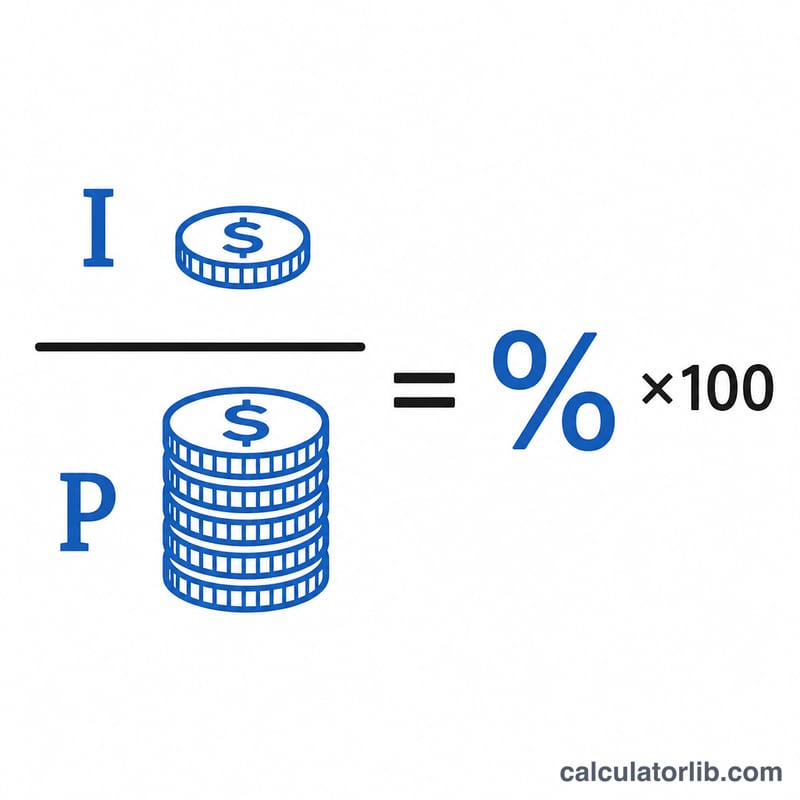
The core calculation is straightforward:
$$\text{Interest Rate} = \frac{\text{Interest Payment}}{\text{Principal Amount}} \times 100$$
This gives the rate for the period you selected. The calculator then converts it to the other periods on a simple basis, treating one month as 30 days and one year as 365 days. So a daily rate is multiplied by 30 to get monthly and by 365 to get annual; a monthly rate is divided by 30 to find the daily figure before scaling up, and an annual rate is divided by 365.
Worked Example
Suppose your Principal Amount is 10,000 and your Interest Payment is 50, selected as Per Month.
- Base monthly rate = \((50 \div 10{,}000) \times 100 = \) 0.5% per month
- Daily rate = \(0.5 \div 30 = \) 0.0167% per day
- Annual rate = \(0.0167 \times 365 = \) 6.083% per year
You instantly see that a modest 50 monthly payment equals roughly a 6.08% simple annual rate.
Frequently Asked Questions
Is this compound or simple interest? It is simple interest. The conversions multiply and divide linearly using 30-day months and 365-day years, so they do not account for compounding.
Why use 30 days and 365 days? These are standard simplifications that keep the period conversions consistent and easy to compare without calendar-specific adjustments.
What if I enter zero or a negative principal? The calculator returns a rate of 0, because dividing by a non-positive principal would not produce a meaningful percentage.