
What is the Equivalent Interest Rate Calculator?
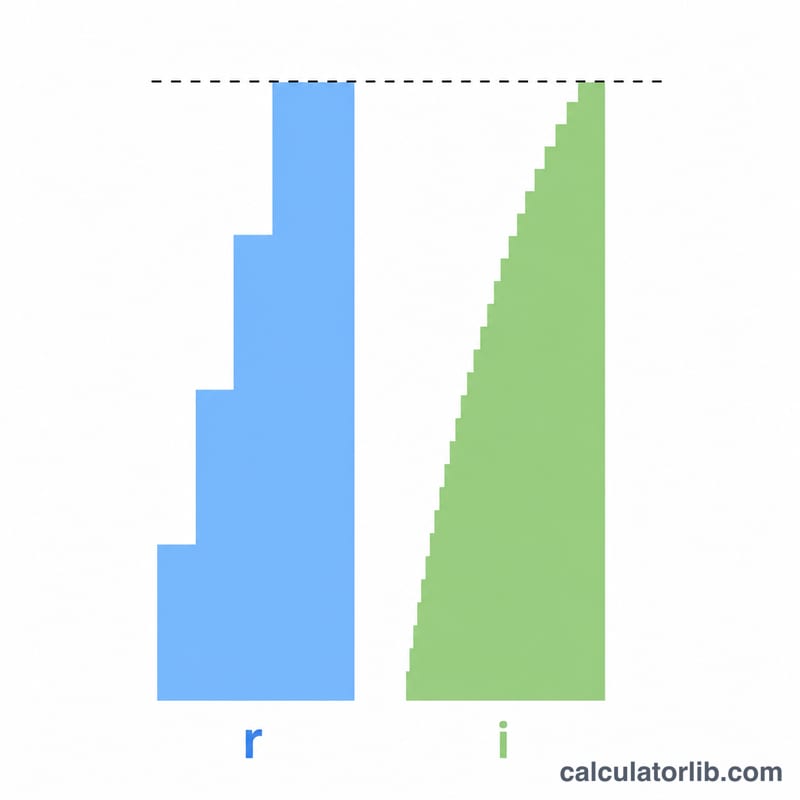
This calculator converts a nominal interest rate from one compounding frequency to another while keeping the underlying effective interest rate exactly the same. If you have a rate quoted as compounded monthly but you need the financially equivalent rate compounded quarterly (or any other frequency), this tool gives you the answer in seconds. It is a universal financial math tool and applies to any country or currency — the "period" is generic and usually represents one year.
How to use it
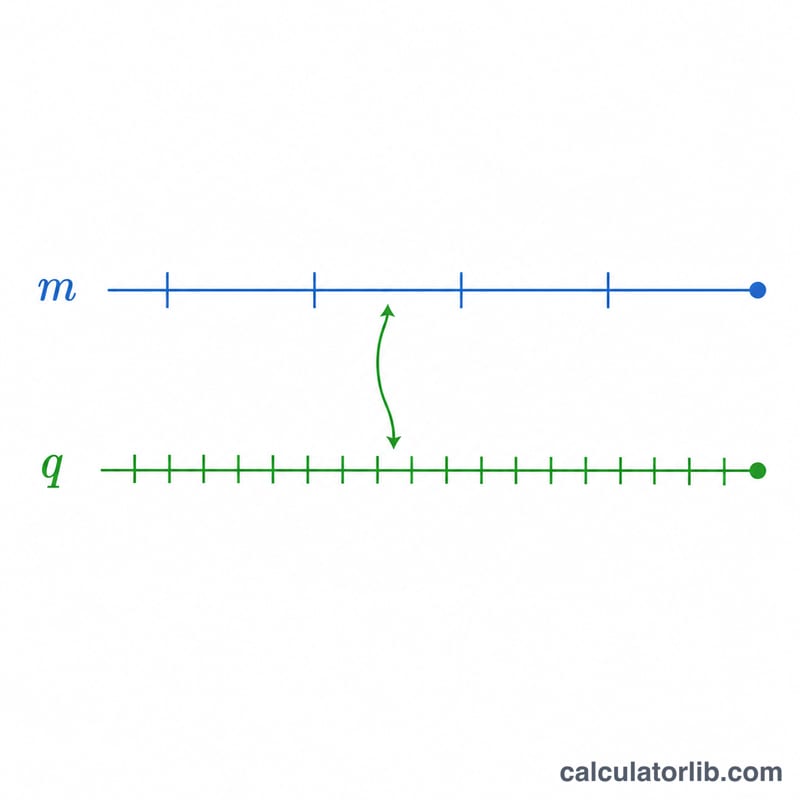
Enter three values: the original nominal Interest Rate (R) as a percentage per period, the number of times that rate is compounded per period (m), and the new number of compounding events per period (q) you want the equivalent rate for. The calculator returns the equivalent nominal rate I, plus both the nominal and effective forms of the original and the converted rate so you can verify the effective rate is preserved.
The formula explained
Let \(r = R / 100\) be the rate as a decimal. The equivalent nominal rate compounded \(q\) times per period is:
$$i = q \left[ \left(1 + \frac{r}{m}\right)^{m/q} - 1 \right]$$ and the displayed \(I = i \times 100\).
The effective rate of any nominal rate \(x\) compounded \(n\) times per period is $$E = \left(1 + \frac{x}{n}\right)^{n} - 1.$$ Because the conversion is built so that \(\left(1 + \frac{i}{q}\right)^{q} = \left(1 + \frac{r}{m}\right)^{m}\), the effective rate is identical for both the original and the converted rate. That equality (\(Re = Ie\)) is the entire purpose of the tool.
Worked example
Suppose \(R = 4\%\), compounded \(m = 12\) times per period, and you want \(q = 4\). Then \(r = 0.04\) and $$i = 4 \left[ \left(1 + \frac{0.04}{12}\right)^{12/4} - 1 \right] = 4 \left[ 1.00333333^{3} - 1 \right] = 0.0401338,$$ so \(I \approx 4.0134\%\). The original effective rate \(Re = (1.00333333^{12} - 1) \times 100 = 4.07415\%\), and the converted effective rate \(Ie\) comes out to the same \(4.07415\%\) — confirming the effective rate is preserved.
FAQ
What if m equals q? The equivalent rate equals the original rate (\(I = R\)), since you are converting to the same compounding frequency.
What "period" should I use? The tool is unit-agnostic. Most people treat the period as one year, so R is the annual nominal rate and m and q count compounding events per year. Any consistent period works.
Why are Re and Ie always equal? The equivalent rate is defined precisely so the two compounding schemes accumulate the same amount over a period; any tiny difference you see is display rounding only.