
What is a Future Value of $1 (FVIF) Table?
A Future Value Interest Factor (FVIF) table is a reference grid that shows how a single dollar grows under compound interest. Each cell holds the factor \(\text{(1 + i)}^n\), where i is the per-period interest rate and n is the number of compounding periods. Because the present value is fixed at $1, the factor itself is the future value: multiply any amount of money by the matching cell to get its future value. This tool is universal — it is pure compound-interest math with no currency, tax, or country-specific rules.
How to use the creator
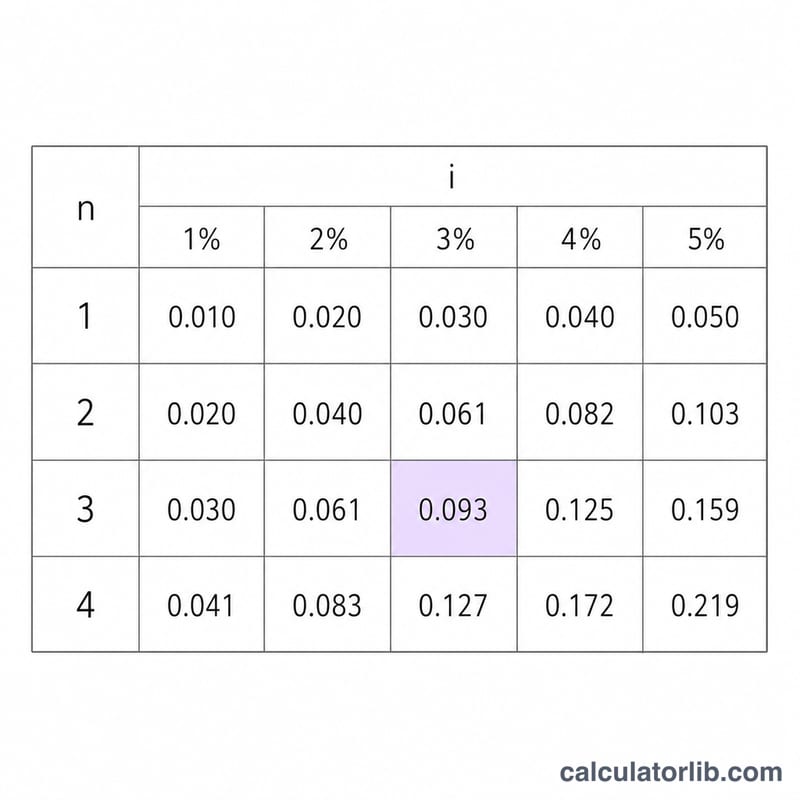
Set the table shape and steps:
- Columns and Starting rate (%) with rate Increments (%) control the interest-rate headers across the top.
- Rows and Starting Period with period Increments control the period counts (n) down the left.
Column k uses a rate of start + k × increment percent; row j uses startPeriod + j × increment periods. Columns are capped at 20 and rows at 50.
The formula explained
The single building block is the compound-growth factor. Convert each header percent to a decimal by dividing by 100 (3% becomes 0.03), then raise (1 + i) to the power n. The result is dimensionless: it tells you how many times bigger $1 becomes.
$$\text{FVIF} = (1 + i)^n$$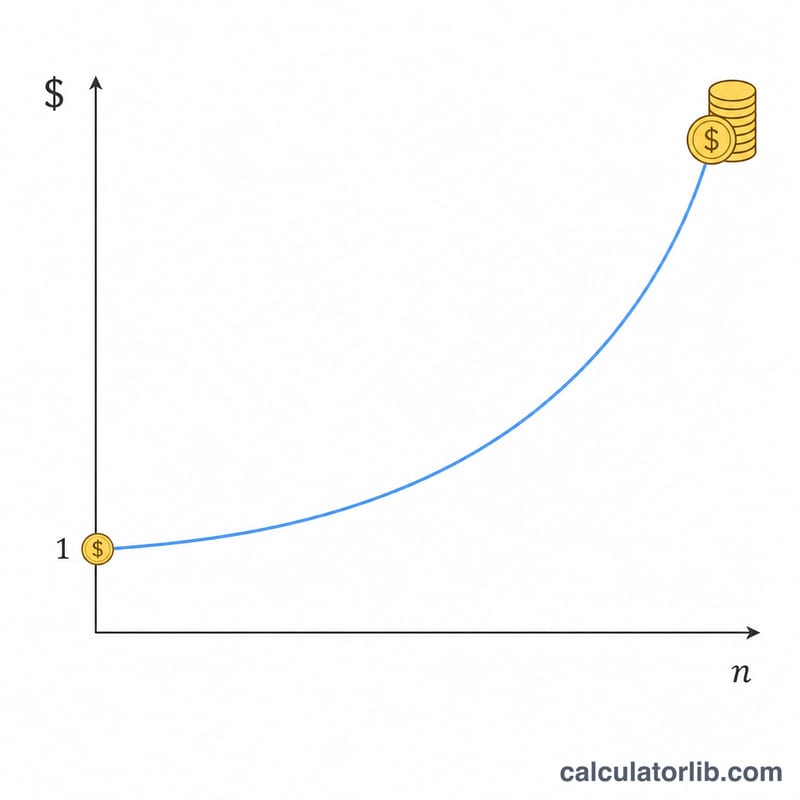
Worked example
Using the defaults (columns=3, starting rate=3%, rate increment=0.25%, rows=10, starting period=10, period increment=1): the columns are 3.00%, 3.25%, and 3.50%. The cell at n=10, i=3.00% is $$(1.03)^{10} = 1.34392.$$ At n=10, i=3.50% it is $$(1.035)^{10} = 1.41060.$$ At n=19, i=3.50% it is $$(1.035)^{19} = 1.92250.$$
FAQ
How do I get a future value of more than $1? Multiply the relevant FVIF cell by your starting amount. For $5,000 at 3% for 10 years: \(5000 \times 1.34392 = \$6{,}719.58\).
What rate do I enter for monthly compounding? Use the per-period rate. For 12% annual compounded monthly, enter 1% and let n count months.
Can the increment be zero? Yes for the rate increment — every column then shares the same rate. The period increment must be at least 1.