
What This Calculator Does
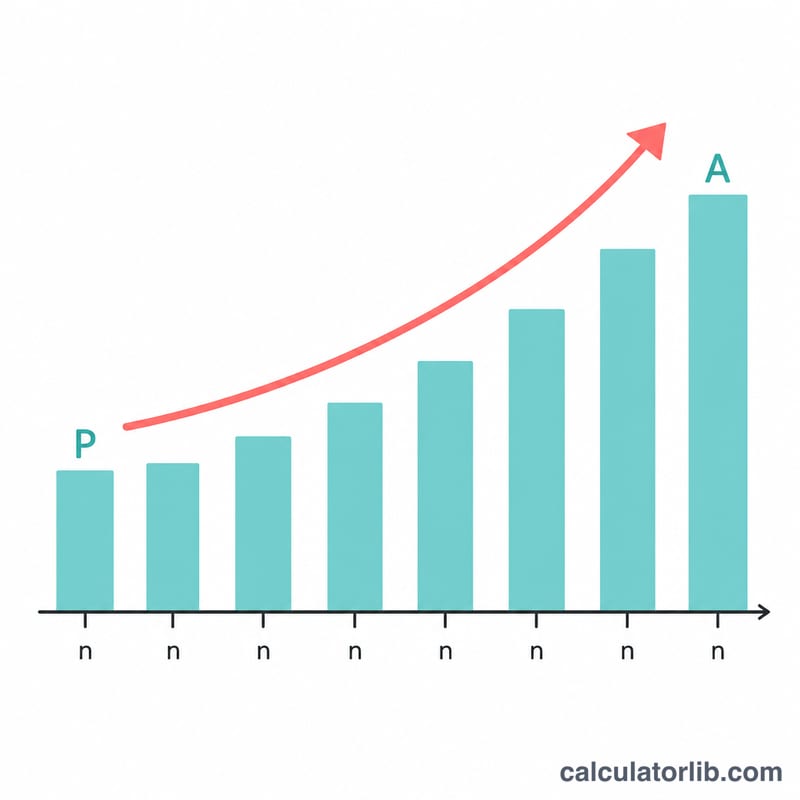
The Implied Interest Rate Calculator works out the constant compound rate of return that grows a starting amount into an ending amount over a given number of periods. It is the reverse of a future value formula: instead of knowing the rate and projecting forward, you already know where you started and where you finished, and you want to know the rate that connects them. This is the same idea as a CAGR (Compound Annual Growth Rate) when your periods are measured in years.
How to Use It
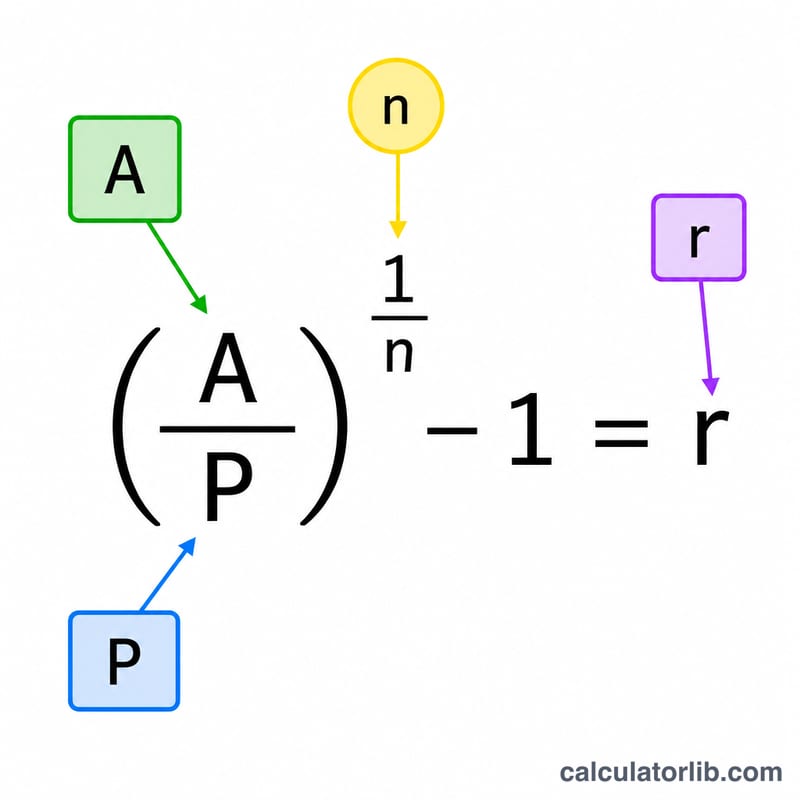
Enter the start value (P) — your initial investment, deposit, or beginning balance. Enter the end value (A) — the final amount after growth. Enter the number of periods (n) — typically years, but it can be months, quarters, or any consistent unit. The result is the implied rate per period, the total growth over the whole span, and the absolute gain.
The Formula Explained
The core equation is $$r = \left( \frac{A}{P} \right)^{\frac{1}{n}} - 1$$ Dividing A by P gives the growth factor over the entire period. Raising it to the power of \(1/n\) "spreads" that growth evenly across each period, and subtracting 1 converts the factor back into a rate. Multiply by 100 to express it as a percentage.
Worked Example
Suppose you invested $1,000 and it became $1,500 after 5 years. The growth factor is \(1{,}500 / 1{,}000 = 1.5\). Raising to the 1/5 power gives \(1.5^{0.2} \approx 1.08447\), so \(r \approx 0.08447\), or about 8.45% per year. Total growth was 50%, and the gain was $500.
FAQ
Is this the same as CAGR? Yes — when the periods are years, the implied rate equals the Compound Annual Growth Rate.
What if the end value is lower than the start? The calculator returns a negative rate, indicating a loss per period.
Can I use months instead of years? Yes. Just set n to the number of months; the resulting rate will be a monthly rate.