
What This Calculator Does
The Hourly Wage Increase Calculator shows your new hourly pay rate after receiving a percentage raise, and translates that change into real weekly and yearly dollars. Instead of guessing what a "5% raise" actually means for your paycheck, you get a clear before-and-after picture so you can budget, compare job offers, or evaluate whether a raise keeps up with the cost of living.
How to Use It
Enter your current hourly rate, the size of the raise as a percentage, and the number of hours you typically work each week. The calculator instantly returns your new hourly rate plus the additional money you'll earn per hour, per week, and per year. Leave the hours field at your usual schedule (40 for full-time) for the most accurate annual figures.
The Formula Explained
The core equation is \(\text{New Rate} = \text{Old Rate} \times \left(1 + \frac{\text{Raise \%}}{100}\right)\). Dividing the percentage by 100 converts it to a decimal, adding 1 keeps your original pay and layers the increase on top. The annual increase is the per-hour gain multiplied by your weekly hours and by 52 weeks in a year.
$$\begin{gathered} \text{New Rate} = \text{Current Rate} \times \left(1 + \frac{\text{Raise \%}}{100}\right) \\[1.5em] \text{Annual Increase} = \left(\text{New Rate} - \text{Current Rate}\right) \times \text{Hours/Week} \times 52 \end{gathered}$$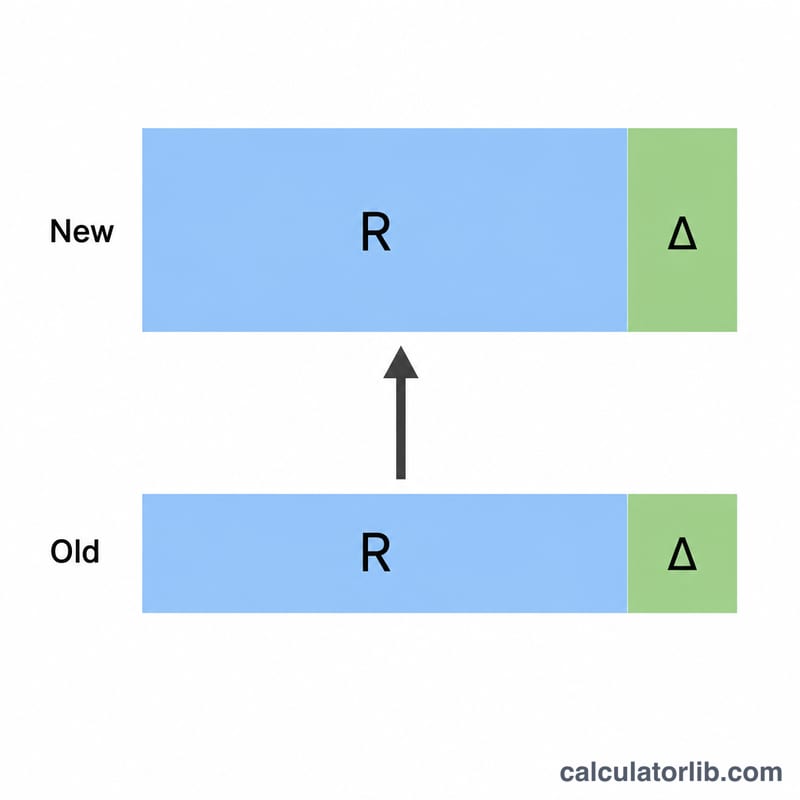
Worked Example
Suppose you earn $20.00 per hour and receive a 5% raise while working 40 hours a week. Your new rate is \(20 \times \left(1 + \frac{5}{100}\right) = 20 \times 1.05 = \$21.00\) per hour. That's a $1.00 hourly increase, $40.00 more per week, and \(40 \times 52 = \$2{,}080.00\) more per year.
FAQ
Does this account for taxes? No. The figures are gross (pre-tax) pay. Your take-home increase will be lower after taxes and deductions.
What if I work overtime or variable hours? Enter your average weekly hours. The hourly rate is exact regardless of hours; only the weekly and annual totals depend on the hours you enter.
Can I use it for a pay cut? Yes — enter a negative percentage (e.g. -3) to see your reduced rate and the corresponding decrease.