

What this calculator does
Contractors and freelancers are usually paid a day rate rather than a salary, which makes it hard to compare an assignment to a permanent role. This calculator converts your day rate into an equivalent gross annual salary, plus monthly and weekly income, based on how many days you actually bill and how many weeks you work each year.
How to use it
Enter your day rate (what you charge for one working day). Set the number of billable days per week — typically 5 for a full-time contract, fewer if you work part-time. Then set the working weeks per year. Most contractors use somewhere between 44 and 48 weeks to account for holidays, bank holidays, illness and gaps between contracts (a permanent employee is effectively paid 52). The calculator instantly shows your projected annual, monthly and weekly figures.
The formula explained
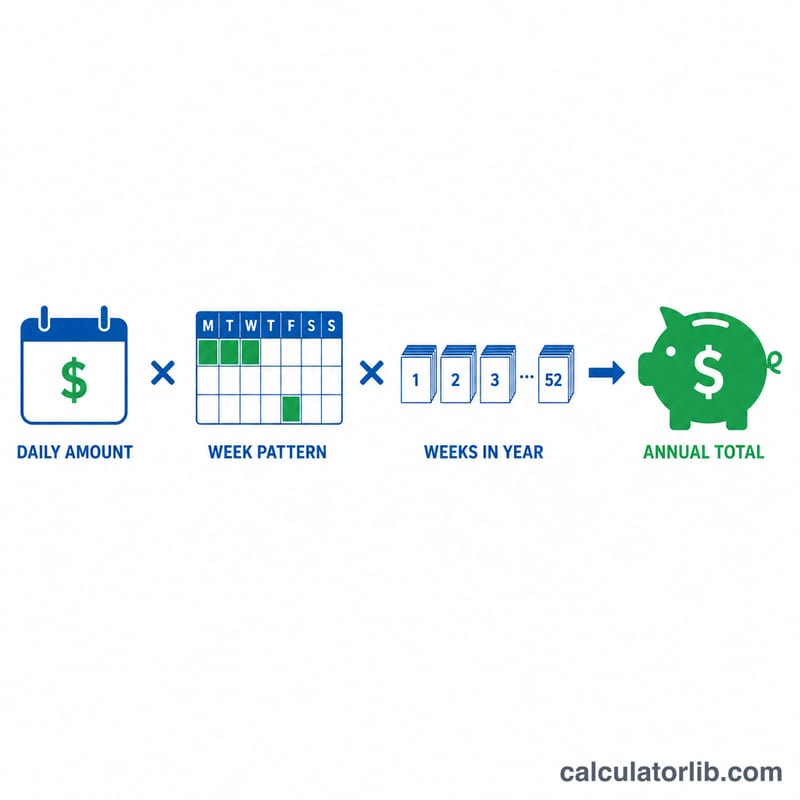
The core formula is simply $$\text{Annual} = \text{Day Rate} \times \text{Days per Week} \times \text{Weeks per Year}$$ The middle two terms multiply together to give your total billable days for the year, and multiplying by the day rate gives gross income. Monthly income is the annual figure divided by 12, and weekly income is the day rate times days worked per week.
Worked example
Suppose you charge £400 per day, bill 5 days a week, and expect to work 46 weeks in the year. Billable days = \(5 \times 46 = 230\). Annual income = \(£400 \times 230 = £92{,}000\). Monthly = \(£92{,}000 \div 12 \approx £7{,}666.67\), and weekly = \(£400 \times 5 = £2{,}000\).
FAQ
How many working weeks should I use? If you want a like-for-like comparison with a salaried role, use a lower number (44–47) to reflect unpaid holiday and downtime that contractors absorb themselves.
Is this figure before or after tax? It is gross income (before tax, expenses and any pension or insurance costs). Contractors typically have higher costs and no employer benefits, so the net comparison is usually lower.
Does it handle part-time work? Yes — set billable days per week to a value like 3 or 3.5 and the totals adjust accordingly.