
What is a contractor day rate calculator?
This tool helps freelancers, consultants and independent contractors work out the daily rate they need to charge to reach a target annual income. Rather than guessing, it converts your income goal into a concrete day rate by accounting for the realistic number of days you can actually bill clients each year.
How to use it
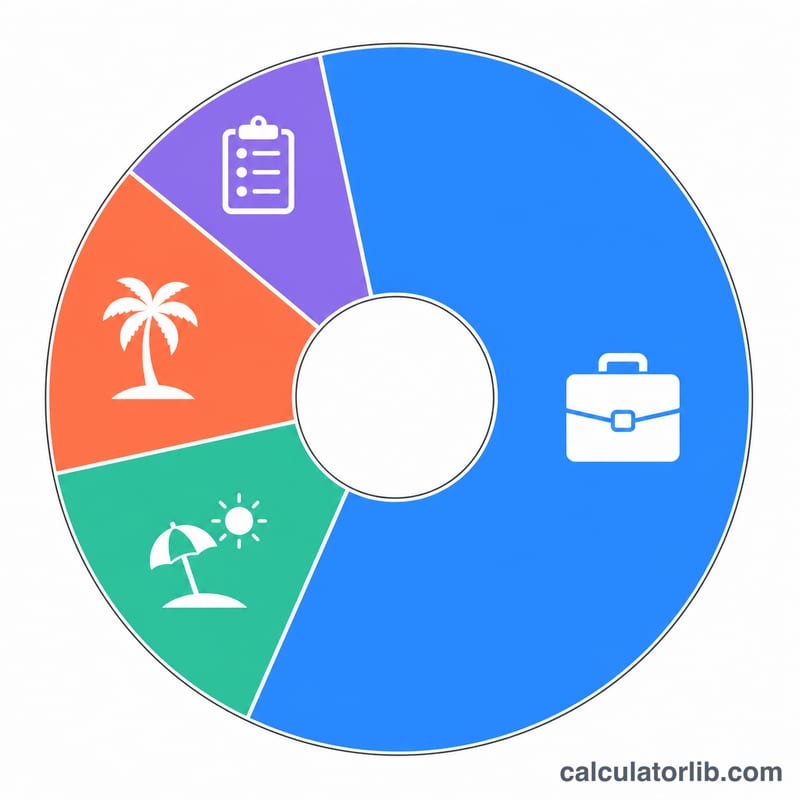
Enter three numbers: your annual target income (the take-home revenue you want your business to generate), the number of working days you have available per year, and the percentage of those days that are non-billable — time lost to admin, marketing, sales, training and unplanned gaps. The calculator subtracts the non-billable share to find your true billable days, then divides your income target by that figure.
The formula explained
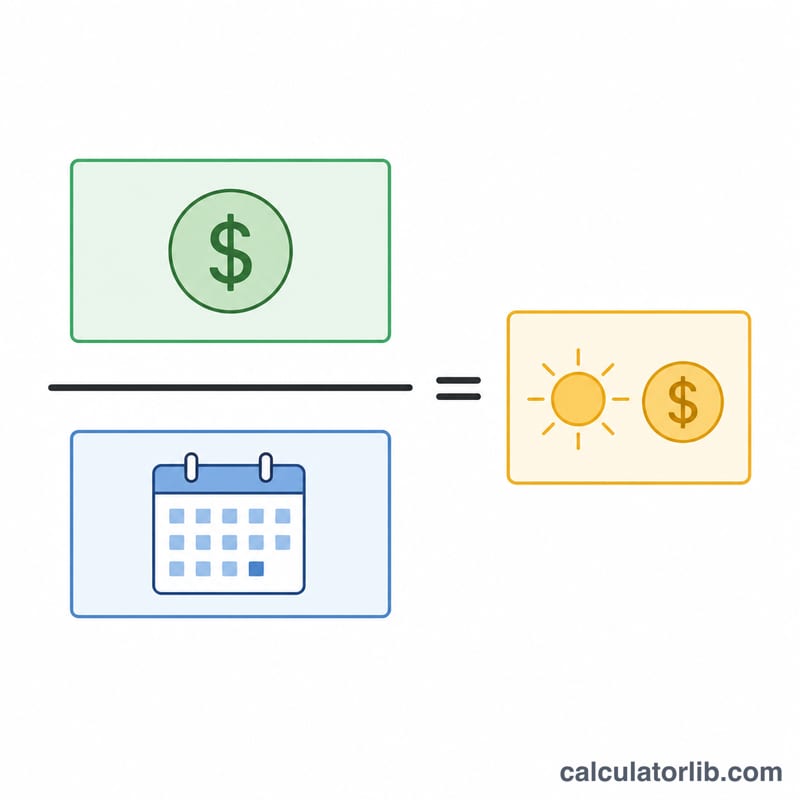
First it computes billable days: $$\text{Working Days} \times \left(1 - \frac{\text{Non-billable \%}}{100}\right)$$ Then the day rate is simply $$\text{Day Rate} = \frac{\text{Annual Target Income}}{\text{Billable Days}}$$ The equivalent hourly rate assumes a standard 8-hour day. Because non-billable time is unavoidable, ignoring it is the most common reason contractors under-price themselves.
Worked example
Suppose you want to earn £80,000 a year. You have 230 working days available, but 20% of them are non-billable. Billable days = \(230 \times 0.8 = 184\). Day rate = $$\pounds 80{,}000 \div 184 \approx \pounds 434.78$$ which works out to about £54.35 per hour over an 8-hour day.
Key Terms Explained
- Annual target income
- The total amount you want your contracting work to generate over a year. This can be defined as gross revenue (the figure your day rate produces before tax, expenses and pension) or as a desired take-home figure. If you want a specific net income, set the target higher to cover tax and overheads, since the calculator treats it as the gross amount to be billed.
- Working days
- The number of days per year you are available to work. A full-time figure is typically around 220–230 days, allowing for weekends, public holidays and personal leave (a calendar year has roughly 260 weekdays before holidays).
- Non-billable percentage
- The share of your working days that cannot be charged to a client — covering admin, invoicing, marketing, training, sick days and gaps between contracts. Independent contractors commonly assume 20–40%.
- Billable days
- The days you can actually invoice, calculated as working days × (1 − non-billable %). This is the denominator that your annual target is spread across.
- Day rate
- The amount you charge a client for one day of work. It equals your annual target divided by your billable days.
- Equivalent hourly rate
- Your day rate divided by the number of chargeable hours in a working day (commonly 7.5 or 8). A £500 day rate over 7.5 hours is about £67 per hour; over 8 hours it is £62.50 per hour.
What Your Day Rate Tells You
The day rate this calculator produces is a break-even-to-target figure: it is the rate required for your billable days to add up to your stated annual income. It is not a profit figure and not a take-home figure. It is gross revenue per day, before any deductions.
That gross revenue must still cover everything a contractor pays out of their own pocket, including:
- Income tax and self-employment / National Insurance contributions — often the single largest deduction.
- Pension contributions — there is no employer scheme funding your retirement.
- Insurance — professional indemnity, public liability and income protection.
- Equipment, software, training and accountancy fees.
Because of this, a contractor's gross day rate generally needs to sit well above the equivalent salaried pay for the same role to deliver comparable take-home pay. If your target of, say, £80,000 is meant to be take-home, you should raise the input to account for tax and overheads before reading off the rate.
Use the result as a floor, then compare it to market benchmarks for your skill, seniority and sector. If the calculated rate is below what comparable contractors charge, you may be undercharging; if it is far above the market, you may need more billable days, a leaner cost base or a higher-value niche. Treat the figure as a planning baseline and reconcile it with what clients in your market actually pay.
This is general information for planning purposes, not financial or tax advice. Consult a qualified accountant about your specific tax position and obligations.
FAQ
Should the income target be before or after tax? Use whichever figure your business plans around — most contractors enter gross business revenue, then handle tax and expenses separately.
What non-billable percentage is typical? Many independents lose 20–40% of working days to non-billable work, so being conservative protects your rate.
How many working days should I use? A full year has about 260 weekdays; subtract holidays and time off to get your realistic available days (often 220–235).