

What This Calculator Does
The Day Rate to Annual Salary Calculator converts a contractor, freelancer, or consultant's daily rate into an equivalent gross annual salary. This is handy when comparing a contract role against a permanent salaried position, setting your rates, or working out how much you'd earn over a full year of billable work.
How to Use It
Enter your day rate — the amount you charge for one day of work — and the number of working days per year you expect to actually bill. A typical full-time year has about 260 weekdays, but after holidays, sick days, and gaps between contracts, many independent workers use 220 days as a realistic estimate. The calculator returns your equivalent annual, monthly, and weekly income.
The Formula Explained
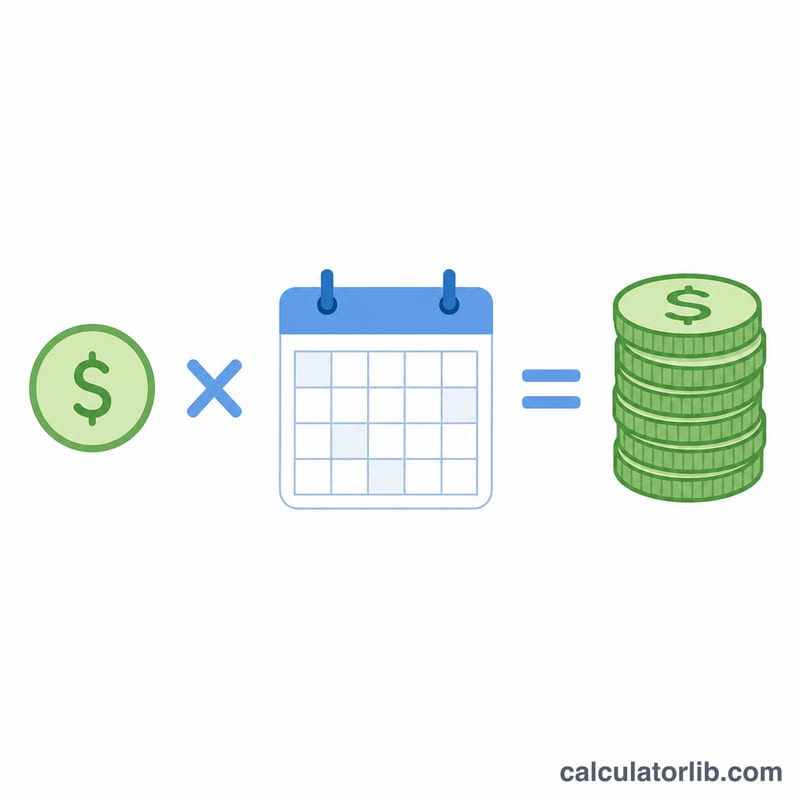
The core calculation is simple multiplication:
$$\text{Annual} = \text{Day Rate} \times \text{Working Days per Year}$$
The monthly figure divides the annual total by 12, and the weekly figure assumes a standard 5-day working week, so it divides the annual total by the number of working weeks (working days ÷ 5).
Worked Example
Suppose you charge a day rate of £300 and expect to bill 220 working days in the year. Your equivalent annual salary is \(300 \times 220 = \textbf{£66{,}000}\). That works out to £5,500 per month and roughly £1,500 per week (over 44 working weeks).
FAQ
How many working days should I use? A full-time employee works about 260 weekdays a year, less around 25–35 days for holidays and bank holidays, giving roughly 220–230 billable days. Contractors often use 220 to allow for downtime between contracts.
Is this figure before or after tax? The result is a gross figure before income tax, National Insurance, pension, and business expenses. Net take-home pay will be lower.
Does it account for benefits? No. A salaried role usually includes paid holiday, pension contributions, and sick pay that a day rate does not, so a contractor day rate often needs to be higher to match an equivalent salary.