
What Is the Annual Salary to Daily Rate Calculator?
This calculator converts your yearly salary into an equivalent daily pay rate. It's useful for freelancers setting day rates, contractors comparing offers, HR teams costing temporary cover, and anyone who wants to know what a single working day of their salary is worth. The tool also breaks the figure down into weekly and monthly equivalents so you can compare pay across different time frames.
How to Use It
Enter your annual salary (gross, before tax) and the number of working days per year. A standard full-time year is often taken as 260 days (52 weeks \(\times\) 5 days) before holidays, or about 230–253 days once paid leave and public holidays are deducted. Adjust this figure to match your contract. The calculator instantly returns your daily rate along with weekly and monthly equivalents.
The Formula Explained
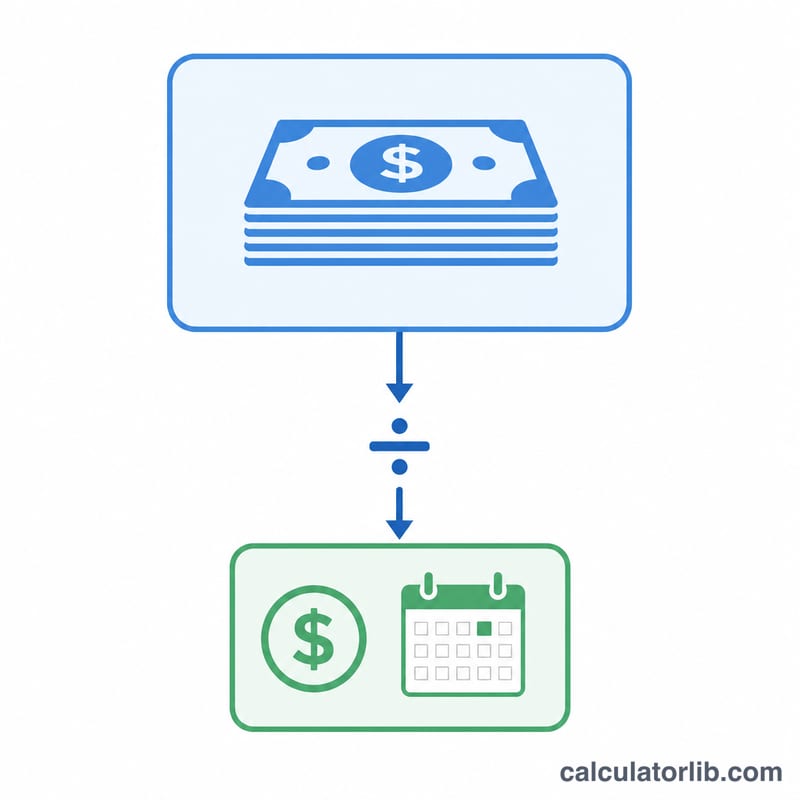
The core formula is simple: $$\text{Daily Rate} = \frac{\text{Annual Salary}}{\text{Working Days Per Year}}$$ The weekly rate assumes a 5-day week (\(\text{Daily Rate} \times 5\)), and the monthly figure divides the annual salary by 12. Choosing a realistic working-days number matters — using 365 (calendar days) understates your true daily worth, while using only actual worked days gives a more accurate "value per day on the job".
Worked Example
Suppose you earn $60,000 a year and work 260 days. Daily rate = $$60{,}000 \div 260 = 230.77$$ per day. Your weekly rate is \(230.77 \times 5 = 1{,}153.85\), and your monthly equivalent is \(60{,}000 \div 12 = 5{,}000\).
Daily Rate Across Salary Scenarios
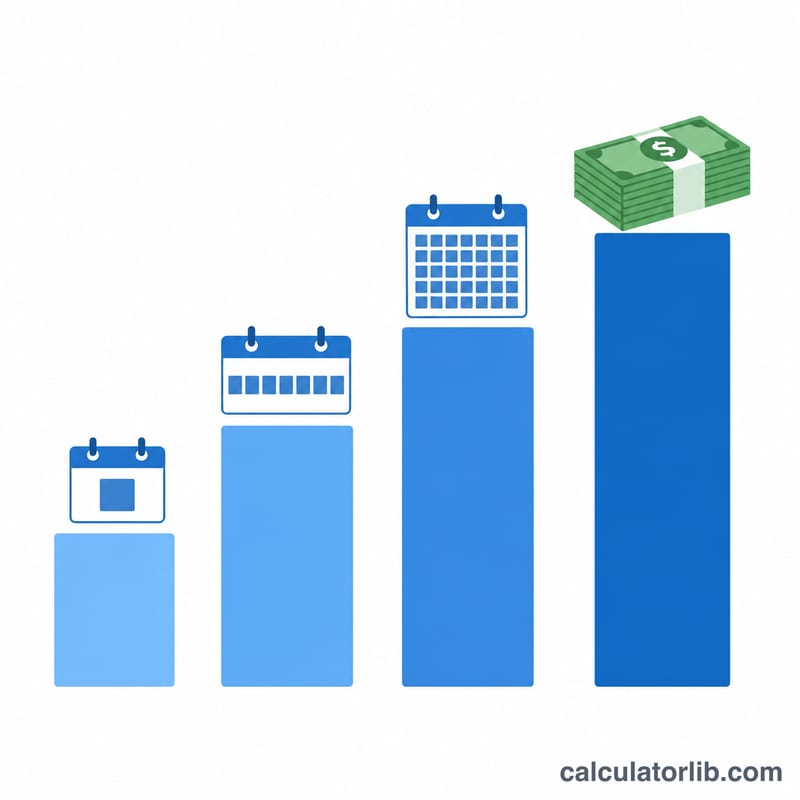
Your daily rate depends on two numbers: your gross annual salary and how many days you actually work in a year. The more working days you spread the same salary over, the lower each day's value becomes. The table below crosses four common salaries against three widely used working-day figures using the formula \(\text{Daily Rate} = \frac{\text{Annual Salary}}{\text{Working Days Per Year}}\).
| Annual Salary | 230 days | 250 days | 260 days |
|---|---|---|---|
| $40,000 | $173.91 | $160.00 | $153.85 |
| $60,000 | $260.87 | $240.00 | $230.77 |
| $80,000 | $347.83 | $320.00 | $307.69 |
| $100,000 | $434.78 | $400.00 | $384.62 |
Worked example: For a $60,000 salary spread over 250 working days, \(\frac{60{,}000}{250} = 240\), giving a daily rate of $240.00. The same $60,000 across all 260 weekday-only days falls to \(\frac{60{,}000}{260} \approx 230.77\). If you also want the hourly equivalent of that salary, dividing by total worked hours (e.g. 52 weeks at 40 hours) gives roughly $28.85 per hour.
Standard Working Days Per Year by Region/Scenario
There is no single "correct" number of working days — it depends on whether you count gross weekdays, subtract public holidays, or also subtract paid vacation. Choose the figure that matches how you actually want to value a day of work, then enter it as your working days per year.
| Days/Year | Represents | Notes |
|---|---|---|
| 365 | Full calendar year | Every day including weekends and holidays. Useful for per-day cost-of-living math, not for valuing time worked. |
| 260 | Gross weekdays (52 \(\times\) 5) | All Monday–Friday days with no holidays or leave removed. A common default for salaried daily-rate estimates. |
| ~253 | Weekdays minus public holidays | Roughly 260 minus 7–11 public holidays (varies by country/state). Reflects paid days you are not expected to work. |
| ~230–240 | Weekdays minus holidays and typical paid leave | Subtracts public holidays plus ~15–25 days of vacation/PTO. Best estimate of days actually worked, often used for contractor day-rate comparisons. |
For a precise count tailored to a specific year and location, count the actual Monday–Friday days and subtract your observed holidays rather than relying on the round figures above.
FAQ
How many working days are in a year? A common baseline is 260 (52 weeks \(\times\) 5 days). Subtract paid holidays and public holidays for a net figure, which is often around 230–250 days.
Is this gross or net pay? The result reflects gross salary unless you enter a post-tax figure. Taxes, pension, and other deductions are not applied here.
Can I use this for hourly conversion? Yes — divide the daily rate by your daily hours to estimate an hourly rate.