
What Is the Real Rate of Return?
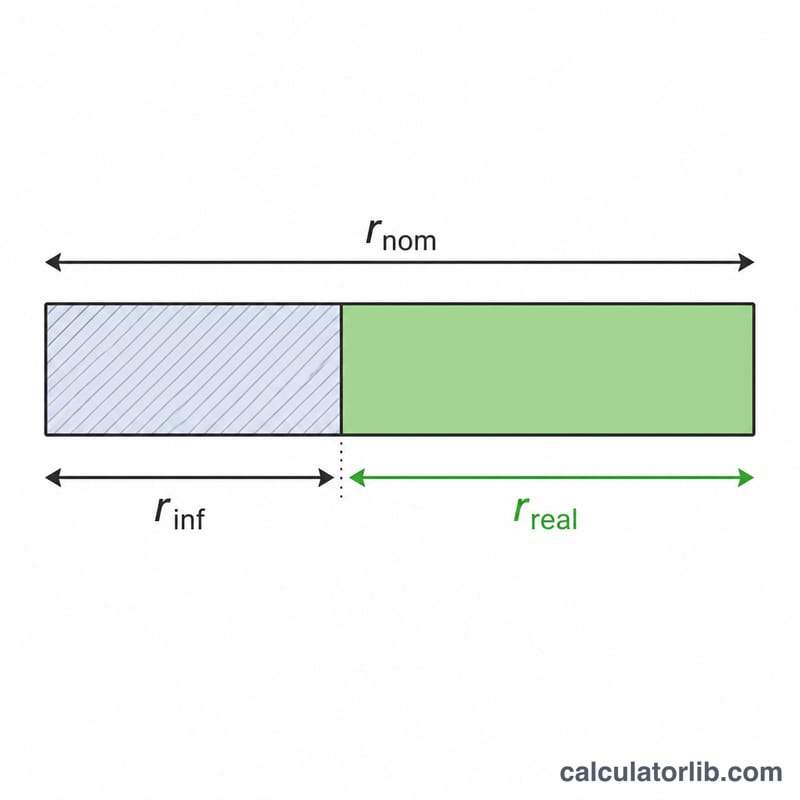
The real rate of return measures how much your money actually grows in purchasing power after accounting for inflation. A savings account paying 5% sounds great, but if prices are rising 3% a year, your true gain is much smaller. This calculator uses the Fisher equation to convert a nominal (advertised) interest rate into the real, inflation-adjusted rate that reflects what your savings can really buy.
How to Use This Calculator
Enter the nominal interest rate your savings or investment earns, then enter the expected or actual inflation rate. The calculator returns your real rate of return as a percentage. It also shows the popular quick approximation (nominal minus inflation) so you can compare the two methods.
The Formula Explained
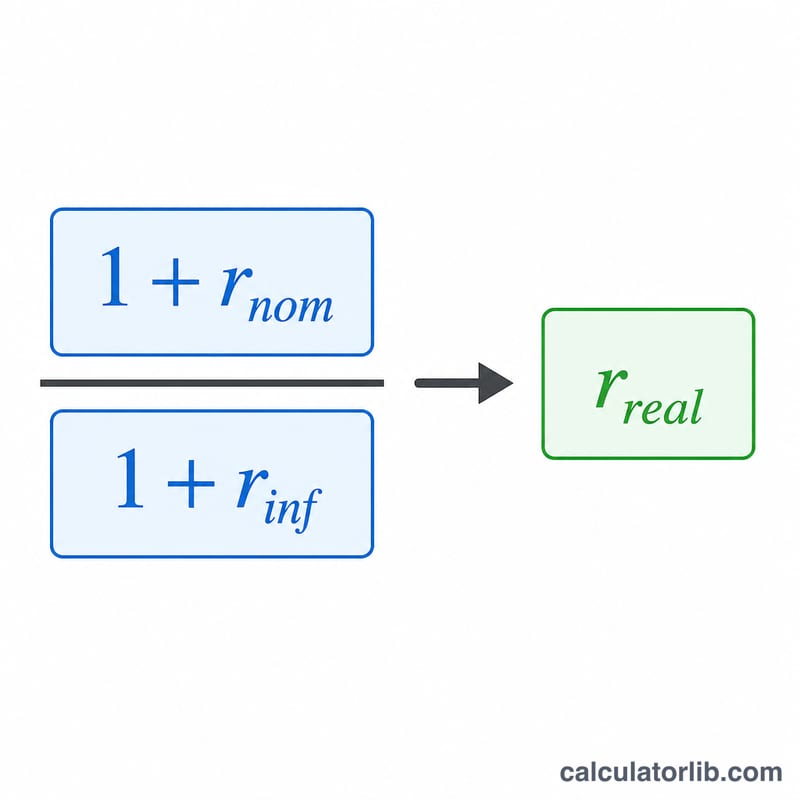
The exact relationship is:
$$\text{Real Rate} = \left(\frac{1 + \dfrac{\text{Nominal Rate (\%)}}{100}}{1 + \dfrac{\text{Inflation Rate (\%)}}{100}} - 1\right) \times 100$$
Rates are entered as percentages and converted to decimals internally. Many people use the shortcut real \(\approx\) nominal \(-\) inflation, which is accurate enough for small rates but slightly overstates the real return because it ignores the compounding interaction between growth and inflation.
Worked Example
Suppose your savings earn 5% nominally and inflation is 3%. Using the exact formula: $$\frac{1 + 0.05}{1 + 0.03} - 1 = \frac{1.05}{1.03} - 1 = 0.019417$$ or about 1.94%. The quick approximation would give \(5\% - 3\% = 2.00\%\), slightly higher than the true figure.
FAQ
Why is the real rate lower than nominal minus inflation? Because inflation erodes not just your principal but also the interest you earn, the exact formula divides rather than subtracts, producing a marginally smaller — and more accurate — result.
Can the real rate be negative? Yes. If inflation exceeds your nominal return, your purchasing power shrinks and the real rate is negative, meaning your savings are losing value in real terms.
What inflation rate should I use? Use your country's reported consumer price index (CPI) figure for historical analysis, or a reasonable forecast for planning. This is a universal financial formula and applies in any currency or country.