

What Is the Annualized Rate of Return?
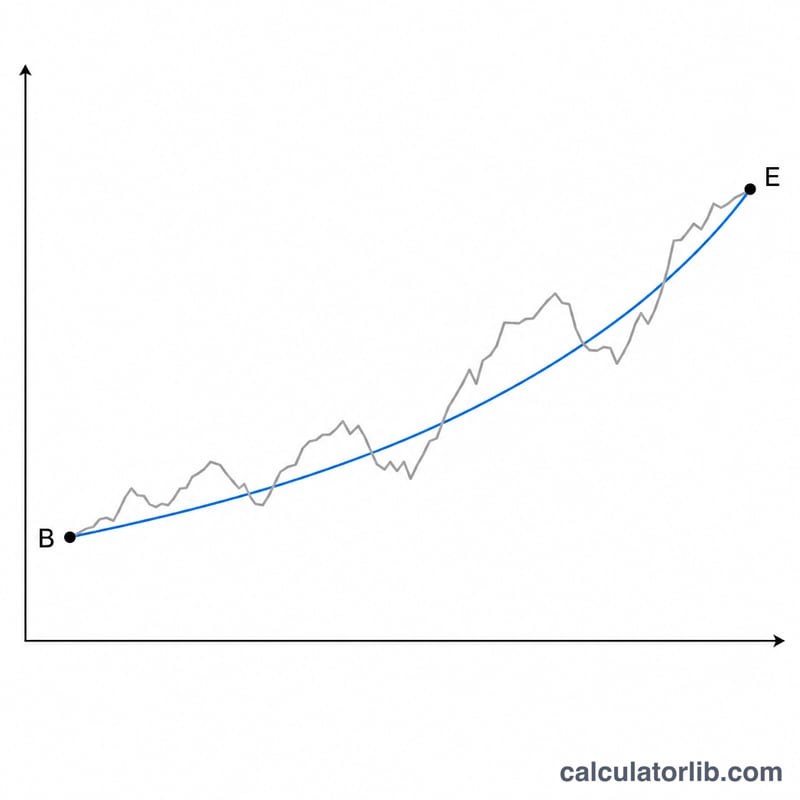
The annualized rate of return — also called the Compound Annual Growth Rate (CAGR) — expresses how much an investment grew per year, on average, assuming the gains compounded smoothly over the holding period. It is the single most useful number for comparing investments held for different lengths of time, because a 50% total return over two years is very different from a 50% return over ten years.
How to Use This Calculator
Enter the beginning value (what the investment was worth at the start), the ending value (what it is worth now), and the number of years you held it. The calculator returns your annualized return, your total cumulative return, and your total gain or loss in currency terms.
The Formula Explained
The formula is:
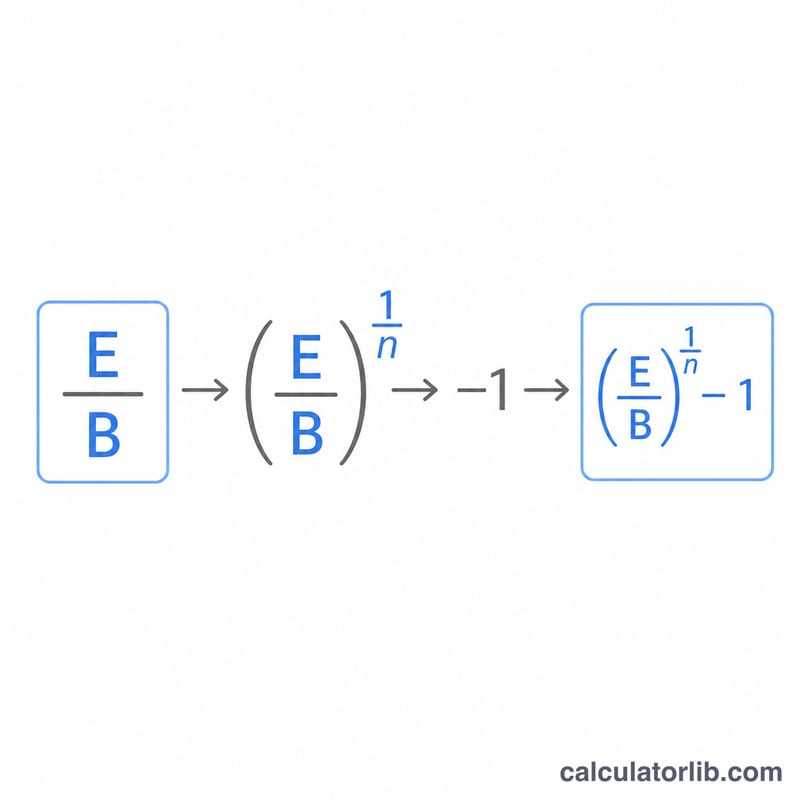
$$\text{Annualized Return} = \left( \frac{\text{Ending Value}}{\text{Beginning Value}} \right)^{\frac{1}{\text{Years}}} - 1$$
Dividing the ending value by the beginning value gives the growth multiple. Raising it to the power of \(1/\text{Years}\) finds the equivalent single-year growth factor, and subtracting 1 converts that factor into a percentage rate.
Worked Example
Suppose you invested $10,000 and it grew to $15,000 over 5 years. The growth multiple is \(15{,}000 / 10{,}000 = 1.5\). Raising to the power 1/5 gives $$1.5^{0.2} \approx 1.08447.$$ Subtracting 1 and converting to a percentage gives about 8.45% per year, even though the total return was 50%.
Interpreting Your CAGR
CAGR answers one specific question: at what constant yearly rate would the beginning value have to grow to reach the ending value over the period? Keep these points in mind when reading the result.
- It is a smoothed average, not the actual path. A portfolio that fell 40% one year and surged the next can show the same CAGR as one that rose steadily. CAGR hides the year-to-year journey entirely.
- It ignores volatility. Two investments with the same CAGR can carry very different risk. CAGR says nothing about how bumpy the ride was, only about the start and end points.
- It ignores intermediate cash flows. If you added or withdrew money during the period, CAGR on the raw beginning/ending values will be misleading. A money-weighted return (IRR) or the MIRR calculator accounts for the timing and size of those cash flows.
- Negative CAGR means a net loss. A result such as −7.17% indicates the value declined at that average annual rate over the holding period; the ending value is below the beginning value.
- Compare against documented long-run benchmarks. Broad equity indices such as the S&P 500 have historically delivered roughly 9–10% nominal annualized returns over multi-decade periods (about 6–7% after inflation), though any specific decade can differ widely. Use published, dated index figures rather than informal estimates when benchmarking.
- Nominal vs. real. CAGR computed from dollar values is a nominal rate. To see purchasing-power growth, convert it to a real rate with a real rate of return (after inflation) calculator.
This section is general educational information about how the metric behaves, not investment or financial advice.
Key Terms Defined
- Beginning Value
- The value of the investment at the start of the measurement period — the original cost or starting balance used as the denominator.
- Ending Value
- The value at the end of the period — the final balance or sale value used as the numerator.
- Holding Period (Years)
- The length of time the investment was held, expressed in years (fractional years are allowed, e.g. 2.5). It is the exponent denominator that annualizes the return.
- CAGR (Compound Annual Growth Rate)
- The constant annual rate that would grow the beginning value into the ending value over the holding period, assuming reinvestment and compounding each year.
- Total / Cumulative Return
- The overall percentage change from beginning to ending value, \(\left(\tfrac{\text{Ending}}{\text{Beginning}}-1\right)\times100\%\), with no annualization. A +50% total return over 5 years is the same total but a much lower CAGR.
- Money-Weighted Return (IRR)
- The internal rate of return that accounts for the size and timing of every deposit and withdrawal during the period. Unlike CAGR, it reflects when cash entered or left the investment.
- Growth Multiple
- The ratio of ending to beginning value, \(\tfrac{\text{Ending}}{\text{Beginning}}\). A value of 2.0 means the investment doubled; a multiple of 0.8 reflects a 20% loss.
FAQ
Is annualized return the same as total return? No. Total return ignores time. Annualized return spreads the growth evenly across each year so investments of different durations can be compared fairly.
Can the result be negative? Yes. If the ending value is less than the beginning value, the annualized return will be negative, reflecting an average yearly loss.
Does this account for deposits or withdrawals? No. CAGR assumes a single lump sum with no cash flows in or out. For ongoing contributions, use a money-weighted return such as IRR.