

What Is the MIRR Calculator?
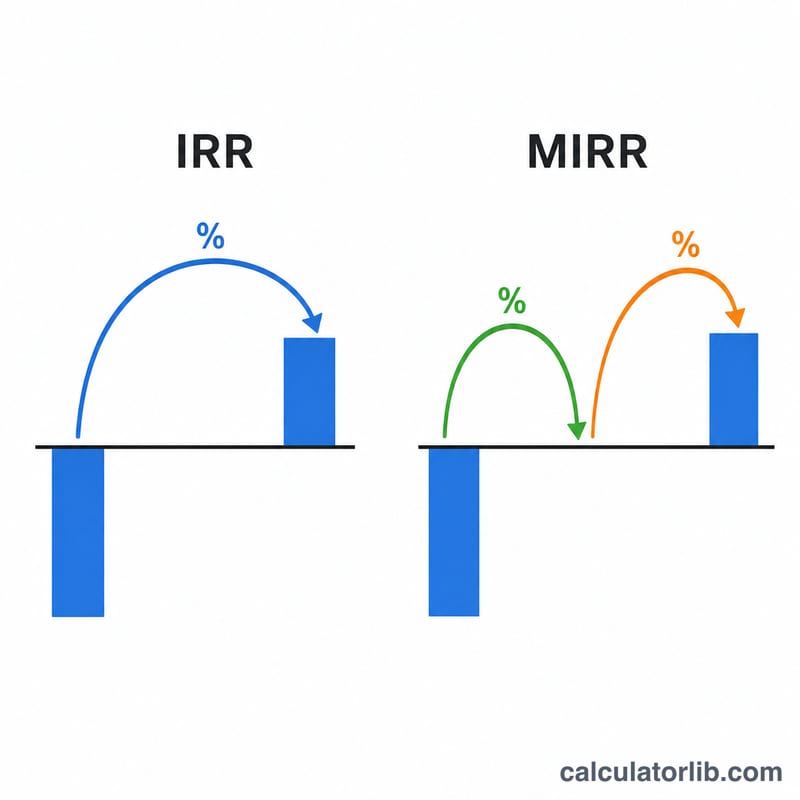
The Modified Internal Rate of Return (MIRR) calculator measures the profitability of an investment while correcting two well-known weaknesses of the ordinary internal rate of return (IRR). MIRR assumes that positive cash flows are reinvested at a realistic reinvestment rate and that negative cash flows are financed at a separate finance rate. This produces a single, unique rate and avoids the multiple-IRR problem that can occur when cash flows change sign more than once.
How to Use It
Enter your cash flows as a comma-separated list, starting with the initial outlay (usually negative), followed by each period's cash flow. Then provide the finance rate (the cost of capital used to discount negative flows) and the reinvestment rate (the return earned on reinvested positive flows). Click calculate to see the annualized MIRR as a percentage, along with the future value of positive flows and the present value of negative flows.
The Formula Explained
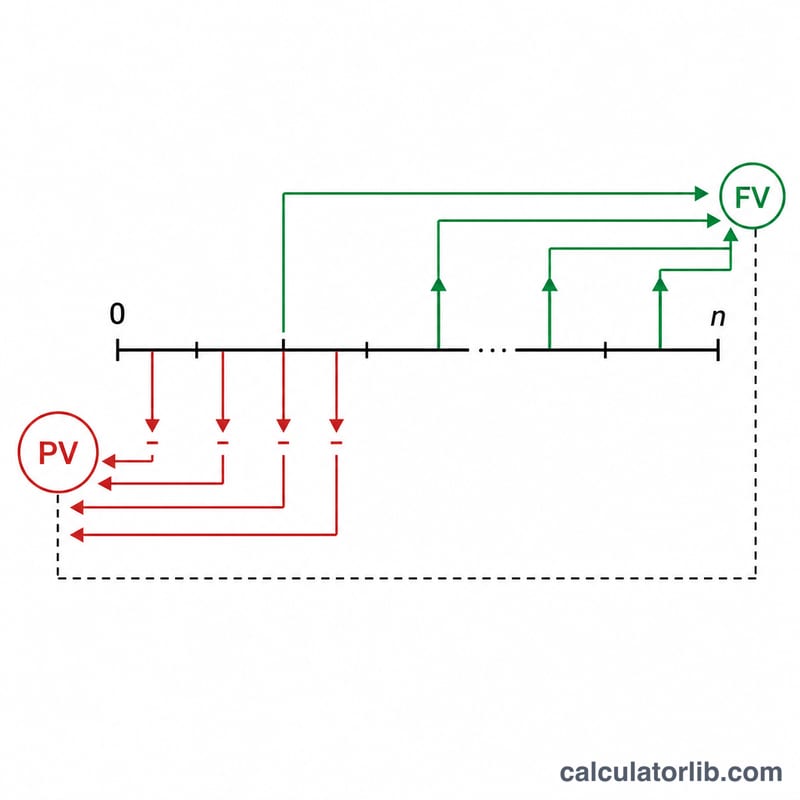
$$\text{MIRR} = \left( \frac{FV_{+}}{|PV_{-}|} \right)^{\frac{1}{n}} - 1$$ where n is the number of periods. \(FV_{+}\) is the sum of all positive cash flows compounded forward to the last period at the reinvestment rate. \(|PV_{-}|\) is the absolute value of all negative cash flows discounted back to time zero at the finance rate.
Worked Example
Suppose cash flows are \(-1000, 300, 420, 680\) with a finance rate of 10% and a reinvestment rate of 12%. The positive flows compound to $$300 \times 1.12^2 + 420 \times 1.12 + 680 = 376.32 + 470.4 + 680 = 1526.72.$$ The single negative flow at time 0 has \(PV = 1000\). With \(n = 3\): $$\text{MIRR} = \left( \frac{1526.72}{1000} \right)^{\frac{1}{3}} - 1 \approx 0.1514,$$ or about 15.14%.
FAQ
Why use MIRR instead of IRR? IRR assumes every cash flow is reinvested at the IRR itself, which is often unrealistic. MIRR uses an explicit, separate reinvestment rate and always gives one answer.
What is the difference between finance and reinvestment rate? The finance rate is your cost of borrowing applied to outflows; the reinvestment rate is the return you can earn on incoming cash.
Can cash flows include several negatives? Yes. All negative flows are discounted to the present and all positive flows are compounded forward, so MIRR handles mixed sign patterns reliably.