
What Is the Real Hourly Wage Calculator?
The number on your payslip rarely reflects what your job truly pays you per hour. Your "nominal" rate ignores the money taxes and work-related costs eat up, and it ignores the unpaid hours you spend commuting, getting ready, and decompressing. The Real Hourly Wage Calculator strips all of that away to reveal your true earnings per hour of life committed to your job — a concept popularized by personal-finance writers like the authors of Your Money or Your Life.
How to Use It
Enter your net (take-home) pay for a chosen period — a week, two weeks, or a month works fine, just be consistent. Add your work expenses for the same period: fuel, transit passes, parking, work clothes, lunches out, childcare premiums, and so on. Then enter your paid work hours and the commute and prep hours you give up for the job. The calculator returns your real hourly wage plus the hidden loss versus what your pay alone implies.
The Formula Explained
The calculation is simple but eye-opening:
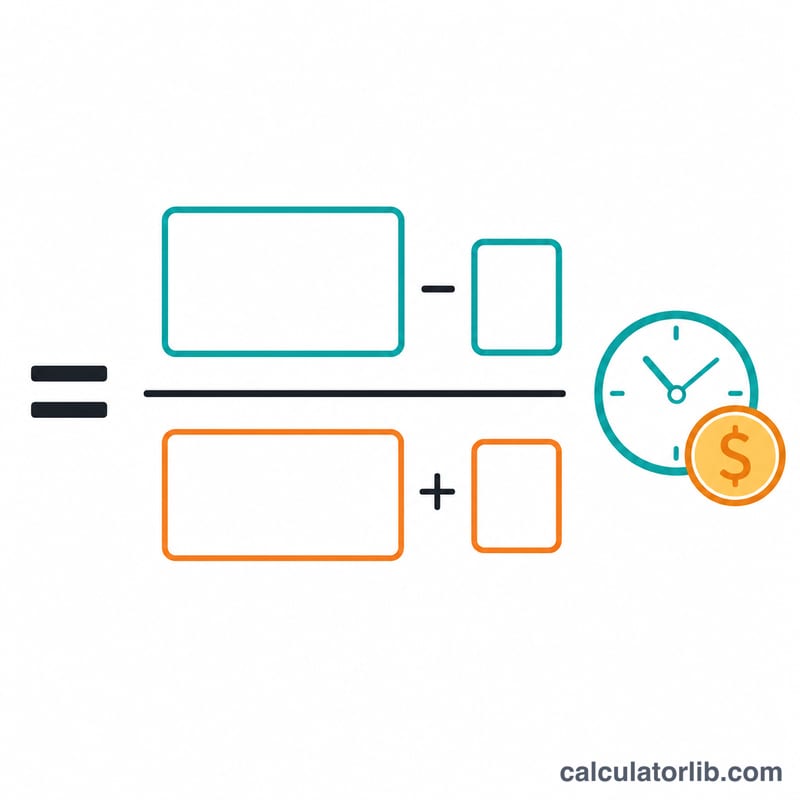
$$\text{Real Wage} = \frac{\text{Net Pay} - \text{Work Expenses}}{\text{Work Hours} + \text{Commute \& Prep Hours}}$$
Subtracting expenses gives the money the job actually leaves in your pocket. Adding commute and prep hours to your paid hours gives the real time cost. Dividing one by the other gives the wage you can spend per hour you sacrifice.
Worked Example
Suppose you take home $1,000 per week, spend $150 on commuting and work lunches, work 40 paid hours, and spend 10 hours commuting and preparing. Net after expenses is \(\$1{,}000 - \$150 = \$850\). Total hours committed are \(40 + 10 = 50\). Your real wage is $$\$850 \div 50 = \$17.00/\text{hour}$$ Meanwhile your nominal wage looks like \(\$1{,}000 \div 40 = \$25.00\) — a hidden loss of $8.00 every hour.
FAQ
Should I include unpaid overtime? Yes. Add any unpaid hours to "work hours" so the denominator reflects reality.
What counts as a work expense? Any cost you only incur because you have this job — transport, parking, uniforms, tools, extra childcare, and meals you wouldn't buy otherwise.
Does the period matter? No, as long as pay, expenses, and hours all use the same period. The hourly result is identical whether you enter weekly or monthly figures.