

What This Calculator Does
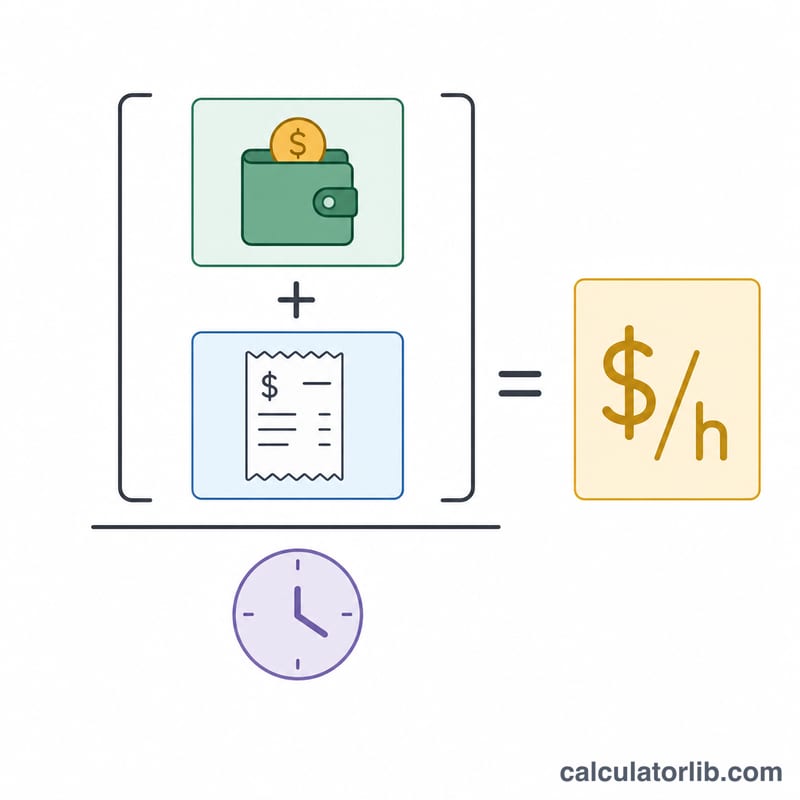
Setting the right hourly rate is one of the hardest parts of freelancing. This calculator works backwards from the income you actually want to take home and the business expenses you must cover, then divides that total by the number of billable hours you realistically work in a year. The result is the minimum hourly rate you should charge to hit your financial goals.
How to Use It
Enter your desired annual income — the money you want left for yourself. Add your annual business expenses, such as software, equipment, insurance, marketing, and accounting. Then estimate how many hours you can actually bill each week and how many weeks you work per year (remember to subtract holidays, sick days, admin time, and unpaid prospecting). The calculator returns your recommended hourly rate plus the total revenue you must generate.
The Formula Explained
The math is simple but powerful:
$$\text{Rate} = \frac{\text{Desired Income} + \text{Expenses}}{\text{Hours per Week} \times \text{Weeks per Year}}$$
The key insight is that not every working hour is billable. Admin, sales, and breaks are unpaid, so your billable hours are usually far lower than the hours you sit at your desk. Lower billable hours mean a higher rate is needed to reach the same income.
Worked Example
Suppose you want to earn $60,000, have $10,000 in expenses, bill 30 hours a week, and work 48 weeks a year. Billable hours = \(30 \times 48 = 1{,}440\). Total revenue needed = \(\$60{,}000 + \$10{,}000 = \$70{,}000\). Rate = \(\$70{,}000 \div 1{,}440 \approx\) $48.61 per hour.
FAQ
Should I include taxes? Yes — add your estimated tax burden into either your desired income or as an expense so the rate covers it.
Why are my billable hours lower than my work hours? Time spent on invoicing, marketing, and client communication usually isn't billed, so 30 billable hours may mean a 40-hour week.
Is this rate the price I quote clients? It's your floor. Add a profit margin and adjust for market value and project risk before quoting.