
What Is the Revenue Growth Rate?
The revenue growth rate measures how much your sales or revenue increased (or decreased) from one period to the next, expressed as a percentage. It is one of the most widely tracked performance metrics for businesses, investors, and analysts because it shows momentum at a glance — whether you compare month-over-month, quarter-over-quarter, or year-over-year.
How to Use This Calculator
Enter your current period revenue and your prior period revenue, then read the result. A positive percentage means growth; a negative percentage means the revenue contracted. The calculator also shows the absolute change so you can see the dollar value behind the percentage.
The Formula Explained
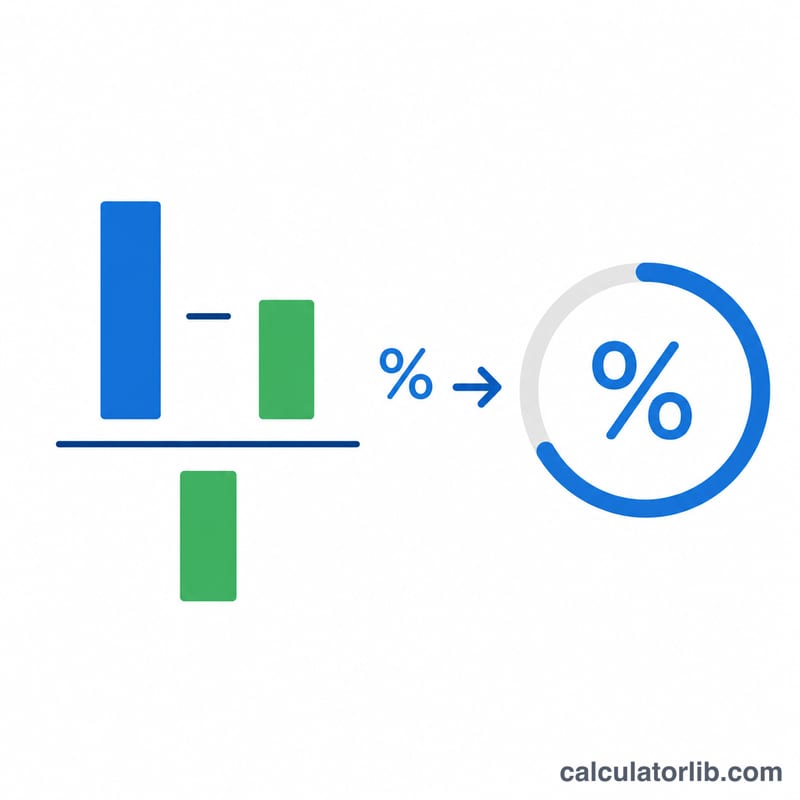
The growth rate is calculated as:
$$\text{Growth Rate} = \frac{\text{Current Revenue} - \text{Prior Revenue}}{\text{Prior Revenue}} \times 100\%$$The numerator captures the change, and dividing by the prior period normalizes it so you can compare growth across different revenue sizes. Note that the prior revenue must be greater than zero — you cannot divide by zero.
Worked Example
Suppose your company earned $100,000 last quarter and $120,000 this quarter. The change is \(\$120{,}000 - \$100{,}000 = \$20{,}000\). Divide by the prior period: \(\$20{,}000 \div \$100{,}000 = 0.2\). Multiply by 100 to get a 20% growth rate.
$$\frac{\$120{,}000 - \$100{,}000}{\$100{,}000} \times 100\% = 20\%$$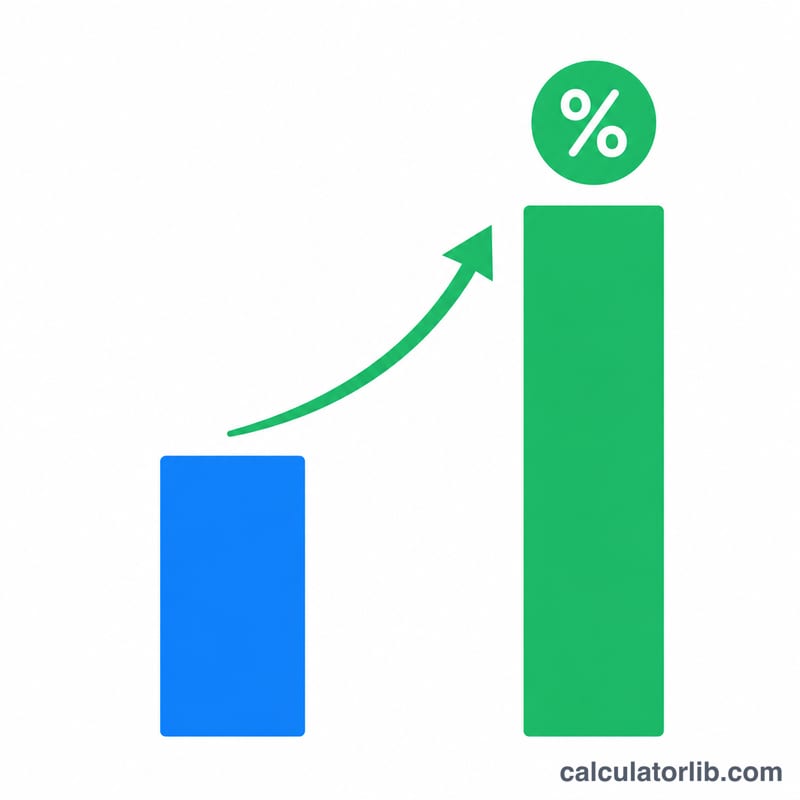
FAQ
What is a good revenue growth rate? It varies by industry and stage. Early-stage startups may target 50%+ annually, while mature companies often see single-digit growth. Compare against your own history and competitors.
Can the result be negative? Yes. If current revenue is lower than the prior period, the growth rate is negative, indicating a decline.
How is this different from CAGR? This calculator gives a single period-over-period rate. CAGR (compound annual growth rate) smooths growth across multiple periods into one average annualized figure.